Many buyers and engineers use h channel beam and H beam interchangeably, but the naming difference can lead to confusion in sourcing, design, and project communication. In this guide, we explain what each term usually refers to, how they differ in practice, and what global steel buyers should confirm before placing an order.
What does h channel beam usually mean in steel sourcing?
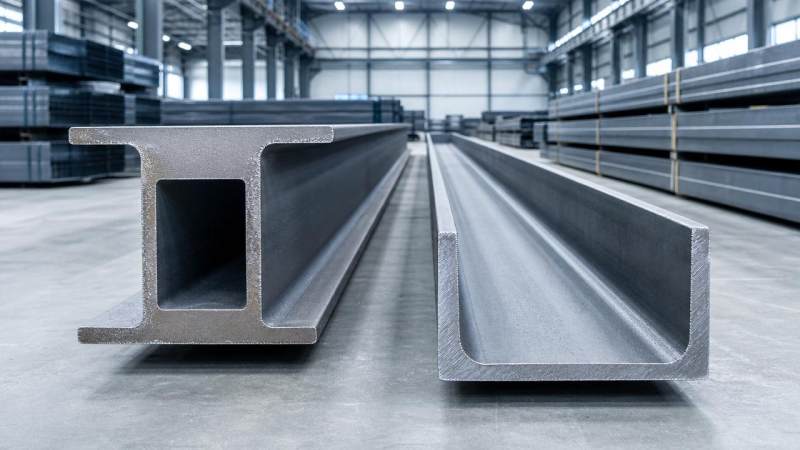
In real-world steel trade, h channel beam is not always a formal technical name. It often appears in search queries, emails, RFQs, and verbal communication when buyers are unsure whether they need an H beam, a channel section, or a beam used in an H-frame structure.
That is why the phrase h channel beam deserves careful interpretation. In engineering drawings, a beam and a channel are different profiles. In procurement, however, the term may reflect a buyer’s intended function rather than the exact section shape.
For information researchers, this naming overlap matters because an incorrect request can affect quotation accuracy, mill scheduling, loading plans, and compliance review. A supplier may quote a hot rolled H beam while the buyer actually needs a U channel or C channel for support framing.
- H beam usually refers to a wide flange structural section with parallel flanges and a web designed for load-bearing applications.
- Channel usually refers to a U-shaped or C-shaped section used for framing, support, bracing, edge structures, and secondary members.
- The phrase h channel beam may be used informally when the buyer knows the project function but not the standard profile name.
The practical lesson is simple: do not treat the keyword alone as a final product definition. Always connect the name with profile drawing, size range, standard, steel grade, and application load.
H beam vs channel steel: what is the real naming difference?
The naming difference is based on cross-section geometry and structural use. An H beam has a broad web-and-flange profile suited to major load transfer. A channel has one web and two flanges extending in the same direction, which makes it useful for support and framing rather than symmetric primary load distribution.
Because the term h channel beam can blur these categories, a side-by-side comparison helps buyers avoid ordering errors. The table below summarizes how global purchasers usually distinguish H beam and channel products during technical review.
The main point is not that one term is always wrong. The issue is that the phrase h channel beam lacks precision. For engineering approval and international purchasing, profile shape must be confirmed before pricing or production begins.
Why do buyers mix up the terms?
There are several reasons. Search habits differ by region. Some buyers translate local terminology into English in a literal way. Others focus on function, such as “beam for support channel,” instead of standard profile names. In export business, this is common across North America, Europe, the Middle East, and Southeast Asia.
An experienced structural steel supplier should therefore not rely on the keyword alone. The better approach is to ask for drawings, target standards, grade, dimensions, coating, and end use.
Which applications are more suitable for channel steel?
When buyers search h channel beam, they may actually be looking for a channel section for a practical construction or industrial use. Channel steel remains a highly versatile profile because it works well in support systems, edge members, mechanical structures, and fabricated assemblies.
A typical example is Structural Steel Channel, which is available in model ranges such as 5-40# and 6.5-30#. It is widely used in building structure, curtain wall engineering, mechanical equipment, vehicle manufacturing, room beam, ship beam, and industrial furnace projects.
The table below shows how channel sections are commonly selected by scenario, especially when a buyer’s original request uses the broad phrase h channel beam.
This comparison shows why channel steel is often the actual requirement behind a vague h channel beam inquiry. The more precisely the application is described, the easier it becomes to narrow the correct section and reduce quoting delays.
Useful channel steel specifications to review
- Common size ranges may include 50*37*4.5-400*104*14.5, 75*40*3.8*7-152*76*6.4*9, and 140*60*7*10-200*75*8.5*11.5.
- Typical lengths are 6m, 9m, and 12m, or cut-to-length according to project requirements.
- Available steel grades may include A36, St37, S235JR, S355JR, Q235B, Q345B, A572 GR50, and SS540 depending on the target market.
- Surface options such as galvanized or paint can be important where corrosion risk is part of the project environment.
How should buyers confirm the right product before ordering?
If your internal team or customer uses the term h channel beam, the safest approach is to convert that phrase into a technical procurement checklist. This avoids disputes between design intent and delivered material.
A practical confirmation process
- Ask whether the required shape is H beam, I beam, U channel, C channel, or a fabricated member.
- Match the section with the project function: main load-bearing beam, secondary frame, equipment support, wall member, or edge reinforcement.
- Confirm standard and grade, such as ASTM, EN, JIS, or GB, together with material options like A36, S235JR, or Q345B.
- Check exact size, length, tolerance, coating, and fabrication requirements including punching, cutting, welding, or OEM processing.
- Review packing, loading method, destination port, and delivery schedule because long profiles affect container planning and freight cost.
This process is especially useful for overseas sourcing. A professional Chinese structural steel manufacturer can help buyers translate loose descriptions into manufacturable specifications, reducing back-and-forth and improving lead time reliability.
What should be included in an RFQ?
An effective RFQ for any h channel beam inquiry should include product name, drawing or sketch, target quantity, grade, standard, surface condition, destination, and inspection requirements. If you only send a keyword, quotations may vary widely because suppliers are estimating different profiles.
Hongteng Fengda supports this stage by supplying standard specifications and OEM solutions for angle steel, channel steel, steel beams, cold formed steel profiles, and customized structural steel components. That matters when a buyer needs both price speed and technical clarity.
What technical and compliance points matter most?
The phrase h channel beam may sound like a naming issue, but in procurement it quickly becomes a compliance issue. The selected section must fit the required standard, material grade, and performance expectation of the destination market and end-use environment.
For example, channel products may be ordered in grades such as A36, S235J0, S235J2, St52, 16mn, S355JO, Q195, Q215, Q235B, Q345B, S355, A572 GR60, and others, depending on design preference and market practice. Buyers also need to review dimensional standards and inspection scope.
The guide table below helps information researchers connect product naming with technical verification steps.
A buyer should not assume that all profiles described as h channel beam share the same standard basis. The correct procedure is to align section type, grade, standard, and coating with the project specification before order confirmation.
When galvanizing becomes important
For outdoor or corrosive service, galvanized channel steel may be preferred. In many applications, the pure zinc layer and zinc-iron alloy layer improve corrosion resistance beyond ordinary electro-galvanizing performance, making the product more suitable for strong corrosive environments such as acid and alkali mist exposure.
That said, buyers should still confirm coating method, thickness expectation, and inspection method rather than assuming all galvanized products are equivalent.
Common mistakes when searching for h channel beam
Most sourcing mistakes happen before production starts. The term h channel beam is a signal that the initial request may need clarification. Catching that early can prevent costly corrections later.
- Using “beam” as a generic word and assuming the supplier will infer the exact cross section without drawings.
- Comparing quotes from different mills without checking whether the same profile, standard, and grade were quoted.
- Overlooking fabrication details such as hole punching, edge preparation, cut length, or bundled shipment requirements.
- Ignoring destination-market expectations on ASTM, EN, JIS, or GB compliance, which can create approval delays at project stage.
- Focusing only on unit price while missing corrosion protection, dimensional tolerance, and lead time stability.
For global buyers, the best supplier is not simply the one that answers fastest. It is the one that identifies ambiguity early, verifies the section correctly, and provides consistent production and export support.
FAQ about h channel beam and H beam naming
Is h channel beam a standard technical name?
Usually no. It is more often an informal search term or communication shortcut. In formal procurement and engineering documentation, buyers should specify whether the requirement is an H beam, I beam, channel steel, or a fabricated structural member.
Can channel steel replace an H beam?
Sometimes in secondary support roles, but not automatically. Replacement depends on load path, span, connection method, and design approval. A channel profile and an H beam do not behave the same way under bending and structural loading.
What should I send to get an accurate quotation?
Send section type, standard, grade, dimensions, quantity, length, coating, fabrication details, and destination port. If your internal term is h channel beam, add a sketch or drawing so the supplier can confirm the intended shape before quoting.
Which standards are commonly relevant in export projects?
That depends on the market and project documents, but ASTM, EN, JIS, and GB are frequently referenced. Buyers should also clarify whether third-party inspection or related documentation is needed before shipment.
Why choose us for structural steel sourcing support?
For buyers researching h channel beam, the real need is usually not just a product name. It is reliable technical clarification, stable manufacturing, and export coordination. Hongteng Fengda provides structural steel products and customized solutions for global construction, industrial, and manufacturing projects from China.
Our manufacturing scope covers angle steel, channel steel, steel beams, cold formed steel profiles, and customized structural steel components. We support both standard specification supply and OEM processing, backed by modern facilities and strict quality control aligned with major international standards such as ASTM, EN, JIS, and GB.
If you are unsure whether your project needs an H beam or a channel section, you can consult us for the following practical items:
- Parameter confirmation, including size range, grade, length, and coating options.
- Product selection advice based on application, load role, fabrication need, and destination-market standards.
- Delivery schedule discussion for standard and customized structural steel orders.
- Certification and compliance alignment for ASTM, EN, JIS, or GB based procurement.
- Sample support, drawing review, and quotation communication for export projects.
A clear inquiry saves time, controls sourcing risk, and improves project execution. If your current request starts with the keyword h channel beam, send the intended application, dimensions, and standard requirement first. That is the fastest way to turn a vague term into the right steel solution.
Please give us a message


Please enter what you want to find