Before carbon steel beams are installed on site, quality and safety teams must verify more than basic dimensions. Material grade, surface condition, straightness, coating integrity, and compliance with project standards all affect structural performance and installation safety. For global projects, careful pre-installation checks also help reduce delays, rework, and sourcing risks while ensuring every beam meets the required specification.
For QA inspectors, HSE managers, and project teams, these checks are not a paperwork exercise. A missed deviation of just a few millimeters, an incorrect steel grade, or damaged primer at connection points can affect fit-up, welding quality, load transfer, and lifting safety.
In structural steel supply chains that span 2 to 4 weeks of production and several more weeks of sea transport, pre-installation verification of carbon steel beams is one of the most practical ways to control risk before erection starts. It also protects schedules, crane time, and labor productivity on site.
Why Pre-Installation Inspection Matters for Carbon Steel Beams
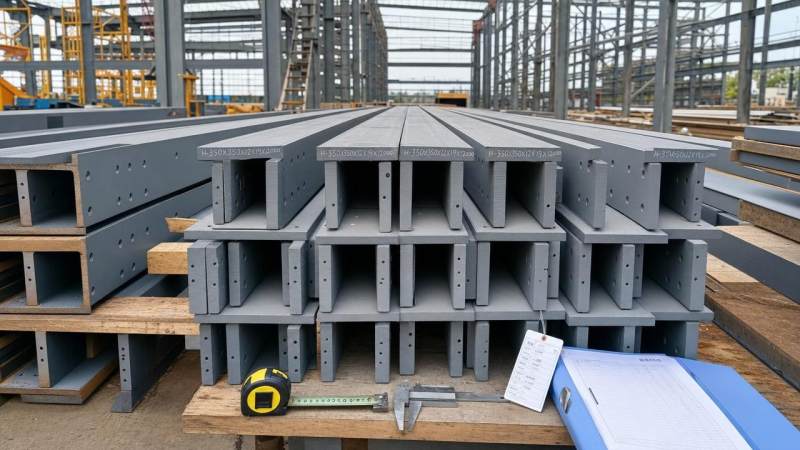
Carbon steel beams are often delivered in batches for commercial buildings, industrial workshops, equipment platforms, and infrastructure projects. Once beams arrive on site, the cost of correction rises quickly. Rework after unloading may involve secondary transport, extra grinding, repainting, or replacement lead times of 7 to 21 days.
For safety personnel, the concern is equally direct. Beam defects can create hazards during lifting, temporary support, bolting, alignment, and final connection. Even when a defect does not cause immediate rejection, it may require engineering review before installation continues.
Common Risks If Checks Are Skipped
- Wrong section size or flange thickness leading to fit-up problems at columns or end plates
- Material mix-up between grades specified under ASTM, EN, JIS, or GB standards
- Twist, sweep, or camber outside project tolerance, affecting alignment during erection
- Coating damage from handling, bundling, or sea shipment exposure
- Missing heat numbers, MTC records, or inspection tags that block traceability
What Quality Teams Should Confirm Before Release to Erection
A practical inspection plan usually covers 5 core areas: identity, dimensions, material compliance, surface condition, and document consistency. On larger projects, inspectors may add 2 more controls: coating verification and packing damage review after unloading.
The table below summarizes the most important acceptance points before carbon steel beams are moved from laydown area to installation zone.
The key point is simple: defects found at ground level are cheaper and safer to correct than defects found when a beam is already suspended by a crane or partially connected in the frame.
Key Technical Checks Before Site Installation
Pre-installation control of carbon steel beams should follow a defined sequence. That sequence helps inspection teams avoid skipping traceability steps while focusing on the conditions that most often create field problems.
1. Verify Material Grade and Mill Documentation
Start with material identification. Inspectors should match each beam’s mark, heat number, and batch information against the mill test certificate. Project documents may require ASTM A36, ASTM A572, EN S275, EN S355, or equivalent grades depending on the design basis.
A visual match is not enough when multiple grades are delivered together. If beams from 2 or 3 grades are bundled in the same laydown area, use a release checklist and physical segregation to prevent accidental installation.
Documentation checklist
- Mill test certificate and packing list
- Section size and piece mark correspondence
- Applicable standard such as ASTM, EN, JIS, or GB
- Coating report if shop primed or painted
- Nonconformance records and disposition notes, if any
2. Check Dimensions Against Drawings
Dimension control should include more than beam depth and length. For fabricated members, inspectors should verify end plate location, bolt hole spacing, cope dimensions, stiffener placement, and weld access areas. A tolerance issue of ±2 mm to ±5 mm can be manageable in some details, but not in every connection.
Use calibrated tapes, steel rules, and gauges. For repetitive members in a large shipment, 100% inspection of critical dimensions and sample inspection of secondary features is a common field approach, especially when delivery volume exceeds 50 to 100 pieces.
3. Inspect Straightness, Sweep, Camber, and Twist
Carbon steel beams may deform during fabrication, bundling, transport, or unloading. Even when a beam passes workshop inspection, it can pick up handling damage across long-distance export routes. Safety teams should check whether the member can be lifted and aligned without forcing or unsafe temporary correction.
Typical field checks include visual sighting along the beam axis, string line comparison, flange edge checks, and measurement at the point of maximum deviation. If the project specification does not define a limit, the inspector should refer to the governing fabrication standard and approved shop drawings.
4. Review Surface Condition and Coating Integrity
Surface quality directly affects corrosion protection and connection preparation. Inspectors should look for rust bloom, oil contamination, salt exposure, gouges, deep scratches, lamination indications, and edge impacts. These conditions are especially important for beams stored outdoors for more than 14 days before erection.
If beams are shop-primed, measure coating continuity at contact points, lifting points, and flange edges. Primer breakdown often appears first where slings, chains, and timber spacers made repeated contact during shipment.
The following table can help quality and safety teams decide which findings require immediate hold, repair, or engineering review before the beam is cleared for installation.
This review matrix helps teams separate repairable cosmetic issues from structural or traceability issues that require a formal stop. That distinction prevents both unsafe installation and unnecessary project delay.
Site Control Procedures That Reduce Delay and Rework
Good inspection is not only about technical acceptance. It also depends on site logistics. Carbon steel beams that pass factory inspection can still become problematic if unloading, stacking, or identification control is weak during site receipt.
Establish a 4-Step Receipt and Release Process
- Confirm shipment quantity, packing condition, and visible transport damage on arrival.
- Separate beams by area, sequence, and grade before removal of supplier marks.
- Inspect critical dimensions and condition before moving beams to erection front.
- Release only tagged and accepted members to crane lifting operations.
This 4-step routine is especially useful on sites where multiple subcontractors share one laydown yard. It reduces the chance of mixing approved and unapproved members and improves traceability when NCRs are raised.
Storage and Handling Controls
Store beams on timber sleepers or steel racks, keeping them off wet ground by at least 100 mm where practical. Use spacer points that limit flange edge damage and avoid stacking heights that make identification impossible or create unstable piles.
For projects in coastal or humid regions, inspect exposed carbon steel beams every 7 days if they remain outdoors without full wrapping or coating protection. Fast checks of drainage, standing water, and strap damage can prevent corrosion repair work later.
Coordination Between Supplier, QA, and Site Safety
A reliable structural steel supplier should support more than shipment. For export projects, buyers benefit when the manufacturer can provide standard-compliant documents, stable production records, and customized marking for faster field verification.
Hongteng Fengda, as a structural steel manufacturer and exporter from China, supplies steel beams, angle steel, channel steel, cold formed steel profiles, and customized structural steel components for global construction and industrial applications. With production aligned to ASTM, EN, JIS, and GB requirements, the company supports buyers who need consistent quality, dependable lead times, and lower sourcing risk.
In mixed-material projects, procurement teams may also source corrosion-resistant components for adjacent systems. For example, equipment enclosures, hygienic panels, or chemical-area accessories may require 316 Stainless Steel Plate because of its 2% to 3% molybdenum content, strong resistance to pitting, and suitability for acidic or high-temperature environments. While that product serves different applications than carbon steel beams, coordinated sourcing can simplify compliance across multi-material packages.
Frequent Inspection Mistakes and How to Avoid Them
Many site issues come from process gaps rather than complex engineering failures. Quality and safety managers can reduce them by standardizing check points before the first lift of each installation shift.
Mistake 1: Checking Size but Not Grade
A beam can match length and section dimensions but still fail the project if the steel grade is incorrect. This is a higher risk when multiple standards are accepted in procurement but only one specific grade is approved for the structure.
Mistake 2: Ignoring Minor Deformation Until Erection
What looks like a small twist on the ground can become a major alignment issue at elevation. If correction requires flame straightening or forced bolting, installation speed drops and safety exposure increases.
Mistake 3: Releasing Unmarked Members
If a member loses its tag during unloading and is installed based on assumption, traceability is broken. The correct action is to hold it, re-identify it from records, and re-mark it before release.
Mistake 4: Treating Surface Damage as Only Cosmetic
Some coating defects are minor, but deep impact marks, exposed steel in aggressive environments, or contamination in weld zones can affect long-term durability or connection quality. Site acceptance should consider service environment, not only appearance.
What Buyers and Project Teams Should Ask Before Ordering Carbon Steel Beams
The easiest installation problems to solve are the ones prevented before fabrication starts. Procurement and project teams should confirm technical and documentation expectations with the supplier at quotation stage, not after shipment.
Key Pre-Order Questions
- Which standard governs the beams: ASTM, EN, JIS, or GB?
- What dimensional tolerances apply to rolled or fabricated members?
- Will each piece carry clear marking linked to the MTC?
- Is shop primer included, and what repair procedure applies after delivery?
- What is the typical production cycle: 2 weeks, 4 weeks, or longer for custom sections?
- Can the supplier support OEM drawings and special packing for export handling?
These questions are practical because they connect purchasing decisions to field installation outcomes. A supplier that answers them clearly is usually better prepared to support inspection, documentation, and schedule control.
For quality inspectors and safety managers, the pre-installation review of carbon steel beams should focus on 3 priorities: structural conformity, safe handling condition, and full traceability. When those controls are in place, erection teams spend less time on field correction and more time on planned installation.
Hongteng Fengda supports global buyers with structural steel products, customized solutions, and quality-focused manufacturing for construction, industrial, and manufacturing projects. If you need carbon steel beams with clear documentation, stable production, and export-oriented support, contact us to discuss specifications, inspection requirements, or a tailored sourcing plan.
Please give us a message


Please enter what you want to find