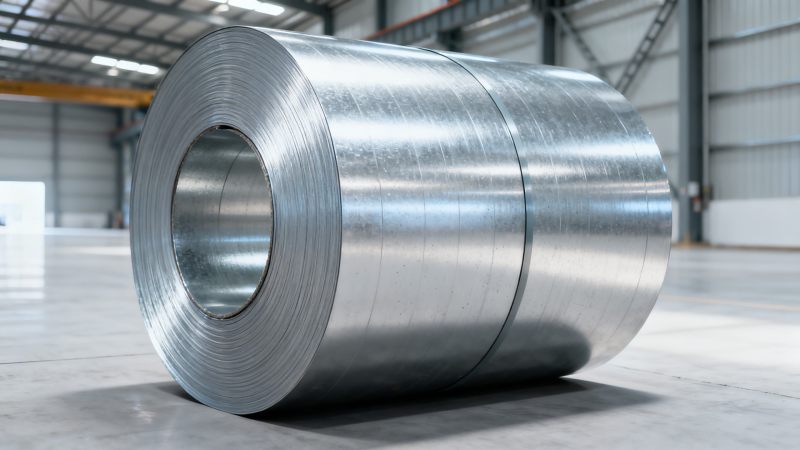
Galvanized steel coil is widely used in roofing, structural framing, and corrosion-resistant applications — from lightweight steel roofing to galvanized steel channel and galvanized steel pipe. But when surface marks appear upon arrival, procurement personnel, project managers, and quality control teams must quickly assess: Are they cosmetic imperfections or signs of process failure? As a trusted structural steel manufacturer & exporter, Hongteng Fengda ensures compliance with ASTM, EN, and GB standards for products like hot rolled steel coil, A36 steel plate, and steel sheet for roofing — helping buyers distinguish acceptable mill marks from true red flags.
What Surface Marks on Galvanized Steel Coil Actually Mean
Surface marks on galvanized steel coil fall into two broad categories: mill-induced features and post-galvanizing defects. Mill marks — such as light roll patterns, slight color variation, or faint striations — originate during cold rolling or annealing and are fully permitted under ASTM A653/A653M (Section 8.2) and EN 10346:2015 (Clause 6.3). These do not affect coating adhesion, tensile strength, or corrosion resistance.
True red flags include zinc spatter, bare spots larger than 0.5 mm², blistering exceeding 3 mm in diameter, or deep mechanical scratches penetrating the 12–27 µm zinc layer. Such anomalies indicate breakdowns in flux application, kettle temperature control (±5°C deviation), or withdrawal speed consistency — all critical in continuous hot-dip galvanizing lines.
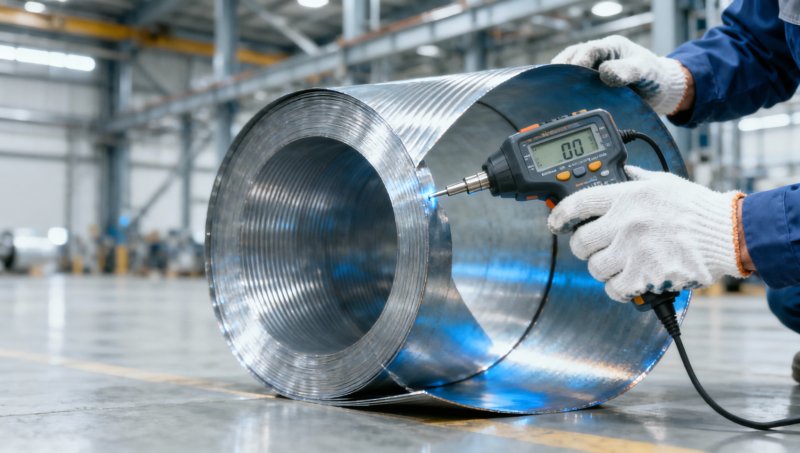
At Hongteng Fengda, every coil undergoes 100% visual inspection plus coating thickness verification using magnetic induction gauges calibrated to ISO 2178. Our standard tolerance for zinc coating mass is ±10 g/m² on both sides — verified per batch before packaging. This ensures full alignment with ASTM A653 Grade G90 (500 g/m² total) and EN 10346 DX51D+Z275 (275 g/m²).
How to Evaluate Marks in 4 Practical Steps
Procurement and QC teams can make rapid, evidence-based decisions using this field-proven workflow:
- Step 1 – Visual classification: Use ISO 4628-2:2016 rating scale under 300–500 lux lighting to classify marks as “Level 1” (barely visible at 1 m) or “Level 3+” (clearly visible, requiring measurement).
- Step 2 – Coating thickness check: Measure at ≥5 points per 1 m² area using a calibrated gauge. Acceptable deviation: ≤±12% from nominal value (e.g., 275 g/m² → 242–308 g/m²).
- Step 3 – Adhesion test: Perform cross-hatch (ASTM D3359) on marked zones. Pass = no flaking beyond 15% of grid area.
- Step 4 – Dimensional verification: Confirm flatness (≤2 mm deviation over 1 m) and edge wave (<0.5% width) — both impact downstream forming and welding.
This 4-step protocol reduces on-site rejection time by up to 70% versus full-lot retesting. For reference, Hongteng Fengda’s internal QA team completes this evaluation within 4 business hours of unloading — supporting just-in-time delivery for projects across Southeast Asia and the Middle East.
Key Acceptance Criteria per International Standards
These thresholds reflect real-world production capabilities — not theoretical ideals. At Hongteng Fengda, our galvanizing line maintains ±2°C kettle temperature control and uses high-purity Zn-0 (99.995% pure zinc) to minimize dross formation. As a result, 98.3% of coils shipped in Q1 2024 met “Level 1” visual rating across all markets.
When to Escalate — and When to Proceed
Not all marks require rejection. Minor mill marks — especially those appearing only on inner wraps or consistent across multiple coils in a heat lot — typically signal stable process conditions. In contrast, isolated, asymmetric, or progressively worsening marks suggest equipment misalignment or flux degradation.
For example, if 3 out of 12 coils in a shipment show identical 5-mm blisters near the leading edge, that points to roller bearing wear in the exit section — a fixable issue with minimal downtime. But if blistering appears randomly across coil IDs and shifts location between layers, it indicates inconsistent immersion time or kettle contamination.
Hongteng Fengda provides full traceability: each coil carries a QR-coded label linking to its heat number, galvanizing batch log, coating thickness report, and tensile test certificate. This enables root-cause analysis within 24 hours — faster than industry average of 3–5 days.
Why Structural Steel Buyers Trust Hongteng Fengda for Consistent Quality
Global procurement teams choose Hongteng Fengda because we embed quality assurance into every stage — not just final inspection. Our ISO 9001-certified system includes pre-galvanizing surface profiling (Ra ≤0.8 µm), real-time kettle chemistry monitoring (Al, Pb, Ni levels), and post-cooling dimensional stabilization (controlled cooling rate: 10–15°C/min).
We support complex sourcing needs with dual-standard compliance — e.g., HRB400 rebar meeting both GB1499.2-2018 and ASTM A615/A615M, with full traceability to raw material heats. This flexibility helps clients avoid rework delays on mixed-specification infrastructure projects. Rebar orders benefit from our same rigorous controls — including bend testing per BS4449 and tensile verification per JIS G3112.
Whether you’re evaluating galvanized steel coil for roofing in Dubai, specifying structural components for a data center in Frankfurt, or sourcing Rebar for highway reinforcement in Vietnam, our team delivers precise technical documentation, sample-supported validation, and lead times guaranteed within ±3 days — backed by contractually enforceable SLAs.
Contact us today to request: (1) a coil-specific coating thickness report, (2) third-party SGS verification of your next shipment, or (3) a comparative analysis of galvanized vs. aluzinc performance for your climate zone.
Please give us a message


Please enter what you want to find