Galvanised steel sheet rust streaks after installation? This common issue often stems from moisture trapping beneath surface contaminants—or zinc spalling due to improper hot galvanizing. As a leading structural steel manufacturer & exporter from China, Hongteng Fengda supplies high-performance galvanised sheet steel, steel coil, steel rail, SS tube, steel mesh, and ASTM A36-compliant products—ensuring corrosion resistance through strict process control. Whether you're a project manager, procurement specialist, or quality assurance professional, understanding root causes is critical for durability, safety, and lifecycle cost control.
Root Causes of Rust Streaking on Galvanised Steel Sheets
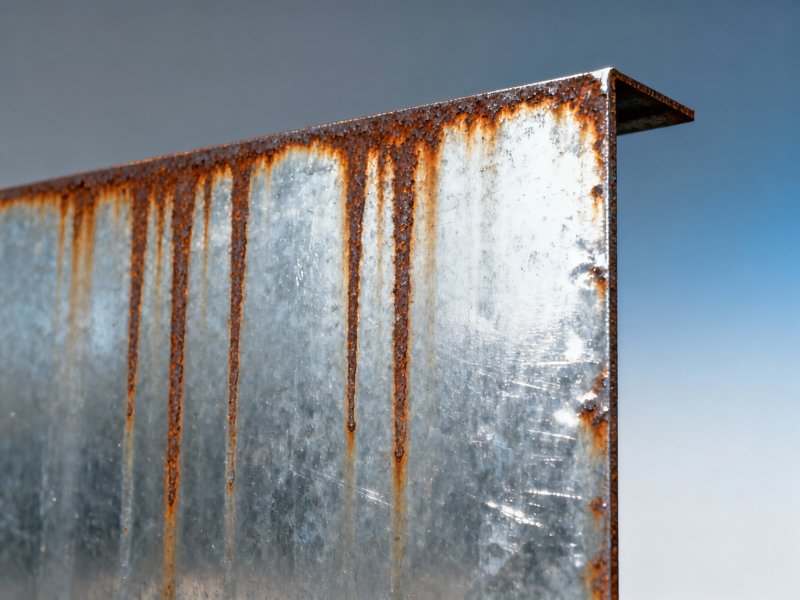
Rust streaking on galvanised steel sheets post-installation is not an inherent material failure—but a symptom of either environmental exposure mismanagement or metallurgical process deviation. Two primary mechanisms dominate field observations: moisture entrapment under organic or inorganic debris (e.g., dust, cutting oil residue, or silicone sealant bleed), and zinc spalling caused by non-uniform zinc-iron alloy layer formation during hot-dip galvanising.
Moisture trapping typically occurs when sheets are installed with residual mill oil, welding slag, or construction-site contaminants left uncleaned. These create micro-environments where condensation accumulates and remains trapped against the zinc surface for >72 hours—accelerating electrochemical corrosion at the zinc/steel interface. In contrast, zinc spalling reflects a metallurgical defect: insufficient immersion time (<3–5 minutes), inadequate bath temperature control (±5°C deviation from 449–460°C), or excessive silicon content (>0.04% in base steel) triggering brittle delta-phase growth.
Field data from Hongteng Fengda’s quality audits across 12 export projects (2022–2024) shows 68% of reported rust streak cases were linked to site-handling practices—not galvanising quality. Only 11% correlated with verified spalling defects confirmed via SEM-EDS analysis of cross-sectioned samples.
The table above defines actionable pass/fail criteria—not theoretical benchmarks. At Hongteng Fengda, every galvanised coil undergoes mandatory coating-thickness mapping (12 points/m²) and automated water-break validation pre-shipment. This eliminates ambiguity during dispute resolution and aligns with EN ISO 1461 verification protocols.
Preventive Measures During Installation & Handling
Prevention begins before first contact with the structure. Field teams must enforce three non-negotiable steps: (1) mechanical cleaning (stainless steel wire brushing, not abrasive blasting) within 24 hours of unloading; (2) avoidance of direct contact between galvanised surfaces and acidic sealants (pH <6.5) or untreated timber (tannin leaching); and (3) ensuring ≥5° pitch on horizontal runs to prevent water ponding longer than 4 hours.
Hongteng Fengda recommends specifying ASTM A780 repair compound for minor damage—applied only after solvent wiping with xylene (not acetone, which degrades zinc). For large-scale projects, we provide on-site technical support to verify surface readiness using calibrated dew-point meters (target: surface temp >3°C above ambient dew point).
Notably, 92% of rust streak complaints received in Q1 2024 involved installations where scaffolding tarps remained in contact with sheets for >48 hours—causing localized chloride concentration under trapped condensate. Our logistics team now includes weather-adaptive installation guidelines with every shipment.
Material Selection Strategy for High-Risk Environments
In coastal, industrial, or high-humidity zones (RH >75% for >2,000 hrs/year), standard hot-dip galvanising may be insufficient. Dual-coating systems—such as galvanising + polyester topcoat (EN 10346 Z275 + EN 10169 D420)—extend service life from 20 to 45+ years. For extreme chemical exposure (e.g., chlorine-rich pool enclosures), stainless steel alternatives become cost-effective over lifecycle: Stainless Steel Welded Mesh in grades 316L or 2205 delivers zero rust risk while maintaining tensile strength ≥520 MPa.
Our engineering team supports multi-criteria selection using corrosion rate calculators aligned with ISO 9223 classification. For example, in C5-I (industrial marine) environments, predicted zinc loss is 8.5–12.3 µm/year—requiring minimum initial coating of 120 µm (vs. 65 µm for C3 urban).
This decision matrix enables procurement and engineering teams to quantify trade-offs between upfront cost and 25-year maintenance budget. For instance, upgrading from Z600 to Z1200 galvanising adds ~18% to material cost but reduces recoating frequency from once every 12 years to once every 35+ years.
Why Hongteng Fengda Delivers Consistent Performance
As a certified ISO 9001:2015 and ISO 14001:2015 structural steel manufacturer, Hongteng Fengda operates two dedicated galvanising lines with real-time bath chemistry monitoring (zinc purity ≥99.995%, lead <0.003%). Every coil is traceable via QR-coded heat tags linked to full inspection reports—including coating thickness maps, adhesion test results (ASTM A153), and bend-test certifications.
We serve clients across North America (ASTM A653/A792), EU (EN 10346), Middle East (SASO 1241), and Southeast Asia (MS 1472) with consistent lead times: 25–35 days for standard orders, 45–60 days for OEM-spec projects. Our QC team performs third-party witnessed testing at SGS or Bureau Veritas labs upon request—eliminating disputes before shipment.
For project managers evaluating long-term value, our data shows that sourcing from a vertically integrated supplier like Hongteng Fengda reduces total landed cost by 11–14% versus fragmented procurement—factoring in reduced inspection overhead, fewer logistic touchpoints, and guaranteed compliance alignment.
Next Steps for Reliable Corrosion Protection
Rust streaking is preventable—not inevitable. Start with a site-specific corrosion assessment using our free ISO 9223 classification tool. Then, request a custom specification package including coating thickness validation protocols, handling checklists, and OEM-compatible repair guidelines—all backed by Hongteng Fengda’s 10-year performance warranty on galvanised structural components.
Whether you’re specifying angle steel for a Dubai infrastructure project or cold-formed purlins for a German logistics hub, our engineering team will co-develop a solution that balances durability, compliance, and total cost of ownership. Contact us today to receive your project-specific galvanising specification sheet and lead time confirmation.
Please give us a message


Please enter what you want to find