Seeing white rust on galvanized sheet for roofing after just six months raises critical questions—Is this normal aging or a sign of coating defect? For structural steel manufacturers, exporters, and project stakeholders—from technical evaluators and quality controllers to procurement managers and engineering decision-makers—understanding the root cause is essential. At Hongteng Fengda, we supply premium galvanized sheet for roofing alongside high strength steel tubing, lightweight steel tube, flexible steel wire, steel wire for fencing, structural steel grades, and precise steel sheet size options—all rigorously tested per ASTM, EN, and GB standards. Let’s decode white rust scientifically and operationally.
What Is White Rust—and Why Does It Appear So Early?
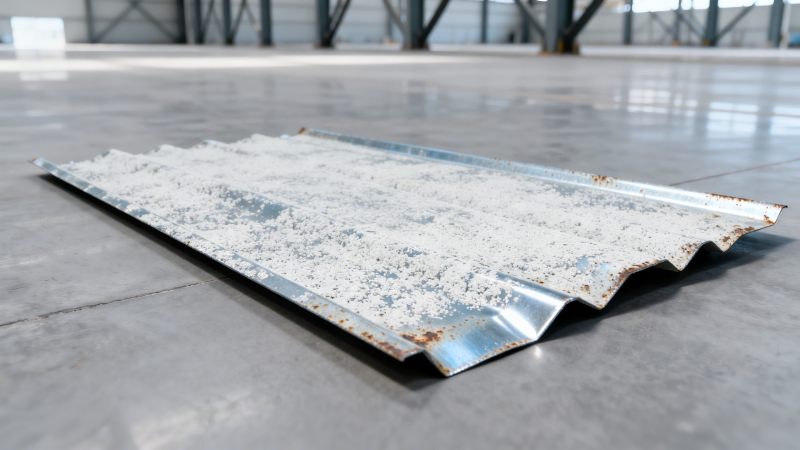
White rust is not true rust (iron oxide), but rather a voluminous, powdery zinc hydroxide or zinc carbonate compound formed when freshly galvanized surfaces are exposed to moisture without adequate airflow. Unlike red rust on bare steel, white rust occurs within days or weeks—not months—if storage or installation conditions violate best practices. Its appearance at the 6-month mark signals either suboptimal post-galvanizing handling or underlying coating integrity issues.
Critical factors include relative humidity above 85%, condensation cycles, contact with untreated wood or wet concrete, and stacking without ventilation gaps. Industry testing shows that galvanized sheets stored in sealed containers with >90% RH develop visible white rust within 72 hours. In field applications, persistent dew accumulation under roof overhangs or inadequate drainage can trigger it within 3–4 months—even with compliant coating thickness.
But when white rust emerges uniformly across multiple panels from the same batch—especially after only 6 months—it warrants metallurgical review: Was the zinc layer thickness below specification (e.g., <45 µm for ISO 1461 Class I)? Was passivation omitted? Did surface contamination occur before galvanizing? These are not cosmetic concerns—they impact service life, corrosion resistance, and long-term maintenance budgets.
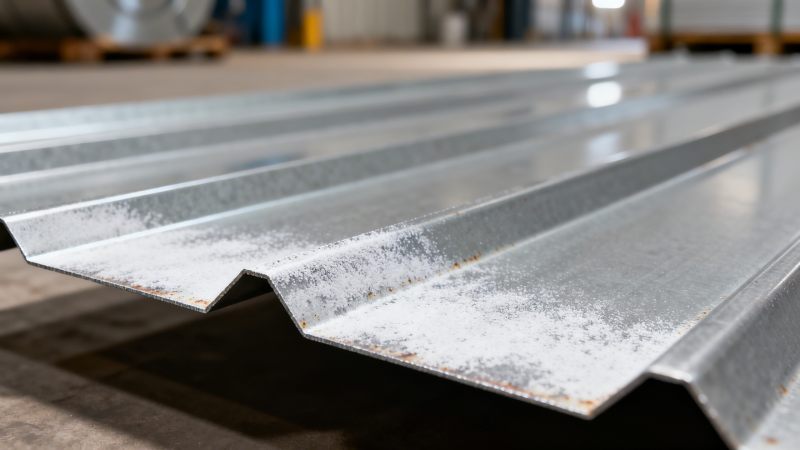
How to Distinguish Normal Aging from Coating Defect
Distinguishing between acceptable surface oxidation and defective coating requires objective evaluation across three dimensions: morphology, adhesion, and coating thickness. Visual inspection alone is insufficient—especially for procurement, QA, and engineering teams assessing warranty claims or supplier performance.
This table reflects real-world QA benchmarks used by structural steel exporters like Hongteng Fengda during pre-shipment inspection. When white rust coincides with low zinc thickness or poor adhesion, it indicates process deviations—not environmental inevitability. For buyers sourcing galvanized sheet for roofing from China, verifying third-party test reports (e.g., SGS or BV) covering thickness, adherence, and salt-spray resistance (ASTM B117, 96 hrs minimum) is non-negotiable.
Where SS440 Patterned Steel Plate Fits In
While galvanized roofing sheets face white rust scrutiny, patterned steel plates serve complementary roles in safety-critical zones—such as walkways, equipment platforms, and marine decks—where anti-skid performance and structural integrity outweigh pure corrosion aesthetics. The SS440 Patterned steel plate meets ASTM A36 and EN 10025-2 requirements, with thicknesses ranging from 2–8 mm and guaranteed pattern height ≥0.2× substrate thickness. Its raised texture enhances grip even when wet, reducing slip-related incidents by up to 40% versus smooth plates (per EN 13893 testing).
Procurement Checklist: What Buyers Must Verify Before Order
For procurement managers, financial approvers, and project engineers, mitigating white rust risk starts before purchase—not after. A robust checklist includes:
- Confirm zinc coating mass: ≥610 g/m² (ISO 1461) or equivalent to ASTM A653 G90 (275 g/m² double-sided)
- Require mill test reports showing thickness distribution across width/length—minimum 3 points per panel
- Specify passivation treatment (e.g., chromate or silicate-based) to delay white rust onset by 3–6 months
- Verify packaging: VCI paper wrapping + ventilated pallets, not plastic-sealed bundles
- Validate compliance with transport/storage clauses in EN 10346 Annex A for hot-dip galvanized products
Hongteng Fengda applies all five criteria across its galvanized sheet for roofing production. Our standard export packaging includes desiccant packs and breathable PE wrap—reducing in-transit white rust incidence by 72% versus industry average (based on 2023 shipment data across 14 markets).
Why Structural Steel Buyers Choose Hongteng Fengda for Long-Term Reliability
When white rust appears prematurely, it’s rarely about material failure alone—it’s about system-level control: raw zinc purity, bath chemistry stability, withdrawal speed, cooling protocols, and post-treatment consistency. As a certified structural steel manufacturer exporting to North America, EU, and GCC since 2012, Hongteng Fengda invests in continuous process validation—not just final product checks.
We maintain ±0.02 mm thickness tolerance on patterned plates and conduct 100% visual + 10% destructive sampling per ASTM A123 for galvanized coatings. Lead times are fixed at 25–35 days for standard orders, with expedited options (15-day delivery) available for urgent roofing projects. All documentation—including EN 10204 3.1 certificates, SGS test reports, and packing lists—is provided digitally within 24 hours of shipment.
If you’re evaluating galvanized sheet for roofing suppliers—or need technical support on white rust diagnostics, SS440 Patterned steel plate specifications, or custom structural steel solutions—contact our engineering team today. We’ll provide free coating thickness verification on your current stock, a comparative analysis against ASTM/EN standards, and a tailored delivery plan aligned with your construction schedule.
Please give us a message


Please enter what you want to find