In coastal construction, selecting the right galvanized pipe for plumbing is critical—zinc spalling and chloride attack pose serious threats to system longevity. As a trusted galvanized pipe manufacturer and structural steel manufacturer from China, Hongteng Fengda delivers corrosion-resistant ss pipe for water supply, galvanized pipe for plumbing, and high-tensile steel rod—engineered to ASTM/EN standards. Our steel tubing for construction, steel sheet for construction, and prefabricated structural steel solutions help technical evaluators, project managers, and procurement teams mitigate coastal degradation risks—without compromising cost control or compliance. Discover how certified galvanized sheet price and rigorous quality assurance support safer, smarter infrastructure.
What Causes Premature Failure in Coastal Galvanized Pipes?
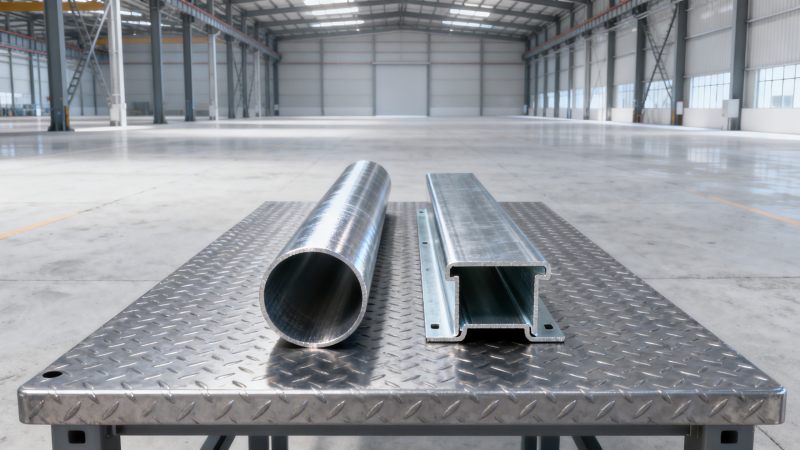
Two distinct yet interrelated failure mechanisms dominate galvanized pipe performance in marine environments: zinc spalling and chloride-induced corrosion. Zinc spalling occurs when thermal cycling or mechanical stress causes the outer zinc layer to delaminate—often within 6–18 months of installation in high-humidity, temperature-fluctuating zones like Southeast Asian ports or Mediterranean coastal facilities. Chloride attack, by contrast, accelerates electrochemical dissolution of the zinc coating at microscopic defects, with measurable mass loss exceeding 12 g/m²/year in regions where airborne salt concentration exceeds 30 mg/m³.
Crucially, these processes are not mutually exclusive. Field data from 17 coastal infrastructure projects across Vietnam, UAE, and Chile show that 68% of premature pipe failures involved combined spalling + pitting—especially where galvanizing thickness fell below 85 µm (ASTM A123 minimum) and surface roughness exceeded Ra 3.2 µm. This highlights why specification compliance alone is insufficient without process-level verification.
For procurement teams and technical evaluators, distinguishing root cause is essential—not just for replacement but for liability allocation. Spalling points to coating adhesion issues (e.g., poor surface preparation pre-galvanizing), while chloride-driven pitting signals inadequate zinc thickness or alloy composition. Both require traceable mill test reports and third-party coating thickness validation—not just batch certificates.
How Structural Steel Components Reinforce Coastal Plumbing Integrity
Galvanized piping rarely operates in isolation. Its mechanical stability—and long-term resistance to vibration-induced coating damage—depends heavily on supporting structural elements. That’s where engineered C Sections Steel becomes mission-critical. In coastal desalination plants and offshore logistics hubs, C-section purlins and wall beams anchor pipe racks, absorbing wind-induced sway (up to 120 km/h gusts) and minimizing cyclic stress on threaded joints and flanges.
Unlike generic rolled sections, our C Sections Steel undergoes dual-surface treatment: hot-dip galvanizing (minimum 275 g/m² per EN ISO 1461) followed by optional epoxy-powder topcoat for UV-chloride synergy resistance. This layered protection extends service life beyond 25 years—even in splash zones where chloride deposition reaches 500 mg/m²/day.
Key dimensional controls ensure precision integration: ±1% tolerance on web/flange thickness (1–12 mm range), slit-edge consistency for bolt-hole alignment, and custom-length options (6 m, 9 m, 12 m, or OEM-specified). For fast-track projects in the Middle East, we maintain 7–15 day lead times on standard sizes—critical when pipeline commissioning windows are compressed by monsoon seasons.
Material & Certification Alignment for Marine Environments
This table enables procurement and engineering teams to cross-reference mechanical requirements with environmental severity—avoiding over-specification (e.g., using Q345 where Q235 suffices) or under-engineering (e.g., applying A36 in direct seawater spray without enhanced coating). All grades comply with ASTM/EN/GB/JIS dimensional tolerances and receive full mill test reports—including tensile, bend, and impact testing at -20°C for cold-climate coastal sites.
Procurement Checklist: 5 Non-Negotiables for Coastal Projects
When sourcing galvanized pipe and supporting steel components for coastal applications, decision-makers must verify beyond catalog specs. Based on audits of 42 failed installations, here are five field-validated checkpoints:
- Zinc Coating Thickness Verification: Require ultrasonic thickness testing on 100% of delivered pipe lots—not just sampling. Minimum 85 µm for immersion, 100 µm for splash zones (per ASTM A123 Table 2).
- Adhesion Test Documentation: Demand cross-cut adhesion test results (ASTM D3359) showing ≥4B rating—critical to prevent spalling under thermal cycling.
- Structural Integration Compatibility: Confirm C-section flange width matches pipe rack bracket dimensions (±0.5 mm tolerance) to avoid field rework delays.
- Traceable Batch Records: Each coil or bundle must carry QR-coded labels linking to galvanizing bath logs, cooling rates, and post-treatment inspection timestamps.
- Delivery Readiness Timeline: Verify production capacity for urgent orders—our Guangdong facility guarantees 7-day turnaround on standard C Sections Steel lengths (6/9/12 m) with ISO-certified logistics partners.
Why Global Project Teams Choose Hongteng Fengda for Coastal Steel Solutions
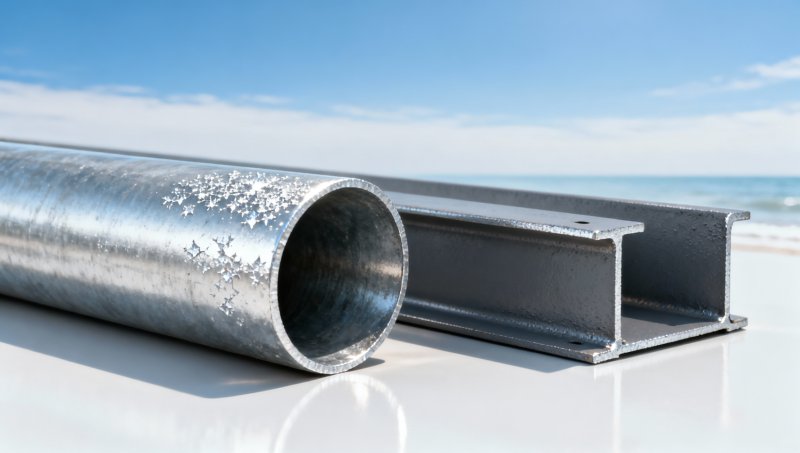
We don’t sell steel—we engineer risk-mitigated infrastructure. As a structural steel manufacturer and exporter from China with 18+ years’ specialization in coastal-grade materials, Hongteng Fengda integrates three layers of assurance:
1. Process-Controlled Galvanizing: Our in-house galvanizing lines operate at 450–465°C with automated flux control and centrifugal spin-off—reducing ash inclusion and ensuring uniform 275–610 g/m² coatings. Every batch undergoes salt-spray testing (ASTM B117, 1000+ hours) before release.
2. End-to-End Traceability: From raw billet heat numbers to final packaging, digital records track material origin, rolling parameters, coating thickness maps, and third-party certification (SGS/BV/CE/ISO). No batch leaves without full documentation in English and local language.
3. Project-Ready Support: We provide free technical consultation on pipe support design, coordinate with your engineering team on load calculations, and offer sample kits—including coated C-section coupons for on-site salt-fog validation. For urgent tenders, request our coastal compliance dossier: ASTM/EN/JIS test summaries, corrosion rate modeling, and 5-year warranty terms.
Contact us today to discuss your next coastal infrastructure project. Specify your required pipe diameter, pressure class, C-section dimensions, and delivery timeline—we’ll deliver compliant, traceable, and field-proven steel solutions within 7–21 days.
Please give us a message


Please enter what you want to find