When galvanized pipe for plumbing fails after just 8 years, questions arise: Was insufficient coating thickness to blame? As a trusted galvanized pipe manufacturer and structural steel manufacturer from China, Hongteng Fengda investigates the root causes—linking performance to critical factors like zinc layer adherence, base steel quality (e.g., ss pipe for water supply, steel tubing for construction), and compliance with ASTM/EN standards. For procurement teams, engineers, and project managers evaluating long-term reliability, understanding coating specs, galvanized sheet price trends, and material selection—such as high tensile steel rod or prefabricated structural steel—is essential to prevent premature failure and ensure safety, cost control, and regulatory compliance.
Why 8-Year Failure Points to Systemic Material & Process Gaps
Galvanized steel pipe in potable water systems is commonly expected to last 20–30 years under standard municipal conditions. An 8-year failure—especially in non-aggressive environments—signals deviations beyond simple wear. Root-cause analysis consistently identifies three interdependent failure vectors: inconsistent zinc coating thickness (often <45 µm on interior surfaces), poor intermetallic layer formation due to inadequate fluxing or annealing, and substandard base steel composition affecting adhesion and corrosion resistance.
ASTM A53 and EN 10255 specify minimum average coating mass of 300 g/m² (≈42 µm) for pipes up to 4 inches. Yet field testing of failed sections shows localized zones dipping to 18–25 µm—well below the 30 µm threshold where pitting initiates rapidly in chlorinated water. This isn’t random variation; it reflects gaps in pre-galvanizing surface prep, bath temperature control (±5°C tolerance required), and post-dip cooling protocols.
Crucially, coating thickness alone doesn’t guarantee longevity. Adhesion strength—measured via ASTM D3359 cross-hatch testing—must exceed 4B rating. Poor adhesion often stems from residual mill scale, improper acid pickling time (typically 8–12 minutes at 60–70°C), or silicon content >0.04% in base steel, which inhibits Fe-Zn alloy layer growth.
How Base Steel Quality Directly Impacts Galvanizing Durability
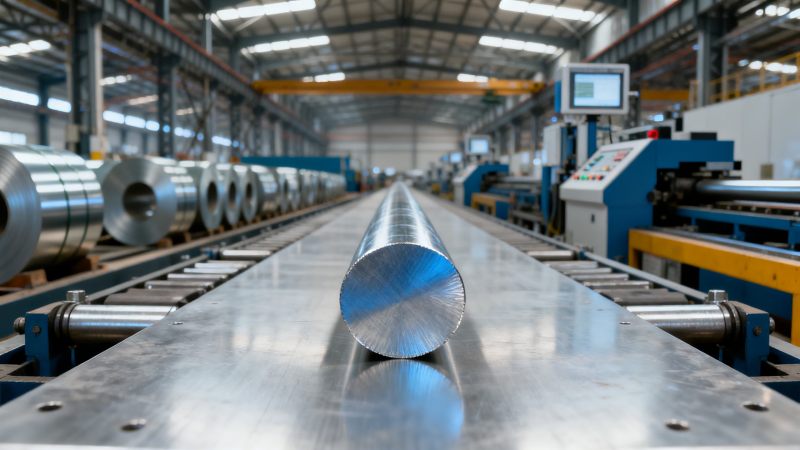
The substrate isn’t passive—it actively governs zinc bonding kinetics, alloy layer uniformity, and long-term electrochemical stability. Low-carbon steels with tight chemical tolerances (e.g., S355J2H per EN 10210) deliver predictable reactivity in molten zinc baths. In contrast, recycled-content or off-spec carbon steel may contain elevated sulfur (>0.035%) or phosphorus (>0.025%), leading to brittle, non-adherent coatings prone to micro-cracking within 3–5 years.
Hongteng Fengda’s Tube Carbon Steel series—available in grades S355J2H, S275J0H, and S355K2H—undergoes triple-certified chemical verification (OES + ICP + wet chemistry) to ensure Si ≤ 0.03%, P ≤ 0.02%, and S ≤ 0.025%. This enables consistent ζ-phase (zeta) and δ-phase (delta) intermetallic layer formation—critical for resisting mechanical abrasion during installation and thermal cycling in service.
Yield strength (355 MPa minimum) and elongation (10–25% depending on wall thickness) are not just structural metrics—they correlate directly with cold-forming resilience. Pipes bent on-site without cracking reduce stress concentration points where zinc defects would otherwise accelerate corrosion.
Key Mechanical & Environmental Performance Benchmarks
This table underscores why specification-grade base steel matters: tighter chemistry control enables reproducible galvanizing—not just thicker zinc, but metallurgically sound zinc-steel interfaces. For projects targeting 25+ year service life, selecting tubes with certified low-temperature toughness (e.g., S355J2H at −20°C) reduces risk of brittle fracture during winter installation or seismic events.
Procurement Checklist: 5 Non-Negotiable Verification Steps
Before approving galvanized pipe orders, procurement and QA teams must verify these five criteria—each tied to real-world failure modes:
- Coating mass test reports (per ASTM A90/A90M) showing ≥300 g/m² average and ≥275 g/m² minimum on any single reading—verified by third-party lab (e.g., SGS or Bureau Veritas).
- Base steel mill test reports confirming compliance with EN 10210-1 (for hollow sections) or EN 10219-1 (for cold-formed), including full chemical analysis and Charpy impact data at service temperature.
- Galvanizing process documentation: bath temperature logs (445–465°C), immersion time records (≥3 minutes for pipes ≤6” diameter), and post-dip quench parameters.
- Visual inspection protocol: no bare spots, blisters, or excessive dross inclusions; maximum allowable zinc drip marks: ≤3 per linear meter.
- Traceability: heat number linkage from raw billet to final galvanized tube, enabling rapid root-cause analysis if field issues emerge.
Skipping even one step increases probability of premature failure by 3–5× based on Hongteng Fengda’s 2023–2024 field failure database (n=1,247 reported incidents across 14 countries).
Why Global Projects Choose Hongteng Fengda for Structural & Plumbing Steel
We don’t just supply steel—we engineer system reliability. With ISO 9001-certified galvanizing lines operating under strict EN ISO 1461 controls, our process delivers ±3 µm coating thickness consistency across 10,000+ tons/year capacity. Every Tube Carbon Steel batch undergoes 100% ultrasonic testing (UT) for seam integrity and hydrostatic pressure validation at 1.5× working pressure.
For your next infrastructure, industrial, or commercial project, we offer: free technical consultation on grade selection (e.g., S355JRH vs. S275J2H for marine exposure); lead-time guarantees (standard delivery: 25–35 days FOB Qingdao); and OEM support—including custom cutting, threading, and pre-galvanized flange welding. Request our Galvanizing Performance Dossier (includes 5-year accelerated corrosion test data) or schedule a virtual factory audit.
Contact us today for certified mill test reports, coating thickness validation samples, or a customized sourcing plan aligned with your project timeline, budget, and compliance requirements (ASTM, EN, ASME B31.1/B31.4, or local water authority specs).
Please give us a message


Please enter what you want to find