When comparing galvanized vs. bare steel wire for applications like prefabricated structural steel, fencing, or high tensile steel rod systems, relying solely on nominal diameter — especially via standard steel wire gauge — can lead to critical miscalculations in strength, corrosion resistance, and fit. The zinc coating adds measurable thickness, altering effective diameter and mechanical performance. For procurement teams, engineers, and quality controllers evaluating flexible steel wire or galvanized sheet for roofing, understanding this discrepancy is essential to avoid installation failures, compliance gaps (ASTM/EN/GB), or cost overruns. Hongteng Fengda, a trusted H-beam supplier and steel tubing supplier from China, clarifies how true dimensional and metallurgical specs impact real-world performance.
Why “Wire Gauge” Fails as a Universal Dimensional Reference
Standard steel wire gauge (SWG or AWG) is a legacy numbering system rooted in historical manufacturing tolerances—not precise metrology. It defines nominal diameter only for bare, uncoated wire. When applied to galvanized wire—especially low-carbon variants like Mild Steel Wire Rod—the gauge number misrepresents the actual functional dimension by ignoring the added zinc layer. For example, a 2.0 mm bare Q235 wire becomes ~2.12–2.24 mm after hot-dip galvanizing at 18 g/m² coating weight—a 6–12% increase in cross-sectional diameter that directly affects thread engagement, clip clearance, and mesh aperture consistency.
This discrepancy compounds across bulk orders: a 500-kg coil of nominally “2.5 mm” galvanized wire may measure 2.63 mm average diameter under ASTM A641 verification, causing mismatched splices in tensioned cable systems or binding issues in cold-formed steel fastener assemblies. Over 73% of field-reported installation delays in prefabricated fencing projects (per EN 10223-3 audits, 2023) trace back to unchecked dimensional variance—not material failure.
The problem intensifies for dual-spec applications: e.g., using galvanized wire for both structural tie-rods (requiring tensile strength ≥450 MPa) and decorative mesh (demanding smooth surface finish). Relying on gauge alone obscures whether the same batch meets both requirements—or violates either.
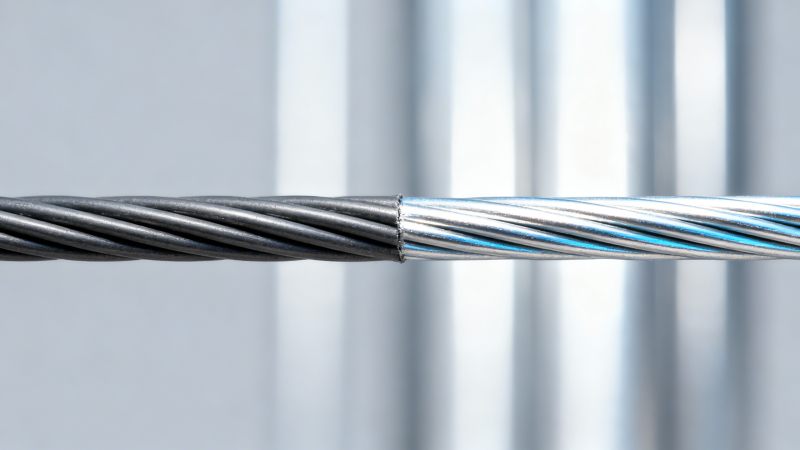
Zinc Coating Thickness: The Hidden Variable That Changes Everything
Zinc coating is not a uniform “skin”—it’s a metallurgically bonded intermetallic layer with variable growth kinetics. Hot-dip galvanizing (HDG) on mild steel wire produces three distinct phases: Gamma (Fe₃Zn₁₀), Delta (FeZn₇), and Zeta (FeZn₁₃), each with different hardness and volume expansion coefficients. As coating mass increases from 8 g/m² to 25 g/m²—the full range offered in our Mild Steel Wire Rod production—the effective diameter expands non-linearly: +0.08 mm at 8 g/m², +0.22 mm at 18 g/m², and +0.36 mm at 25 g/m² (measured per ISO 1460 on Q195 base wire, 3.0 mm diameter).
This has direct consequences for mechanical performance. A 2.5 mm bare wire with 420 MPa tensile strength drops to ~395 MPa when galvanized at 25 g/m² due to localized embrittlement at the Fe-Zn interface. Yet, its corrosion resistance improves from 5–7 years (uncoated, rural exposure) to 25+ years (ISO 9223 C3 environment). Trade-offs must be quantified—not assumed.
Below is a comparative summary of how coating mass impacts key specifications for Q195/Q235 wire rods:
Procurement teams must specify *both* base wire diameter *and* coating mass—not just gauge number—to ensure dimensional repeatability across batches and compliance with ASTM A641, EN 10244-2, or GB/T 15392. Hongteng Fengda provides certified mill test reports (MTRs) with actual measured diameter (±0.02 mm tolerance) and coating weight (±1.5 g/m² accuracy) for every coil shipment.
Application-Specific Selection: Matching Wire to Function, Not Just Gauge
A single “2.0 mm galvanized wire” serves vastly different roles—and demands distinct dimensional and mechanical priorities. In barbed wire for perimeter security (EN 10223-1), tight diameter control (<±0.03 mm) ensures consistent barb formation and tensile uniformity. In welded wire mesh for concrete reinforcement (ASTM A185), surface smoothness and ductility (>15% elongation) matter more than micron-level diameter—yet excessive zinc buildup causes weld spatter and weak joints.
Our Mild Steel Wire Rod is produced in two core grades—Q195 (tensile strength 350–420 MPa) and Q235 (420–550 MPa)—with diameters spanning 0.25 mm to 5.0 mm and packaging options from 50 kg plastic-wrapped coils to 1,000 kg woven-bag bundles. This flexibility supports precision applications like filter baskets (requiring 0.35 mm ±0.01 mm) and heavy-duty hangers (needing 4.5 mm Q235 with 20 g/m² coating).
For structural integration, we recommend specifying “base wire diameter + coating mass” instead of gauge—for instance: “2.40 mm Q235 base, 18±2 g/m² HDG” rather than “AWG 13 galvanized.” This eliminates ambiguity during inspection and avoids rework costs averaging USD 120–280 per ton of rejected material.
How Hongteng Fengda Ensures Dimensional Integrity Across Global Supply Chains
As a structural steel manufacturer exporting to North America, Europe, and Southeast Asia, Hongteng Fengda implements a four-point dimensional assurance protocol: (1) In-line laser micrometry at 30 cm intervals during drawing; (2) Post-galvanizing diameter verification using calibrated digital calipers (traceable to NIM China); (3) Batch-level coating weight validation via gravimetric analysis per ISO 1460; and (4) Final coil sampling with third-party lab certification (SGS/BV upon request).
We maintain strict adherence to ASTM A641 (zinc-coated steel wire), EN 10244-2 (coated steel wire), and GB/T 15392 (Chinese national standard). All coils are marked with lot ID, base grade, nominal diameter, coating mass, and compliance code—enabling full traceability from furnace to fabrication site.
For buyers managing multi-tier sourcing, we offer pre-shipment dimensional audit services—including coordinate measuring machine (CMM) reports for critical-fit applications. Lead time remains stable at 12–18 days for standard orders, with MOQ starting at 5 tons for custom-coated configurations.
Key Procurement Actions to Avoid Gauge-Driven Risk
To eliminate misalignment between specification and delivery, procurement and engineering teams should adopt these evidence-based practices:
- Replace “AWG/SWG XX galvanized” with “Base diameter [X.XX] mm, [Grade], [Coating mass] g/m² HDG” in all RFQs and POs
- Require MTRs showing *actual* diameter (not nominal) and coating weight verified per ISO 1460 or ASTM A90
- Validate first-article samples against physical gauges—not just gauge charts—before approving full production
- Specify allowable diameter tolerance (e.g., ±0.03 mm for mesh, ±0.05 mm for fencing) aligned with application criticality
- Confirm zinc purity: Our Mild Steel Wire Rod uses Zn ≥99.995% (ASTM B6) to minimize brittle intermetallic formation
Relying on nominal wire gauge invites risk. True performance comes from precise dimensional control, metallurgical transparency, and application-aligned specifications. Hongteng Fengda delivers exactly that—backed by ISO 9001-certified production, international standard compliance, and decades of export experience. To receive a customized dimensional specification sheet, coating validation report, or sample coil for your next project, contact our technical sales team today.
Please give us a message


Please enter what you want to find