Choosing a galvanized pipe for water supply requires more than comparing size and price. For project planners, engineers, and buyers, the key questions often involve corrosion resistance, coating quality, water safety, applicable standards, and long-term performance. This guide explains the essential safety basics of galvanized steel pipes in water supply applications, helping you understand where they are suitable, what risks to evaluate, and how to make informed sourcing decisions for construction, industrial, or infrastructure projects.
What Is a Galvanized Pipe for Water Supply?
A galvanized pipe for water supply is a steel pipe protected by a zinc coating.
The coating helps slow rust, surface oxidation, and moisture-related corrosion.
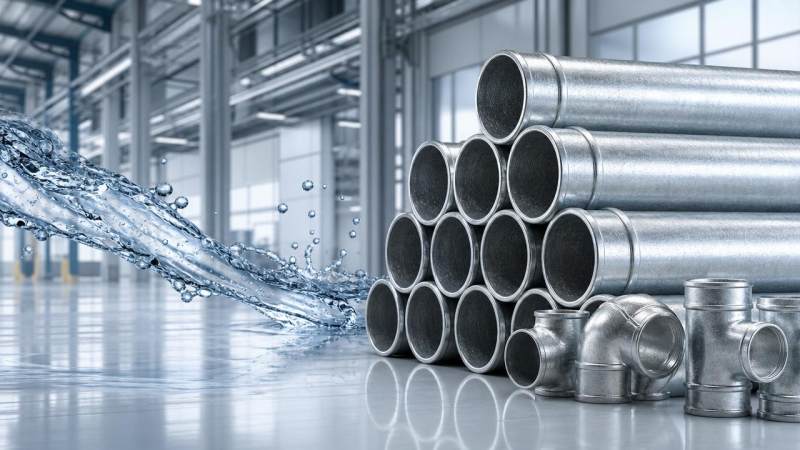
In most cases, the zinc layer is applied by hot-dip galvanizing.
The steel pipe is immersed in molten zinc after surface preparation.
This creates a bonded protective layer, not a simple surface paint.
For water systems, the main purpose is corrosion control and mechanical strength.
A galvanized pipe for water supply can handle pressure, impact, and installation stress.
However, its safety depends on water chemistry, coating quality, age, and maintenance.
It should not be selected only because it looks durable.
How does the zinc coating protect the pipe?
Zinc acts as a barrier between water and steel.
It also provides sacrificial protection when small scratches expose the base steel.
This is why a galvanized pipe for water supply often performs well in controlled conditions.
Still, zinc can gradually dissolve under aggressive water conditions.
Low pH, high chloride, and stagnant water may shorten service life.
Is Galvanized Pipe for Water Supply Safe for Potable Water?
Safety depends on compliance, water quality, and the intended use.
A new galvanized pipe for water supply may be acceptable in some systems.
Local plumbing codes and potable water regulations must always be checked first.
Older galvanized piping can raise different concerns.
Internal corrosion may trap deposits, reduce flow, or affect water appearance.
In legacy buildings, old pipes may also connect with lead-containing components.
This does not mean every galvanized pipe is unsafe.
It means water testing and system review are important before reuse.
What should be tested before approval?
- pH and alkalinity of the water.
- Chloride, sulfate, and dissolved oxygen levels.
- Zinc concentration after stagnation periods.
- Lead risk from connected valves or fittings.
- Turbidity, discoloration, odor, and sediment.
A galvanized pipe for water supply should be evaluated as part of the full system.
Pipe quality alone cannot guarantee potable water safety.
Where Is Galvanized Pipe for Water Supply Suitable?
A galvanized pipe for water supply is often used where strength matters.
Examples include service lines, industrial water distribution, and utility support networks.
It may also suit fire protection, non-potable water, and temporary construction systems.
For exposed environments, galvanized steel offers useful resistance against external corrosion.
This is helpful in outdoor plants, workshops, farms, and infrastructure projects.
For aggressive potable water, alternatives may be better.
Stainless steel, lined steel, copper, or approved plastic piping may be considered.
The right choice depends on pressure, temperature, flow, budget, and code requirements.
How can application type guide selection?
A galvanized pipe for water supply should match both service conditions and inspection expectations.
What Standards and Quality Details Matter Most?
Standards help define dimensions, coating, testing, and mechanical performance.
Common references may include ASTM, EN, JIS, GB, and local plumbing codes.
A galvanized pipe for water supply should be ordered with clear technical requirements.
Ambiguous purchasing terms can cause coating variation or dimensional mismatch.
Important details include pipe grade, outside diameter, wall thickness, and zinc coating mass.
Thread quality, straightness, end finish, and marking should also be checked.
What documents should accompany shipment?
- Mill test certificate for steel grade and chemistry.
- Coating inspection report or galvanizing confirmation.
- Dimensional inspection record for critical sizes.
- Hydrostatic or pressure test report when required.
- Packing list with heat number or batch traceability.
Hongteng Fengda supplies structural steel products and customized steel solutions from China.
Its manufacturing and export experience supports projects requiring ASTM, EN, JIS, or GB alignment.
For adjacent filtration, screening, or industrial separation needs, 316 Stainless Steel Welded Mesh may complement steel piping systems.
It offers corrosion resistance, acid resistance, alkali resistance, heat resistance, and durable stainless steel wire construction.
Available models include SS 201, 304, 304L, 316, 316L, and 430.
Typical uses include filters, sieves, chemical industry, mining, architecture, and residences.
What Risks Should Be Considered Before Installation?
The main risks relate to internal corrosion, scaling, and water chemistry mismatch.
A galvanized pipe for water supply can build deposits over time.
These deposits may reduce flow and increase pumping costs.
When corrosion progresses, water may show color, particles, or metallic taste.
Threaded joints can be another vulnerable area.
Cutting and threading remove or disturb part of the zinc coating.
Proper joint sealing and corrosion protection are therefore important.
Which installation mistakes reduce service life?
- Using pipe without confirming potable water compliance.
- Ignoring chloride, pH, and stagnation risks.
- Mixing metals without controlling galvanic corrosion.
- Leaving damaged coating unprotected after field cutting.
- Selecting wall thickness only by lowest price.
A galvanized pipe for water supply performs best when installation details are controlled.
Good material can still fail early if site practices are poor.
How Does Galvanized Pipe Compare With Other Water Pipe Materials?
Material comparison should consider safety, durability, cost, and maintenance.
A galvanized pipe for water supply provides strong mechanical performance.
It is less flexible than plastic and may need more labor during installation.
Compared with stainless steel, galvanized pipe usually has a lower initial cost.
However, stainless steel may perform better in corrosive water environments.
Compared with copper, galvanized steel can be stronger under impact.
Copper may offer advantages for potable water in many regulated building systems.
Quick comparison table
The best option is not universal.
A galvanized pipe for water supply is suitable when its strengths match project conditions.
How Should Galvanized Pipe for Water Supply Be Specified?
A clear specification reduces quality disputes and project delays.
It should describe the pipe, coating, standard, test method, and packing requirement.
For export projects, documentation format should be agreed before production.
A galvanized pipe for water supply order may include several inspection points.
- Applicable standard and pipe grade.
- Nominal size, outside diameter, and wall thickness.
- Zinc coating requirement and inspection method.
- End type, threading, coupling, or plain end.
- Pressure testing, marking, bundling, and loading.
For large infrastructure work, sampling plans should be defined in advance.
This helps verify consistency across batches and delivery schedules.
Hongteng Fengda supports steel sourcing with stable production capacity and controlled lead times.
Its product scope includes angle steel, channel steel, beams, and cold formed profiles.
Customized structural steel components can also support connected construction requirements.
FAQ: Common Questions About Galvanized Pipe for Water Supply
A galvanized pipe for water supply should be treated as an engineered material decision.
It is not just a commodity pipe selection.
Final Guidance for Safer Sourcing Decisions
A galvanized pipe for water supply can be reliable when properly specified and installed.
Its benefits include steel strength, zinc protection, and practical cost control.
Its limitations appear when water chemistry, coating damage, or aging are ignored.
Before procurement, confirm code acceptance, standards, coating requirements, and inspection documents.
For existing systems, test water quality and inspect internal pipe condition.
For new projects, compare galvanized steel with stainless, copper, and approved plastics.
The safest next step is to share drawings, standards, quantities, and service conditions.
With clear data, a suitable galvanized pipe for water supply can be evaluated accurately.
Hongteng Fengda can support steel sourcing with quality control, export experience, and project-focused service.
Please give us a message


Please enter what you want to find