For operators and fabrication teams, knowing whether ASTM A36 steel plate can meet welding requirements is essential for safe, efficient, and compliant structural work.
As a widely used carbon structural steel, A36 offers good weldability when proper procedures, consumables, and heat control are applied.
This article explains key welding considerations, common methods, and practical precautions to help achieve reliable joints and reduce project risks.
Can ASTM A36 steel plate meet welding requirements?
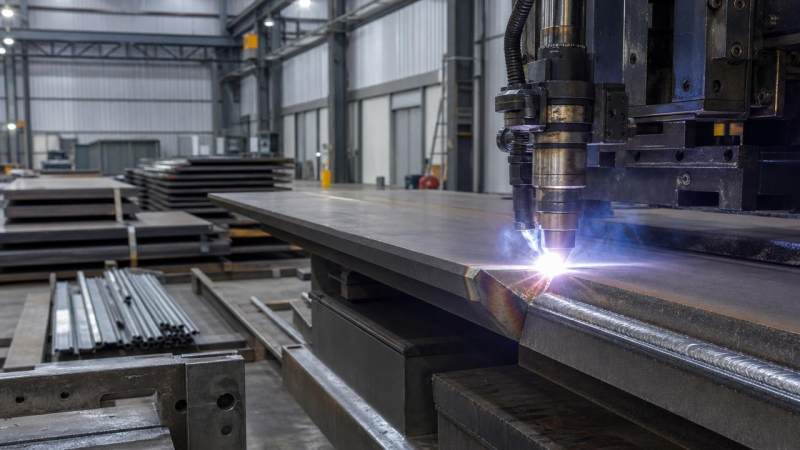
Yes, ASTM A36 steel plate can usually meet welding requirements for structural, industrial, and general fabrication applications.
Its low carbon content supports stable arc performance, acceptable toughness, and reliable fusion under qualified welding procedures.
ASTM A36 steel plate is commonly welded in building frames, platforms, base plates, brackets, supports, and machinery structures.
However, good weldability does not mean welding can be uncontrolled. Joint design, plate thickness, restraint, and service conditions still matter.
For code projects, welding should follow approved procedures such as AWS D1.1, project specifications, or local engineering requirements.
When ASTM A36 steel plate is sourced for export projects, material certificates and heat traceability should also be reviewed before fabrication.
Why is ASTM A36 steel plate considered weldable?
The main reason is chemistry. ASTM A36 steel plate is a mild carbon structural steel with moderate strength and relatively low hardenability.
Lower hardenability reduces the risk of forming brittle microstructures in the heat-affected zone after welding.
Compared with higher-strength alloy steels, A36 is more forgiving under standard welding conditions.
This makes ASTM A36 steel plate suitable for shop welding and field welding when workmanship is properly controlled.
Its typical applications involve static structural loads rather than extreme wear, high temperature, or severe impact service.
That practical balance helps reduce fabrication complexity while maintaining dependable structural performance.
Key material factors affecting weldability
- Carbon content influences hardness after cooling.
- Manganese supports strength and deoxidation.
- Plate thickness affects heat input needs.
- Surface cleanliness affects porosity risk.
- Mill certification confirms standard compliance.
Before welding ASTM A36 steel plate, surface rust, oil, moisture, paint, and heavy mill scale should be removed near the joint.
Clean preparation is often more important than complex equipment for achieving consistent weld quality.
Which welding methods are suitable for ASTM A36 steel plate?
Several common processes can be used successfully on ASTM A36 steel plate.
The best choice depends on plate thickness, position, productivity, environment, and inspection requirements.
Shielded metal arc welding
SMAW is widely used for structural fabrication, repair work, and outdoor welding.
Electrodes such as E6010, E6011, E6013, E7018, and similar classifications may be selected according to the required performance.
Low-hydrogen electrodes are preferred for thicker ASTM A36 steel plate or restrained joints.
Gas metal arc welding
GMAW offers high productivity, clean weld appearance, and stable quality in controlled shop conditions.
It is suitable for repeat production using ASTM A36 steel plate in frames, equipment bases, and welded assemblies.
Shielding gas, wire feed speed, voltage, and travel speed should be matched to joint thickness.
Flux-cored arc welding and submerged arc welding
FCAW is useful for heavier fabrication and can offer good deposition rates.
SAW is often selected for long seams, thick plates, beams, and large structural components.
Both methods can produce reliable welds on ASTM A36 steel plate when parameters and flux systems are qualified.
Does ASTM A36 steel plate need preheating before welding?
Thin ASTM A36 steel plate usually does not require preheating under normal conditions.
Still, preheat may be recommended for thicker sections, cold environments, high restraint, or joints exposed to critical loading.
Preheating slows cooling, reduces hydrogen cracking risk, and improves weld metal fusion.
The exact temperature should follow the welding procedure specification, applicable code, and project engineering guidance.
For many general A36 jobs, moderate preheat is enough when plate thickness increases.
Excessive heat should also be avoided because it can increase distortion and reduce production efficiency.
How should filler metals be selected for ASTM A36 steel plate?
Filler metal selection should match strength, ductility, welding process, and code requirements.
For many structural welds, E70-class consumables are commonly used with ASTM A36 steel plate.
They normally provide weld metal strength compatible with the base steel.
Low-hydrogen consumables help reduce delayed cracking, especially in thick or highly restrained assemblies.
Consumables must be stored correctly. Damp electrodes or contaminated wires can cause porosity, cracking, and inconsistent bead appearance.
When ASTM A36 steel plate is welded to another steel grade, the filler choice should consider the weaker or governing material.
Common filler selection checks
- Confirm base metal grade and certificate.
- Match tensile strength requirements.
- Review impact toughness requirements if specified.
- Control hydrogen for thick sections.
- Follow approved WPS limits.
What risks should be avoided when welding ASTM A36 steel plate?
The most common risks are hydrogen cracking, lack of fusion, undercut, porosity, distortion, and poor fit-up.
These problems usually come from weak preparation, unsuitable parameters, poor technique, or uncontrolled environmental conditions.
ASTM A36 steel plate can tolerate normal fabrication practice, but it still requires disciplined execution.
Joint edges should be prepared according to drawings, especially for full-penetration welds.
Excessive gaps can increase weld volume, heat input, cost, and shrinkage stress.
Too little heat may cause lack of fusion. Too much heat may increase distortion and weaken dimensional control.
Practical quality reminders
- Remove moisture before welding.
- Use suitable travel speed.
- Keep interpass temperature controlled.
- Clean slag between passes.
- Inspect critical welds after cooling.
For galvanized components near A36 assemblies, zinc coating must be considered before welding.
Solutions from Galvanized Pipe Manufacturers may support corrosion-resistant structures, but galvanized surfaces need ventilation and coating repair after welding.
This is important in bridges, shed construction, low-pressure pipelines, supports, storage facilities, and outdoor steel projects.
How does welding affect cost, schedule, and inspection?
ASTM A36 steel plate is often cost-effective because it is widely available and easy to fabricate.
Its welding efficiency can reduce shop time when the design uses practical joint details.
However, inspection level can change the total cost significantly.
Visual inspection may be enough for non-critical parts, while load-bearing structures may require MT, UT, or radiographic testing.
A clear fabrication plan reduces rework and avoids delays caused by missing certificates or unqualified procedures.
For export steel projects, stable material supply and standard compliance are also important.
Hongteng Fengda supplies structural steel products and customized components under ASTM, EN, JIS, and GB requirements.
Reliable sourcing helps reduce welding uncertainty, especially when projects need consistent chemical composition and dimensions.
FAQ: ASTM A36 steel plate welding questions
Conclusion: how to achieve reliable A36 welds
ASTM A36 steel plate can meet welding requirements in most structural and fabrication projects.
Its good weldability comes from mild steel chemistry, broad process compatibility, and practical fabrication behavior.
Reliable results depend on qualified procedures, suitable consumables, controlled heat input, clean surfaces, and proper inspection.
Before ordering ASTM A36 steel plate, confirm thickness, standard, certificates, welding code, and application environment.
For structural steel supply, fabrication support, or customized steel components, choose a supplier that understands international standards and project execution.
Hongteng Fengda supports global steel projects with stable quality, dependable delivery, and professional structural steel solutions.
Please give us a message


Please enter what you want to find