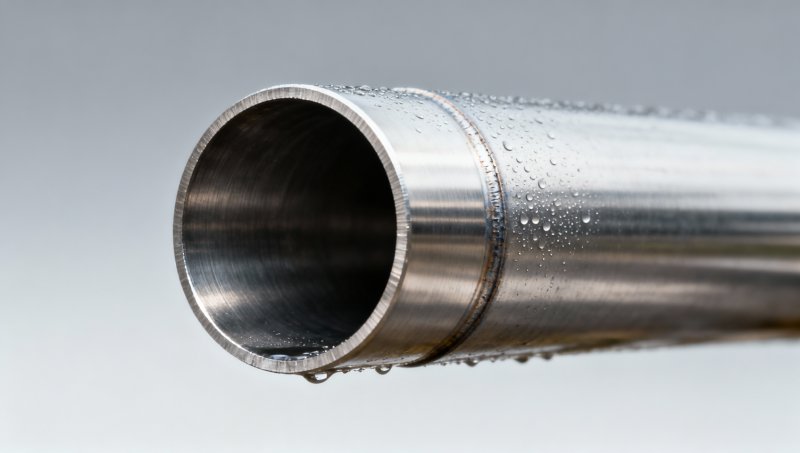
Can 201 stainless steel pipe be used for outdoor structural framing under ASTM A554?
Short answer: Yes — but only in very specific, low-risk outdoor applications. For most structural framing exposed to rain, humidity, de-icing salts, or coastal air, 201 stainless steel pipe certified to ASTM A554 is not recommended as a primary load-bearing element. Its lower nickel and higher manganese content create a material that looks like stainless, performs adequately in mild indoor or sheltered settings, and meets the dimensional and surface requirements of A554 — yet falls short where real-world corrosion resistance and long-term mechanical integrity matter.
This isn’t a failure of the standard. ASTM A554 itself makes no claim about corrosion performance, service life, or suitability for structural use. It’s a *manufacturing specification*: it governs how welded stainless steel mechanical tubing is produced — wall thickness tolerance (±10%), ovality limits, surface finish, hydrostatic test pressure, and weld seam quality. It does not define minimum chromium/nickel content for environmental resistance (that’s ASTM A240 or A276), nor does it assign structural design values (those come from ASTM A1085 or AISC 360). Confusing A554 compliance with fitness-for-purpose is where many project managers misstep — often after receiving quotes for “A554-certified 201 pipe” that look compelling on paper but carry hidden lifecycle risk.
Why 201 stainless fails where it matters most outdoors
The core issue lies in metallurgy, not certification. 201 stainless contains ~4–6% nickel and ~7–10% manganese — roughly half the nickel of 304, and zero molybdenum. Nickel stabilizes the austenitic structure and improves resistance to stress corrosion cracking; molybdenum dramatically enhances pitting resistance in chloride-laden environments. Without them, 201 relies heavily on its 16–18% chromium for passivation. That works well in dry, urban, or interior settings — but breaks down rapidly when exposed to:
- Repeated wet-dry cycling (common on open-framed canopies or stair railings);
- Atmospheric chlorides (coastal zones >1 km from shore, or inland areas using road salt);
- Trapped moisture in welded joints or crevices (a frequent issue in structural framing where pipes intersect or are gusseted);
- Acid rain or industrial fallout (which accelerates chromium depletion at grain boundaries).
Field observations from projects across Southeast Asia and the Middle East show visible rust staining on 201 pipe within 12–18 months in non-coastal humid climates — not full-through corrosion, but enough to compromise aesthetics, raise maintenance flags, and trigger early replacement in high-visibility architectural framing. In one documented case, a 201 A554-compliant railing system installed near a desalination plant showed localized pitting through 2.0 mm wall thickness in under 3 years.
When 201 A554 *can* work — and what conditions must hold
There are narrow, defensible use cases — but they require deliberate engineering judgment, not procurement convenience. 201 stainless pipe per ASTM A554 may be acceptable for outdoor structural framing only when all of the following apply:
- Exposure is strictly limited: Fully sheltered (e.g., covered walkways with overhang ≥1.5× framing depth), inland locations >50 km from coast, low-rainfall zones (<600 mm/year), and no exposure to de-icing chemicals or industrial aerosols;
- Structural role is secondary: Non-load-bearing infill, decorative bracing, or light-duty handrails where failure has no safety consequence and replacement is easily accessible;
- Design includes corrosion mitigation: Full welding (no bolted connections that trap moisture), generous drainage radii at joints, and avoidance of tight crevices or contact with dissimilar metals (e.g., carbon steel fasteners without isolation washers);
- Lifecycle expectation is ≤10 years: Projects with planned refurbishment or where aesthetic degradation is contractually acceptable.
If any one condition fails — especially exposure or structural responsibility — upgrading to 304 (ASTM A554 Type 304) becomes the baseline responsible choice. For coastal, marine, or high-salinity environments, 316 (with its 2–3% molybdenum) isn’t luxury — it’s due diligence.
A note on alternatives: Where carbon steel still wins
It’s also worth questioning the assumption that “stainless = always better outdoors.” For many structural framing applications — particularly purlins, wall beams, or light industrial supports — hot-dip galvanized carbon steel offers superior value, predictability, and longevity. Take the C-beam, for example: formed from Q235 or Q345 steel and hot-dip galvanized to ASTM A123, it delivers proven 50+ year corrosion resistance in typical atmospheric exposures, with consistent yield strength (235–345 MPa), full traceability, and straightforward connection detailing. Unlike 201 stainless, its performance doesn’t degrade unpredictably in humid microclimates or near concrete runoff. And unlike stainless, galvanized steel’s sacrificial zinc layer self-heals minor scratches — a critical advantage in construction-handling environments.
What to verify before approving 201 A554 for outdoor framing
Don’t rely on mill test reports alone. Request and review the following — before purchase, not after delivery:
- Actual heat chemistry report (not just grade designation): Confirm Ni ≤6.0%, Mn ≥7.5%, and Cr ≥16.0%. Some borderline 201 heats fall below effective passivation thresholds;
- Weld seam verification: ASTM A554 requires full-penetration welds with no slag inclusions. Ask for ultrasonic testing (UT) records on sample lengths — especially for pipes >114 mm OD;
- Surface finish specification: A554 allows No. 1 (hot-rolled, pickled), No. 2B (cold-rolled, annealed), or No. 4 (brushed). For outdoor use, avoid No. 1 — its rougher scale traps moisture. Specify No. 2B minimum;
- Post-fabrication passivation documentation: If field welding is required, confirm whether the supplier provides citric acid passivation services — and whether procedures follow ASTM A967.
Finally, cross-check against your local building code. While ASTM A554 is widely accepted, some jurisdictions (e.g., California’s OSHPD, or UAE’s DM Civil Code) explicitly restrict 200-series stainless in exterior structural applications — regardless of A554 compliance.
Bottom line: Certification ≠ Capability
ASTM A554 ensures a pipe was made to certain dimensional and fabrication standards. It says nothing about whether that pipe belongs outside — especially where people, assets, or reputation depend on its performance over time. For outdoor structural framing, material selection must start with exposure, not cost. If your project sits within 5 km of saltwater, endures monsoon rains, or serves a high-profile architectural façade, 201 stainless pipe — even A554-certified — should be treated as a short-term compromise, not a solution. The upfront cost difference between 201 and 304 A554 pipe is rarely more than 15–20%. The cost of premature replacement, warranty claims, or reputational damage is never calculable in advance.
Please give us a message


Please enter what you want to find