Many project delays and cost overruns begin with one overlooked issue: why steel wire for construction fails earlier than expected. For project managers and engineering leaders, understanding the causes behind premature failure is essential to protecting safety, schedules, and budgets. From material quality and corrosion exposure to improper specifications and installation, this article explains the key risks and how to prevent them in demanding construction environments.
In practice, early failure rarely comes from one single defect. It is usually the result of 3 to 5 weaknesses acting together, such as inconsistent tensile performance, uncontrolled coating thickness, poor storage, and installation stress beyond design assumptions.
For project leaders managing large civil works, precast systems, scaffolding, reinforcement support, or lifting-related applications, the cost of replacing failed steel wire for construction can extend far beyond material value. It can affect safety inspections, subcontractor sequencing, and handover dates within 7 to 30 days.
Why Early Failure Happens on Real Construction Sites
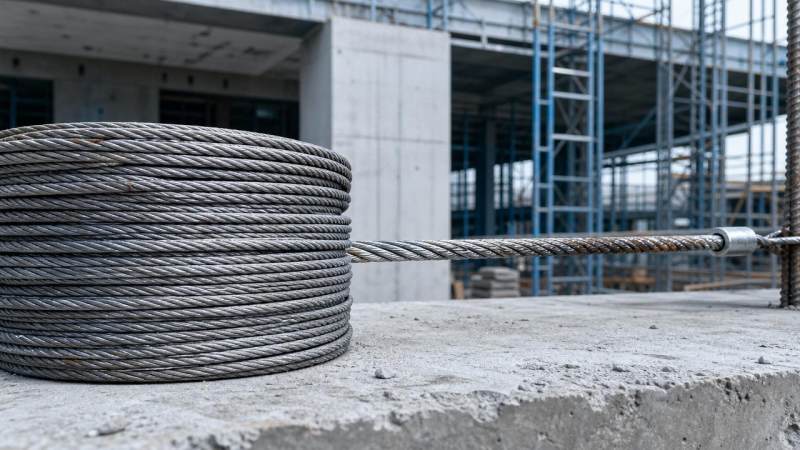
Steel wire may appear simple, but its field performance depends on chemistry, processing, protection, handling, and load condition. Even when wire meets a nominal diameter target, failure can still occur if elongation, coating integrity, or fatigue resistance does not match site demands.
Project teams often focus on price per ton or lead time, while underestimating 4 critical variables: base steel grade, manufacturing consistency, exposure environment, and installation method. This is one reason steel wire for construction sometimes fails months earlier than planners expect.
Material inconsistency is a hidden starting point
Not all wire sold under similar descriptions performs the same way. Variations in carbon content, residual elements, and heat treatment can change tensile strength, ductility, and bend performance. A wire that looks acceptable at delivery may crack under repeated loading after only 20 to 50 service cycles.
For construction applications, small dimensional variation can also become a larger mechanical problem. Diameter deviation, decarburization depth, and uneven surface finish may concentrate stress at one point, especially where wire is tied, tensioned, or bent around sharp edges.
Common quality gaps that shorten service life
- Unstable tensile strength between production lots
- Surface micro-cracks formed during drawing or coiling
- Insufficient galvanizing or uneven protective coating
- Out-of-range tolerance causing stress concentration at anchor points
The table below shows how common failure drivers affect steel wire for construction at different stages, from procurement to field service.
The key lesson is that procurement quality and site handling are inseparable. A good product can fail under poor installation, and a low-grade product can create risk even with careful handling. Project managers need both supply control and field discipline.
Corrosion exposure is often underestimated
Corrosion is one of the fastest ways to reduce service life. In coastal, industrial, or high-humidity environments, unprotected or poorly protected wire can begin surface oxidation within days. Once corrosion pits form, cross-sectional area decreases and local stress rises sharply.
This matters especially when steel wire for construction is used in temporary structures, fixing systems, reinforcement ties, barriers, or support assemblies exposed to rainwater, cement slurry, chlorides, or temperature swings from 5°C to 40°C.
Installation errors create premature fatigue
Many failures blamed on material quality are partly installation issues. Excessive twisting, tight-radius bending, over-tensioning, or abrasive contact with rough steel edges can reduce useful life by a significant margin. Repeated micro-movement then accelerates fatigue cracks.
A practical rule for site teams is to review at least 6 inspection points before acceptance: diameter, coating condition, packaging integrity, identification, visible damage, and storage record. These checks typically take less than 15 minutes per batch but can prevent costly downstream problems.
How to Specify Steel Wire for Construction More Effectively
The best way to prevent early failure is to match specification to application rather than buying on generic description alone. Construction projects differ widely in load pattern, exposure level, expected service duration, and compliance requirements such as ASTM, EN, JIS, or GB-based purchasing standards.
A wire selected for indoor tying over a 2 to 4 week phase is very different from wire exposed outdoors for 6 to 18 months. The right specification should define strength range, diameter tolerance, coating expectation, and storage method before the purchase order is issued.
Four specification questions every buyer should ask
- What is the actual load case: static, dynamic, cyclic, or impact-related?
- What is the exposure level: dry indoor, wet outdoor, marine, or chemically aggressive?
- What service period is expected: days, months, or multi-stage project duration?
- Which tolerance and compliance standard must be verified before shipment?
The specification matrix below can help project teams align performance requirements with procurement decisions.
When buyers define these points early, they reduce ambiguity for suppliers and avoid last-minute substitutions. This also improves schedule reliability, especially for multi-country sourcing where shipping windows may range from 2 to 6 weeks.
Why upstream steel quality also matters
The performance of steel wire for construction begins with the quality of the steel feedstock. Stable hot rolled input improves forming consistency, mechanical behavior, and downstream surface quality. For industrial applications requiring high load-bearing capacity and weight reduction, feedstock selection becomes even more important.
As one example, Hrc Coil can be used as a reliable upstream material option in manufacturing chains that demand high strength and favorable mechanical properties. Available grades include Q195, Q215, Q235, Q345, SS490, SM400, SM490, SPHC, SPHD, SPHE, and related specifications aligned with ASTM, EN, JIS, and GB/T requirements.
Typical thickness ranges from 0.12 to 12mm, width from 100 to 2000mm, with thickness tolerance around ±0.02mm and width tolerance around ±2mm. For buyers evaluating consistency, these parameters matter because upstream dimensional control supports more predictable downstream processing and finished wire performance.
Site Controls That Extend Service Life and Reduce Replacement Risk
Even well-specified materials can fail if site controls are weak. For project managers, the most effective prevention plan combines pre-delivery review, receiving inspection, protected storage, and disciplined installation procedures. These 4 control stages can significantly lower avoidable material loss.
On many projects, steel wire for construction is delivered in coils, bundles, or reels and then exposed to weather before use. A few days of uncontrolled moisture, mud contact, or packaging damage can reduce expected service quality before the wire ever reaches its installation point.
A practical 5-step control process
1. Pre-shipment document review
Confirm grade, size, standard, quantity, and test records before loading. This reduces disputes after arrival and helps teams verify that the delivered product matches contract specifications.
2. Receiving inspection within 24 hours
Inspect packaging damage, moisture exposure, labeling, and visible surface condition immediately after unloading. Delayed inspection can make it difficult to separate transport damage from site handling issues.
3. Controlled storage conditions
Store coils off the ground, under cover, and away from standing water. In humid regions, ventilation matters as much as roof protection. Condensation trapped under wrapping can accelerate oxidation in less than 72 hours.
4. Installation discipline
Avoid over-bending, shock loading, and direct rubbing against sharp edges. If the application involves repetitive loading, review bending radius and tension procedure with field supervisors before work starts.
5. Post-installation monitoring
For medium- and high-risk areas, schedule visual checks every 2 to 4 weeks. Look for rust initiation, slackening, abrasion, and distortion. Early detection is far less expensive than emergency replacement after failure.
The table below summarizes routine control actions that can improve reliability without adding major cost.
These actions are practical because they rely more on process discipline than on expensive equipment. For many project teams, the biggest improvement comes from clearer responsibility between procurement, warehouse, and site installation personnel.
Common buyer mistakes that create avoidable failure
- Choosing by lowest quotation without defining application conditions
- Accepting generic certificates without matching heat or batch information
- Ignoring storage planning for 1 to 3 months of phased use
- Using one wire type across multiple load and exposure conditions
- Failing to communicate bending or tension limits to installers
Each of these mistakes increases uncertainty. For project managers, uncertainty is costly because it appears later as rework, delayed inspection, safety review, or unplanned purchase replacement.
What Project Managers Should Look for in a Steel Supply Partner
Reliable sourcing is not only about factory output. It also includes documentation quality, communication speed, production consistency, and the ability to support custom requirements. For international construction procurement, these factors can be as important as the material itself.
A capable structural steel supplier should be able to discuss standards, tolerances, application needs, and shipment planning in concrete terms. That is especially important when steel wire for construction is part of a larger package involving angle steel, channels, beams, cold formed profiles, or custom fabricated components.
Key evaluation points for B2B buyers
- Ability to supply according to ASTM, EN, JIS, or GB requirements
- Stable production capacity for phased or repeat orders
- Clear quality control procedures from raw material to shipment
- Support for OEM or customized structural steel solutions
- Dependable lead times and export coordination across regions
Hongteng Fengda serves global buyers as a professional structural steel manufacturer and exporter from China, supporting construction, industrial, and manufacturing projects with angle steel, channel steel, steel beams, cold formed profiles, and customized structural steel components. With modern manufacturing facilities and strict quality control, the company supports sourcing decisions that prioritize consistency, compliance, and predictable delivery.
For project teams in North America, Europe, the Middle East, and Southeast Asia, that matters because sourcing risk often appears in 3 forms: inconsistent quality, unstable lead times, and poor communication on specifications. Reducing these risks helps keep both budgets and schedules under tighter control.
Final guidance for preventing premature failure
If steel wire fails earlier than expected, the root cause is usually traceable. Start by reviewing the original specification, then compare it with site exposure, handling records, and installation practice. In most cases, one of these 4 areas will show a mismatch.
For better results, define performance requirements before purchase, verify batch-level consistency at delivery, and apply disciplined storage and installation controls. These steps are straightforward, but they can protect months of project planning from disruption.
Early failure in steel wire for construction is not just a material issue; it is a project control issue. When buyers align specification, supply quality, and field practice, they reduce safety exposure, avoid unnecessary replacement, and improve schedule certainty. If you need support on structural steel sourcing, customized solutions, or upstream material selection for demanding construction applications, contact Hongteng Fengda to get a tailored solution, discuss product details, and explore more reliable supply options for your next project.
Please give us a message


Please enter what you want to find