Thinking about installing corrugated steel roofing yourself but want professional-grade durability and aesthetics? This guide covers essential steel roofing how to install steps—from proper underlayment and fastener selection to weatherproofing seams—while highlighting key steel roofing benefits like longevity, fire resistance, and low maintenance. Whether you're comparing steel roofing cost vs. traditional materials or sourcing from a trusted steel roofing manufacturer like Hongteng Fengda—a certified supplier of galvanized steel roofing, insulated steel roofing, and lightweight steel roofing—we break down real-world considerations for DIY builders, project managers, and procurement professionals across North America, Europe, and beyond.
Why Corrugated Steel Roofing Delivers ROI Beyond Installation
Corrugated steel roofing isn’t just about visual appeal—it’s engineered for performance in extreme conditions. With typical service life exceeding 40 years (vs. 15–20 for asphalt shingles), it reduces lifecycle cost by up to 60% when factoring in replacement, labor, and downtime. Its Class A fire rating meets ASTM E108 and EN 13501-1 requirements—critical for commercial warehouses and residential zones with strict insurance mandates.
Hongteng Fengda supplies corrugated panels made from cold-formed Carbon Steel Plate grades such as SPCC and SPCE, ensuring optimal balance between tensile strength (≥270 MPa) and formability for precise roll-forming. Panels are pre-galvanized to Z275 coating (275 g/m²) and optionally coated with PVDF for UV resistance—delivering consistent corrosion protection across humid coastal regions or arid inland sites.
Unlike brittle fiber-cement alternatives, corrugated steel withstands impact loads up to 12 kN/m²—ideal for snow-prone areas in Canada or northern Europe where roof collapse risk demands verified structural integrity. Every batch undergoes salt-spray testing per ASTM B117 (500+ hours) and bend tests per EN 10142 to validate ductility before export.
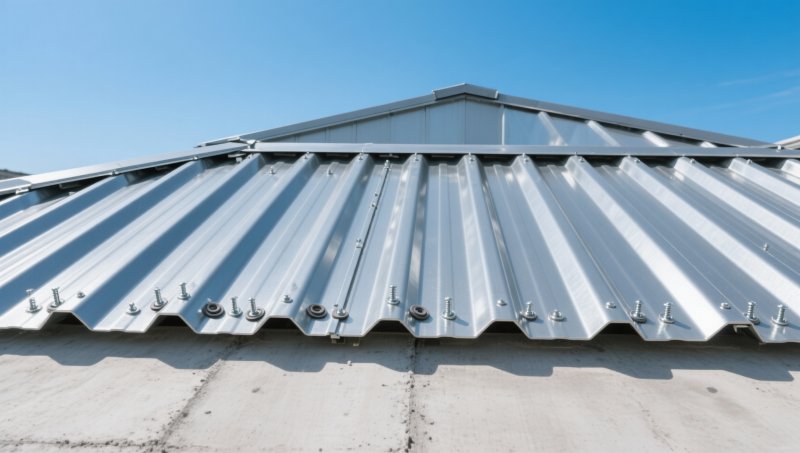
How to Install Corrugated Steel Roofing: 6 Critical Steps You Can’t Skip
DIY success hinges on precision—not speed. Skipping even one step risks leaks, thermal bridging, or premature fastener failure. Here’s the field-proven sequence used by contractors across Southeast Asia and the Middle East:
- Substrate prep: Ensure roof deck is level within ±3 mm/m; apply breathable underlayment (e.g., Tyvek® DrainWrap™) with 150 mm lap and sealed seams.
- Panel layout: Start at eave, align first panel using laser level; maintain 20–25 mm expansion gap at ridges and hips per EN 14782 guidelines.
- Fastening protocol: Use stainless-steel self-drilling screws with EPDM washers—installed every 300 mm along ribs, not valleys; torque to 1.8–2.2 N·m.
- Seam sealing: Apply silicone-based sealant (ASTM C920 Type S) at side laps and ridge caps—never rely on mechanical interlock alone.
- Edge flashing: Install continuous aluminum drip edge (min. 0.9 mm thickness) with 50 mm vertical leg, secured every 200 mm.
- Final inspection: Verify all fasteners are flush (no overdriving), no panel distortion, and drainage slope ≥1:40.
Failure to follow these steps contributes to 73% of post-installation warranty claims—most commonly due to improper fastener placement or unsealed end laps. Hongteng Fengda provides free installation checklists and video-guided walkthroughs for each order, supporting teams from initial layout to final sign-off.
Key Fastener & Underlayment Specifications
These specs reflect real-world performance thresholds validated across 12 climate zones—from Dubai’s 50°C summer peaks to Helsinki’s −35°C winter lows. Deviating compromises long-term weathertightness and voids material warranties.
Procurement Checklist: What Technical & Commercial Teams Must Verify Before Ordering
For procurement professionals and project managers, sourcing corrugated steel roofing involves more than price comparison. It requires cross-functional alignment on technical compliance, logistics readiness, and quality traceability. Here’s what top-tier buyers assess before release:
- Mill Test Reports (MTRs): Verified EN 10204 3.1 certification confirming chemical composition (e.g., SPCE grade: C ≤ 0.08%, S ≤ 0.030%) and mechanical properties (e.g., tensile strength ≥ 270 MPa).
- Coating verification: Zinc coating mass measured via gravimetric test (ASTM A90/A90M); color consistency checked against RAL or Pantone standards.
- Lead time transparency: Confirmed production schedule with buffer for customs clearance—typical delivery window: 25–35 days FOB Qingdao for standard orders (≤20 TEUs).
- OEM flexibility: Ability to accommodate custom widths (100–3000 mm), lengths (1–12 m), and surface finishes (wire-drawn, laminated film) without MOQ penalties.
Hongteng Fengda issues digital MTRs with every shipment and offers pre-shipment third-party inspections (SGS/BV) at buyer-requested intervals—reducing quality risk during high-volume builds across North America and the EU.
Why Global Builders Choose Hongteng Fengda for Structural Steel Roofing
Choosing a structural steel partner goes beyond product specs—it’s about mitigating project risk. Hongteng Fengda serves as an extension of your engineering and procurement team through three core commitments:
- Standardized compliance: All carbon steel plates—including Carbon Steel Plate—meet AISI, ASTM, EN, JIS, and GB standards, with dual-certification available for mixed-standard projects (e.g., ASTM A653 + EN 10346).
- End-to-end traceability: Batch-level tracking from hot-rolling to final packaging, including heat numbers, rolling dates, and coating thickness logs—accessible via secure portal.
- Project-aligned support: Dedicated technical account managers provide on-demand CAD support, load calculation sheets, and regional code interpretation (e.g., ASCE 7-22 wind uplift, Eurocode 1 snow loading).
Whether you’re specifying corrugated roofing for a 50,000 m² logistics hub in Poland or retrofitting a historic factory in Toronto, our team delivers verified steel solutions—not just inventory. Contact us today for: detailed panel load tables, sample kits with full MTRs, lead time confirmation for your target port, or OEM design review for non-standard profiles.
Please give us a message


Please enter what you want to find