Thinking about installing steel roofing over existing shingles? This guide explores the practicality, steel roofing how to install best practices, steel roofing benefits like durability and energy efficiency, and key steel roofing cost considerations. As a trusted steel roofing manufacturer and supplier, Hongteng Fengda provides premium galvanized steel roofing, corrugated steel roofing, lightweight steel roofing, and insulated steel roofing — all compliant with ASTM, EN, and GB standards. Whether you're a project manager, procurement specialist, or contractor evaluating code compliance and long-term value, this analysis balances technical feasibility with real-world installation constraints.
Can You Install Steel Roofing Over Shingles — Legally and Structurally?
Yes — but only under strict conditions. Overlaying steel roofing on existing asphalt shingles is permitted in many U.S. jurisdictions (e.g., IRC Section R908.3) and EU national building codes — provided structural load capacity, roof deck integrity, ventilation, and fire rating requirements are verified first. The maximum allowable overlay thickness is typically limited to one layer of shingles (≤ 3/8" total), and local authorities often require stamped engineering calculations confirming dead load increase remains within 15% of original design limits.
Structural engineers routinely assess rafter spacing (commonly 16" or 24" o.c.), species-grade lumber strength (e.g., SPF #2), and deflection thresholds (L/240 max under live + dead load). For projects where existing framing shows signs of rot, rusted fasteners, or sagging (>1/4" per 10 ft), full tear-off becomes mandatory — not optional. Skipping this step risks voiding warranties and triggering insurance exclusions for moisture-related failures.
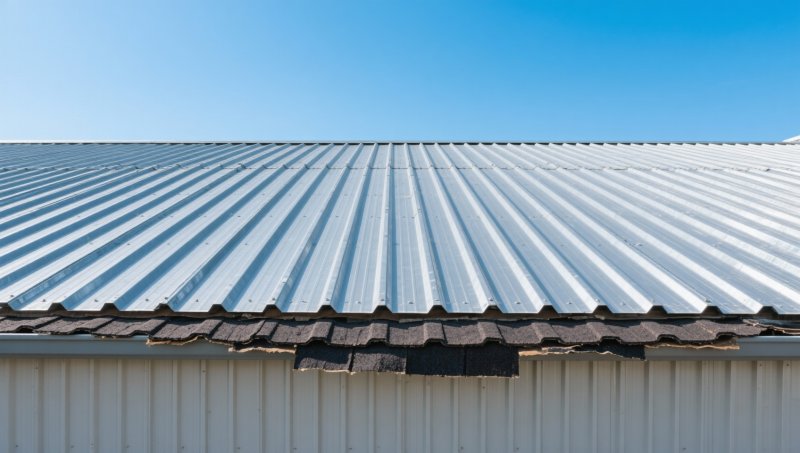
Critical Code Compliance Checklist
- Verify local AHJ accepts IRC R908.3 or EN 1991-1-1 Annex A for composite loading
- Confirm roof deck sheathing meets minimum ½" CDX plywood or OSB Grade 28/32
- Ensure attic ventilation ratio ≥ 1:150 (net free area) with balanced intake/exhaust
- Validate fire classification: Class A (ASTM E108) required for most commercial zones
Pros vs. Cons: When Does an Overlay Make Business Sense?
Overlaying steel roofing saves 3–5 days of labor versus full removal — but only if substrate conditions align. Key advantages include reduced disposal fees ($200–$600 per dumpster), lower site disruption, and faster weather-tightness. However, hidden risks persist: trapped moisture between layers accelerates corrosion, uneven shingle wear causes visible waviness, and thermal bridging reduces effective R-value by up to 25% without integrated insulation.
The decision hinges on lifecycle cost modeling: while overlay cuts upfront spend by $1.80–$3.20/sq.ft., it may shorten roof service life by 8–12 years due to concealed deterioration. For commercial clients prioritizing ROI over speed, full replacement delivers superior TCO across 20+ year horizons.
Support Structure Requirements: Why Purlin Selection Matters
Steel roofing systems rely heavily on secondary framing — especially when installed over shingles. Uneven substrates amplify point loads, making purlin spacing and section modulus critical. Standard 24" o.c. spacing works only with reinforced supports; for overlays, engineers often specify closer intervals (16" o.c.) or upgraded sections like Metal C Beam — particularly where wind uplift exceeds 110 mph or snow loads exceed 40 psf.
Metal C Beam offers high torsional rigidity and consistent dimensional tolerance (±1%), essential for maintaining panel alignment across variable substrate heights. Its cold-rolled Q235/Q345 base material supports galvanized coating (Z275 g/m² min) and powder-coated finishes — both critical for corrosion resistance beneath condensation-prone assemblies.
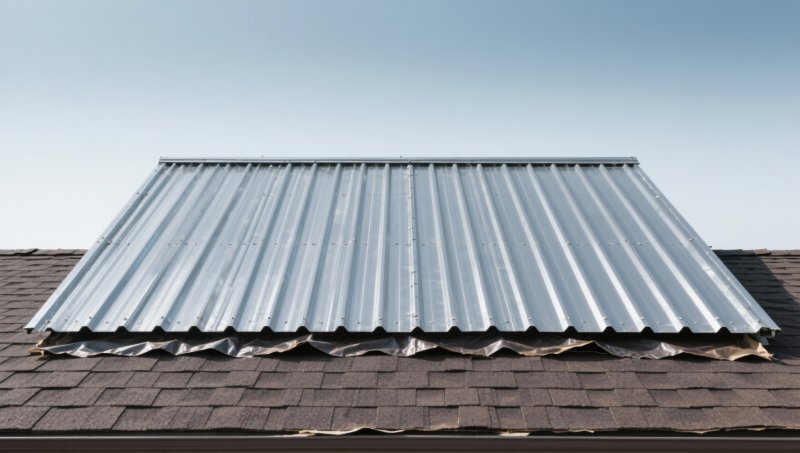
C Beam Performance Metrics for Roof Support Applications
Why Global Buyers Choose Hongteng Fengda for Structural Steel Integration
When specifying steel roofing support components, procurement teams prioritize consistency across batches, certification transparency, and responsive engineering collaboration. Hongteng Fengda delivers ISO 9001-certified production with full mill test reports (MTRs) traceable to ASTM A36, EN S235JR, and GB/T 700 standards — enabling seamless integration into international project specifications.
Our cold-formed Metal C Beam is manufactured using automated roll-forming lines with real-time dimensional monitoring — ensuring ±1% tolerance across lengths up to 12 m. With stock availability in 6 m, 9 m, and 12 m standard lengths — plus custom cutting, punching, and bending services — we reduce lead times to 12–18 days for FOB China shipments. For buyers managing multi-site construction schedules, this reliability translates directly into on-site labor optimization and penalty avoidance.
Contact our technical sales team today to request: (1) Load-span tables for your specific purlin spacing and wind zone, (2) ASTM/EN-compliant MTR samples, (3) Customized packaging plans for containerized logistics, or (4) Joint engineering review sessions with your structural designer.
Please give us a message


Please enter what you want to find