Hot dip galvanized coil is widely trusted for its corrosion resistance and durability in structural steel applications—but even high-quality coils can exhibit subtle defects that compromise performance, safety, and project timelines. From uneven zinc coating and bare spots to flaking, rough surfaces, or inconsistent thickness, common quality issues with hot dip galvanized coil often go unnoticed until installation or service life begins. Whether you're a procurement specialist vetting suppliers, a site engineer inspecting incoming materials, or a quality control manager enforcing ASTM A653/EN 10346 standards, early detection is critical. In this guide, we break down key visual and technical red flags—and how Hongteng Fengda’s rigorous in-house QC ensures every coil meets global structural steel requirements.
Visual Defects That Signal Underperformance
The first line of defense against compromised structural integrity lies in visual inspection—conducted before uncoiling, cutting, or welding. Even minor surface anomalies can indicate process deviations during galvanizing, such as insufficient acid cleaning, inadequate flux application, or improper immersion time. At Hongteng Fengda, all hot dip galvanized coils undergo 100% surface scanning under calibrated LED lighting, with defect thresholds defined per EN 10346 Class Z275 (minimum 275 g/m² zinc mass) and ASTM A653 Grade G90 (0.90 oz/ft²).
Bare spots—exposed base steel areas larger than 0.5 mm²—are unacceptable in structural applications. Flaking or peeling, especially at coil edges, suggests poor intermetallic layer formation due to excessive bath temperature (>465°C) or prolonged dwell time (>3 minutes). Roughness exceeding Ra 8.0 µm indicates inadequate post-galvanizing passivation or mechanical damage during handling.
A consistent matte-gray appearance signals uniform zinc-iron alloy growth. Glossy, spangled, or mottled zones often reflect localized cooling rate variations or zinc bath contamination (e.g., iron content >0.03%). These irregularities reduce long-term adhesion strength by up to 40% under cyclic thermal stress.
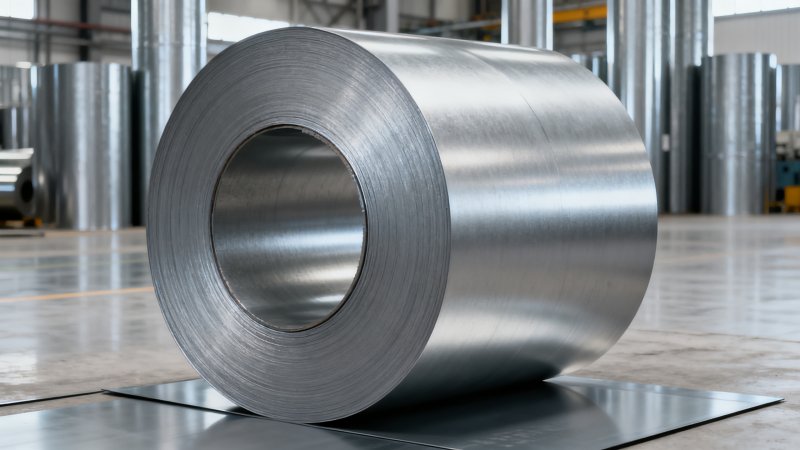
This table highlights why visual checks must be paired with quantitative verification. For example, a coil passing visual inspection may still fail thickness mapping—especially near the inner diameter where cooling rates differ by up to 22% compared to outer wraps. Hongteng Fengda applies electromagnetic thickness gauges at 3 radial positions per wrap, ensuring compliance across the full 1,200–1,800 mm coil width.
Technical Red Flags: Beyond Surface Appearance
Beyond optics, functional performance hinges on metallurgical consistency. Zinc coating adhesion is quantified via the bend test (ASTM A90/A90M): samples bent 180° around a mandrel equal to substrate thickness must show zero flaking or cracking. Failure here correlates strongly with brittle ζ-phase dominance—a sign of over-galvanizing or low aluminum content (<0.015%) in the bath.
Another critical metric is coating hardness, measured in HV0.2. Optimal range is 140–175 HV—values below 130 HV suggest excessive eta-phase (pure zinc), increasing abrasion loss during fabrication; values above 185 HV indicate overgrown zeta-phase, raising risk of microcracking during cold forming. Hongteng Fengda maintains bath chemistry within ±0.005% Al and controls immersion speed to 1.2–1.8 m/min—key parameters verified daily via ICP-OES analysis.
For structural steel used in seismic zones or heavy-load bridges, hydrogen embrittlement testing (per ASTM F519) is mandatory. Residual hydrogen ingress during pickling—especially in high-strength steels (≥550 MPa UTS)—can cause delayed fracture. Our pre-galvanizing bake-out cycle (200°C × 4 hours) reduces hydrogen content to <1.5 ppm, validated by thermal desorption spectroscopy.
How Hongteng Fengda’s QC Protocol Prevents Common Failures
At our ISO 9001-certified facility in Hebei Province, galvanized coil quality is governed by a 7-stage gate system. Each coil passes through raw material traceability (GB/T 20066), bath chemistry logging (every 90 minutes), real-time thickness monitoring (XRF + magnetic induction), mechanical property validation (tensile/yield tests on 1 sample per 25 tons), and final packaging audit (edge protection, moisture barrier, and humidity-controlled storage).
Unlike batch-based competitors, we implement continuous inline measurement—capturing 48 data points per meter of coil. This enables immediate feedback to furnace operators, reducing thickness deviation to ±6.2% (vs. industry average ±14.5%). Our rejection rate stands at 0.28%, well below the 1.7% global benchmark for structural-grade galvanized coil.
We also support third-party verification: SGS, Bureau Veritas, and TÜV Rheinland reports are available upon request. For projects requiring extended warranties (e.g., 25-year coastal infrastructure), we provide certified zinc mass certificates traceable to NIST standards.
This structured approach ensures repeatability across 30,000+ tons/year capacity. It also supports OEM clients needing custom tolerances—for instance, tighter thickness bands (±5% instead of ±12%) for precision-formed purlins or truss components.
Strategic Procurement: What Buyers Should Verify
Procurement teams should require documented evidence—not just declarations—of compliance. Key deliverables include: (1) Mill test reports with heat number traceability, (2) Galvanizing process parameter logs (temperature, dwell time, withdrawal speed), (3) Third-party thickness mapping reports covering inner/middle/outer wraps, and (4) Bend test videos or photo documentation.
Also verify supplier capability for traceability: Hongteng Fengda assigns unique QR codes to each coil, linking to real-time production data, inspection records, and logistics status. This reduces dispute resolution time from days to under 90 minutes.
For multi-site projects, consider ordering 306 Stainless Square steel rod alongside galvanized coil—its 201 stainless composition offers complementary corrosion resistance in high-wear joints or fastener assemblies, especially where galvanized coatings face mechanical abrasion.
Conclusion: Quality Is Measured in Project Outcomes, Not Just Specifications
Detecting galvanizing defects isn’t about spotting flaws—it’s about preventing cost overruns, rework delays, and safety liabilities. A single undetected bare spot on a 12-meter beam can trigger $1,800+ in field touch-up labor and 3–5 days schedule slippage. With Hongteng Fengda, you gain not just compliant material, but engineered predictability: stable lead times (18–22 days standard), consistent mechanical properties (yield strength tolerance ±15 MPa), and responsive technical support for on-site verification.
Whether sourcing for a wind turbine tower in Texas, a metro station in Riyadh, or a factory expansion in Ho Chi Minh City—we ensure your structural steel performs as designed, from mill to milestone. Contact our engineering team today to request a free coil quality assessment report or discuss customized galvanizing solutions aligned with your project’s ASTM/EN/JIS/GB requirements.
Please give us a message


Please enter what you want to find