Choosing ASTM stainless steel for chemical processing is not just about corrosion resistance. Many after-sales maintenance teams face early failures because of wrong grade selection, poor welding practices, or ignoring actual media conditions.
Understanding these common mistakes can reduce downtime, extend service life, and improve safety. It also helps evaluate ASTM stainless steel for chemical processing with more practical and cost-effective criteria.
Why does ASTM stainless steel fail in chemical processing even when it looks corrosion resistant?
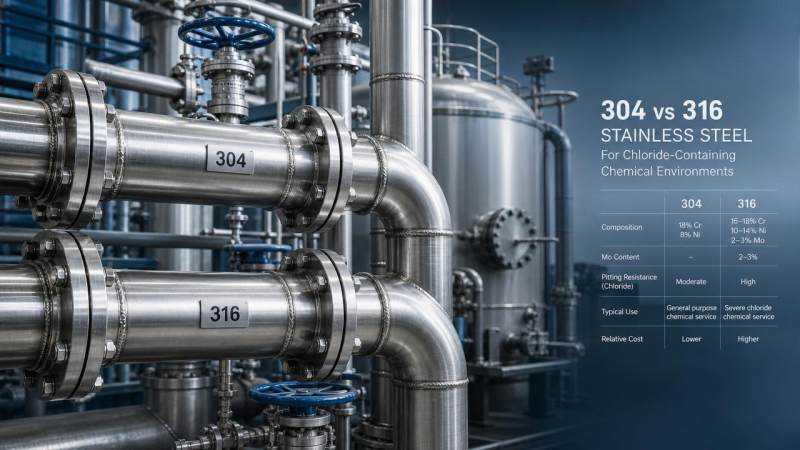
A frequent mistake is assuming all stainless steels behave the same in aggressive media. In reality, chemical plants expose steel to chlorides, acids, alkalis, solvents, and fluctuating temperatures.
ASTM stainless steel for chemical processing must be selected by exact service conditions. A grade that performs well in water systems may fail quickly in hot chloride solutions.
Another error is focusing only on base metal corrosion charts. Actual service includes crevices, deposits, stagnant zones, stress concentration, and cleaning chemicals.
These factors often trigger pitting, crevice corrosion, or stress corrosion cracking. Failures then appear suddenly, even when the material met ASTM requirements on paper.
Common misunderstanding
- “Stainless” means immune to all chemicals.
- ASTM compliance alone guarantees field durability.
- Room-temperature compatibility data always applies at operating temperature.
- Smooth startup conditions represent long-term service exposure.
Which grade selection mistakes are most common with ASTM stainless steel for chemical processing?
Grade selection errors are the main cause of premature failure. Many projects choose 304 because it is widely available and economical.
However, 304 may be unsuitable for chloride-bearing media, acidic wash systems, or wet process environments with concentration cycling. In those conditions, 316 or higher alloys may be necessary.
A second mistake is selecting by nominal alloy family only. ASTM stainless steel for chemical processing should be reviewed by composition, PREN tendency, fabrication route, and product form.
Plate, pipe, bar, and welded assemblies can behave differently. Surface finish, heat tint, and weld quality strongly affect corrosion resistance in real plants.
Typical grade selection errors
- Using 304 in chloride-rich cleaning systems.
- Using 316 without checking temperature and chloride concentration.
- Ignoring duplex or higher alloy options where cracking risk is high.
- Assuming stainless is always better than coated carbon steel for every auxiliary part.
For some support structures, cable brackets, or non-media-contact components, a protected carbon steel product can be more practical than stainless.
For example, Galvanized Round Steel can serve in external structural or utility applications requiring anti-corrosion protection and tight dimensional control.
How do welding and fabrication mistakes reduce service life?
Welding mistakes are often underestimated. Even correct ASTM stainless steel for chemical processing can fail early if the fabrication process damages the protective passive layer.
One common issue is excessive heat input. This can increase sensitization risk, distort microstructure, and reduce corrosion resistance near the weld zone.
Another issue is skipping post-weld cleaning. Heat tint left on the surface becomes a weak point where localized attack starts much earlier.
Contamination from carbon steel tools is also serious. Embedded iron particles may rust and create misleading signs of “stainless failure.”
Fabrication controls that matter
- Use suitable filler metals for the target media.
- Control heat input and interpass temperature.
- Remove heat tint by pickling or proper mechanical methods.
- Separate stainless fabrication tools from carbon steel tools.
- Inspect welds for crevices, undercut, and incomplete penetration.
Poor joint design is another hidden problem. Narrow gaps and stagnant corners trap chemicals, making even a premium grade vulnerable to crevice attack.
What operating conditions are often ignored when evaluating ASTM stainless steel for chemical processing?
Media concentration is often checked, but operating variation is ignored. During shutdown, evaporation or drying can increase local concentration far above design values.
Temperature is another critical factor. A stainless grade acceptable at ambient conditions may become unsafe when exposed to hot process streams or steam cleaning cycles.
Flow pattern matters too. High velocity can damage passive films, while stagnant areas can promote deposits and differential aeration cells.
Many teams also forget mixed-chemical exposure. Cleaning agents, residual product, moisture, and air can combine into a far more aggressive environment.
Conditions that must be reviewed
- Normal and upset temperatures
- Chloride, sulfur, and acid concentration changes
- Shutdown, idle, and cleaning cycles
- Crevices under gaskets, clamps, or deposits
- External atmosphere near marine or coastal sites
This is especially important in steel-related facilities where process equipment sits beside structural members, pipe supports, and access systems exposed to splashing chemicals.
How can buyers compare stainless steel, coated steel, and other options without making cost mistakes?
A common purchasing mistake is comparing only initial price per ton. That approach ignores maintenance frequency, inspection access, replacement shutdowns, and fabrication complexity.
ASTM stainless steel for chemical processing may cost more upfront, but lifecycle value can be better in wet, hot, or corrosive service.
At the same time, using stainless for every part is not always economical. Dry-area frames, secondary supports, and outdoor structures may use protected carbon steel effectively.
That is where clear scope separation helps. Media-contact parts, splash zones, and hygienic surfaces need one logic. Structural and external parts may need another.
For projects involving structural steel supply, integrated planning is valuable. Hongteng Fengda provides structural steel products and customized solutions aligned with ASTM, EN, JIS, and GB requirements.
What checklist helps avoid ASTM stainless steel for chemical processing mistakes before ordering?
A practical checklist reduces guesswork. It also improves communication between design, fabrication, installation, and maintenance teams.
Pre-order and pre-fabrication checklist
If external components need durable corrosion protection, a product such as Galvanized Round Steel may support towers, poles, frames, or ancillary facilities efficiently.
How should ASTM stainless steel for chemical processing be reviewed after installation?
Post-installation review is often skipped until leakage appears. That is too late for low-cost correction.
Early inspections should focus on weld discoloration, deposits, gasketed joints, dead legs, and splash-prone zones. These areas often reveal the first signs of wrong material choice.
Cleaning procedures also need validation. Some maintenance chemicals are harsher than the process fluid itself, especially when concentration or soaking time is uncontrolled.
Good records support future upgrades. Track media changes, failures, weld repairs, and seasonal effects. That data improves later decisions on ASTM stainless steel for chemical processing.
Conclusion: what is the safest way to avoid costly stainless mistakes?
The biggest mistake is treating stainless selection as a simple catalog choice. Successful ASTM stainless steel for chemical processing depends on media, temperature, fabrication, design detail, and lifecycle planning.
Review the full operating environment, not just the alloy label. Confirm weld practice, identify crevice risks, and separate process-contact components from structural steel applications.
For projects requiring dependable steel supply, customized fabrication, and internationally compliant structural products, Hongteng Fengda can support efficient material planning and reduce sourcing risk.
Use the checklist above before ordering or replacing parts. That simple step can prevent failure, protect uptime, and improve long-term value in demanding chemical environments.
Please give us a message


Please enter what you want to find