You can sometimes enlarge pre-drilled holes in angle iron and still retain enough strength for the job, but you cannot remove steel without changing the section. The practical question is whether the remaining steel and the modified connection can still carry the required load. A small clearance adjustment in a lightly loaded bracket is a different decision from widening holes in a structural brace, lifting attachment, or equipment support.
If you are working with angle iron with pre drilled holes, check the intended bolt size, the steel left around each hole, and the direction of the load before choosing a drill bit. A larger bolt does not automatically make the connection stronger: the bolt may gain capacity while the surrounding angle becomes more vulnerable to tearing or deformation.
First establish why the bolt will not fit
Before removing metal, separate a diameter problem from an alignment problem. Paint, galvanizing buildup, burrs, or a damaged bolt thread can prevent assembly even when the underlying hole is correctly sized. Clean and inspect the opening, then measure it rather than judging by whether a bolt can be forced through.
If the bolt fits through each component separately but will not pass through the assembled joint, the holes are probably misaligned. Check whether the parts are square, whether the angle has twisted, and whether earlier bolts were tightened before the remaining bolts were inserted. Where the assembly instructions allow it, loosening and repositioning the parts may resolve the problem.
Enlarging holes to compensate for incorrect alignment can create excessive clearance or an unintended slot. The joint may then move before the bolt bears against the steel. If the angle carries vibration, reversing loads, or machinery alignment, that movement can matter even when the connection does not immediately fail.
Also establish the specified hole diameter. Bolt holes usually need assembly clearance, but the permitted clearance depends on the connection design. Do not assume that the next available drill size is acceptable simply because it makes installation easier.
What actually changes when a hole gets larger?
Enlarging a hole removes material from the angle and changes how forces pass through the connection. Several possible failure modes deserve attention.
Reduced net section: A hole interrupts the steel carrying tension across the member. A larger opening leaves less metal along that section. With several holes, their arrangement matters because a possible fracture path can pass through more than one opening.
Tear-out toward an edge: When a bolt pushes against the hole wall, the steel between the hole and a nearby end or edge must resist that force. Enlarging the opening reduces this remaining ligament. A neat, round hole can still be unsuitable if it leaves too little steel in the direction of loading.
Bearing deformation: The bolt transfers force into the hole wall in a bearing connection. Depending on thickness, material, and loading, the wall can deform and the hole can become elongated. Changing the bolt diameter and clearance changes this contact condition; connection capacity cannot be judged from bolt strength alone.
Block shear: A group of holes near the end of an angle can create a path along which a block of steel separates. This involves the combined arrangement of holes and edges, so checking each hole individually is insufficient.
Repeated loading adds another concern. Rough edges, deep scratches, and cracks around a modified hole can become locations where fatigue cracks start. Deburring improves the finish, but it does not restore the steel removed or establish that the new geometry is acceptable.
Check the metal that will remain, not just the current hole
Record the leg widths, angle thickness, existing hole diameter, proposed final diameter, hole spacing, and distances to nearby edges. Inspect both legs for corrosion, distortion, and previous modifications. Significant section loss or cracking is a reason to stop treating the work as a simple drilling adjustment.
Edge distance and clear edge distance are different measurements. Edge distance commonly refers to the distance from the hole center to the steel edge. The clear distance is the metal between the hole boundary and that edge. If a hole is enlarged concentrically, its center stays in place while the clear distance decreases.
The same distinction applies between neighboring holes. Their center-to-center spacing may remain unchanged, yet the bridge of steel between them becomes narrower. Measure the proposed opening against adjacent holes, including unused holes that still interrupt the material.
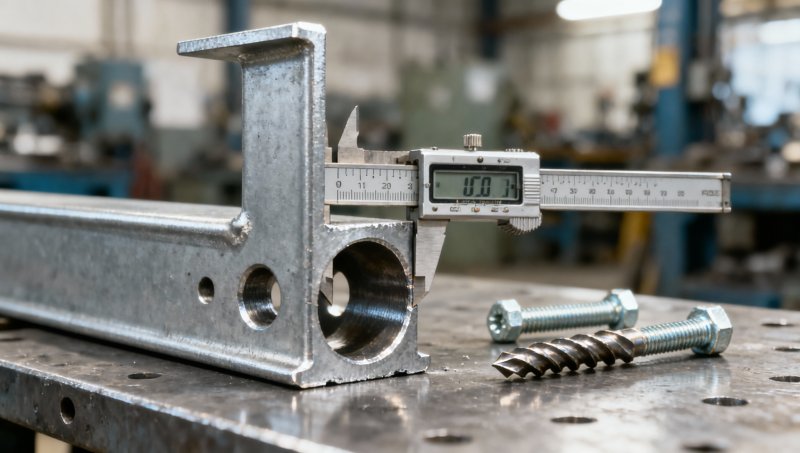
A useful inspection sketch shows the original and proposed hole outlines, the nearest free edge, adjacent holes, and the load direction. This makes it easier to see which strip of steel is being reduced.
There is no universal rule that an increase below a particular amount is safe for every angle. Acceptable dimensions depend on the bolt, hole category, steel properties, connection arrangement, and applicable design requirements. For a structural connection, assess the proposed final dimensions against the connection drawing and design requirements.
Pay attention to the inside corner, or heel, of the angle as well. A hole close to this area can complicate drilling and prevent a bolt head or washer from seating flat. The rounded inside corner is not the same as a free edge, but its geometry still affects access and assembly.
When enlargement is reasonable—and when to stop
A modest enlargement may be workable in a lightly loaded, noncritical bracket where the final hole dimensions are acceptable, ample material remains, and the fastener seats correctly. For example, adapting a decorative frame connection presents different consequences from modifying an angle supporting overhead equipment. Appearance alone does not establish which category applies.
Obtain engineering approval before changing holes in structural bracing, building connections, lifting points, overhead supports, or other joints whose failure could cause injury or major damage. The review should cover the final hole size, bolt specification, remaining section, and connection behavior. A successful trial assembly establishes fit, not load capacity.
Stop and consider replacement or redesign if:
- The proposed opening approaches a free edge or neighboring hole closely enough to leave a narrow strip of steel.
- The existing hole is cracked, visibly stretched, or surrounded by substantial corrosion.
- The modification would create a slot or merge two holes.
- The bolt head, nut, or washer cannot seat fully on a flat surface.
- The joint relies on controlled slip resistance, repeated load performance, or precise positioning.
Commercial perforated angle and structural angle with specified drilled holes also need different treatment. A perforated section may be supplied with a load rating for its original configuration. Changing the perforations can take the part outside that rating, even if the altered bracket still feels rigid by hand.
How to enlarge an acceptable hole cleanly
Once the final diameter and connection suitability are established, the machining goal is a round, correctly positioned hole with minimal damage to the surrounding steel. Remove the angle from service or fully unload and secure the assembly before starting. Do not drill a connection while it is carrying the load you are trying to preserve.
- Mark the final geometry. Identify the required center and diameter. If the new center differs from the old one, this is a hole relocation problem; simply running a larger drill through the opening may produce an irregular shape.
- Clamp and support the angle. Secure it in a vise or suitable fixture, supporting the leg being drilled so it cannot rock or flex. Never hold a short piece of angle by hand: a catching drill can spin it suddenly.
- Choose a tool suited to the thickness and enlargement. A machine reamer is often useful for a small, accurate increase in an existing hole when the correct allowance and equipment are available. A step drill can suit thinner steel within its rated capacity. Thicker sections generally need an appropriate twist drill, reamer, or machining setup.
- Control the cut. Use a sharp tool, suitable cutting fluid, and the speed and feed recommended for the material and cutter. A larger twist drill can grab as it engages an existing opening, so rigid fixturing and controlled feeding matter. Avoid forcing a rubbing or chattering tool.
- Deburr both faces. Remove sharp edges and loose burrs without grinding away a broad area around the hole. Excessive countersinking or chamfering removes additional material and can affect fastener seating.
- Measure and inspect. Check diameter, roundness, position, and the remaining clear distances. Look for cracks, gouges, or distortion, then check that the specified bolt and washers seat properly.
A drill press or suitable machine generally provides better alignment and control than a handheld drill. Where portable drilling is necessary, the work still needs secure support and a controlled tool position. Wear eye protection, restrain loose clothing and hair, and keep gloves away from rotating tooling. Remove swarf after the tool has stopped, using a brush rather than bare fingers.
For galvanized or painted angle, machining exposes fresh steel. Restore corrosion protection with a repair system suitable for the original coating and service environment. Keep coatings and lubricants off surfaces that must meet specified friction or assembly conditions.
Will a larger washer or stronger bolt compensate?
A larger washer can improve seating and spread clamping pressure over a wider surface, provided it fits flat and meets the connection requirements. It does not replace the missing steel between a hole and an edge. A washer covering an oversized opening can make the assembly look satisfactory while tear-out or net-section weakness remains.
A stronger or larger bolt has a similar limitation. It may address a bolt capacity problem, but it cannot automatically address weakness in the angle. Changing fasteners can also affect the mating component, required tightening procedure, and permitted hole dimensions.
Do not weld around the hole or add a reinforcing plate as an improvised strength repair. Welding changes the connection and can introduce distortion and local material effects. A reinforcement plate needs a designed load path and suitable attachment; placing extra steel nearby does not ensure that it shares the load.
When a different part is the better fix
If enlargement would leave insufficient material, replacing the angle with a correctly detailed component is often more practical than trying to rescue the existing hole pattern. A wider leg, greater thickness, revised bolt layout, or suitable adapter plate may solve the underlying fit problem, but each changes the connection and needs appropriate assessment.
For repeated fabrication, specify the required holes before production. Give the manufacturer the angle size and grade, hole diameters, center locations, orientation, tolerances, coating requirements, and mating-part details. Hongteng Fengda supplies angle steel and customized structural steel components, making a correctly specified replacement or production hole pattern a relevant option when standard perforated stock does not fit the assembly.
Before picking up the drill, answer three questions: What final hole geometry does the connection require? How much usable steel will remain around it? Who has established that the modified joint can carry its intended load? With those answers, enlargement becomes a controlled fabrication operation. Without them, getting the bolt through only solves the fit problem.
Please give us a message


Please enter what you want to find