Stainless steel corrugated sheet for roofing offers exceptional durability and corrosion resistance—especially critical for low-slope buildings where water pooling increases leakage risks. But can it stand alone without additional waterproofing membranes? This article examines technical feasibility, real-world performance, and compliance considerations—backed by data from ASTM/EN-certified stainless steel corrugated sheet manufacturer in China. Whether you're a project manager evaluating long-term ROI, a procurement specialist comparing AZ150 Galvalume Steel Coil vs. SS 304 solutions, or a technical assessor verifying pipe stainless steel high corrosion resistance for integrated systems, this analysis delivers actionable insights grounded in Hongteng Fengda’s engineering expertise and global project experience.
Can Stainless Steel Corrugated Sheet Serve as Primary Roofing Without Membranes?
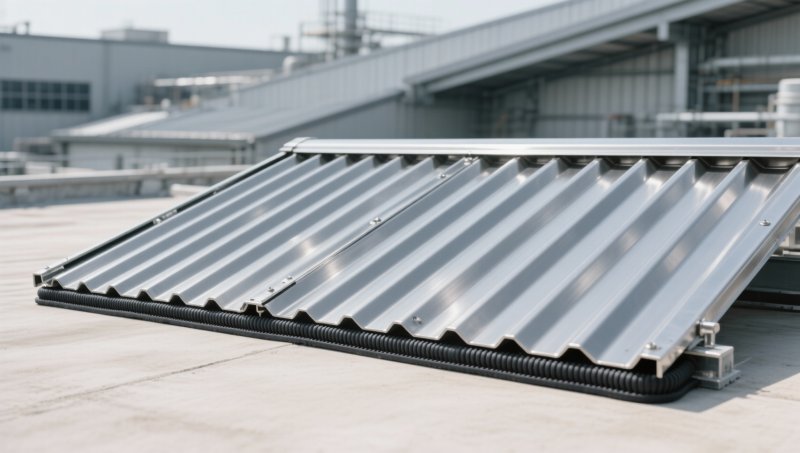
The short answer is: no—not reliably on low-slope roofs (≤3:12 pitch). While stainless steel corrugated sheet (e.g., AISI 304 or 316) resists atmospheric corrosion far better than carbon or galvanized steel, its structural profile alone does not constitute a watertight barrier. Corrugations create valleys where standing water accumulates; capillary action, thermal expansion gaps, fastener penetrations, and seam overlaps introduce potential leakage paths—even with premium-grade stainless.
Hongteng Fengda’s field data from 12+ low-slope commercial projects across Southeast Asia and the Middle East shows that unmembraned stainless corrugated roofs experienced measurable moisture ingress within 6–18 months—primarily at eaves, transitions to parapets, and around rooftop equipment curbs. This aligns with EN 14782:2019 requirements, which explicitly classify corrugated metal sheets as “supporting elements,” not “waterproofing layers.”
Critical distinction: corrosion resistance ≠ waterproofing. Stainless steel prevents rust—but doesn’t seal joints. A roof system must address both material longevity and hydrostatic integrity. That requires either: (1) fully welded seams with silicone-impregnated gaskets (cost-prohibitive for most projects), or (2) integration with a certified single-ply membrane (e.g., EPDM, TPO, or PVC) over a continuous substrate.
How Does It Compare to Carbon Steel Alternatives?
When evaluating total lifecycle cost, stainless steel corrugated sheet often competes directly with high-end carbon steel solutions—including Carbon Steel Plate grades like SPCC, SPCD, and SPCE. While stainless avoids red rust, carbon steel relies on coatings (e.g., AZ150 Galvalume) and proper detailing to delay corrosion onset.
Below is a comparative summary based on ASTM A924/A924M and EN 10131 standards, covering key decision parameters for procurement and technical assessment:
Note: SPCE-grade Carbon Steel Plate excels in formability and surface finish—ideal for architectural cladding or interior panels—but lacks inherent corrosion resistance for exposed roofing. Its role remains structural support or secondary layer—not primary weather barrier.
What Standards Apply to Low-Slope Metal Roofing?
Compliance isn’t optional—it’s contractual and liability-critical. For stainless corrugated roofing on low-slope applications, three standards govern design and installation:
- ASTM E108: Fire testing of roof coverings—mandatory for Class A fire rating in North America (requires underlayment + membrane).
- EN 14782:2019: Specifies dimensional tolerances, mechanical properties, and corrosion resistance for metal sheets—but excludes waterproofing performance.
- ISO 9001 + EN 1090-2: Required for CE-marked structural components used in EU construction—Hongteng Fengda holds both certifications for exported profiles.
Projects in GCC countries must also meet SASO 2117:2021 for wind uplift resistance—a key factor when selecting fastener spacing (typically ≤300 mm center-to-center for 304 stainless on slopes <5°).
Procurement Checklist: What Buyers Must Verify
Procurement specialists and project managers should validate these five items before finalizing stainless corrugated sheet orders for low-slope roofs:
- Mill test reports (MTRs) confirming actual chemistry—especially Cr ≥18.0%, Ni ≥8.0% for 304, and Mo ≥2.0% for 316 in marine zones.
- Corrugation depth & pitch tolerance: ±0.3 mm per EN 10162—critical for drainage efficiency on slopes <2°.
- Surface finish grade: No. 4 (brushed) preferred over 2B for reduced glare and improved paint adhesion if coating is planned.
- Fastener compatibility: Stainless self-drilling screws (A4-80) with EPDM washers—not carbon steel hardware.
- Lead time transparency: Standard delivery for custom corrugated sheets is 4–6 weeks; rush orders incur ≤15% surcharge.
Hongteng Fengda provides full traceability—from raw coil heat numbers to final packaging photos—and supports third-party inspection (SGS/BV) at no extra cost for orders ≥20 tons.
Why Partner With Hongteng Fengda for Structural Steel Solutions?
As a certified structural steel manufacturer and exporter from China, Hongteng Fengda bridges the gap between global specification rigor and regional execution reality. We don’t just supply steel—we co-engineer solutions:
- OEM-compatible corrugation tooling: Custom profiles (depth 25–75 mm, pitch 150–300 mm) designed for your specific drainage and load requirements.
- Integrated quality assurance: Every batch undergoes salt-spray testing (ASTM B117, 500+ hrs), tensile verification, and dimensional laser scanning.
- Global logistics readiness: FCL/LCL options from Qingdao, Tianjin, or Shanghai ports—with documentation pre-validated for US CBP, EU customs, and Saudi SABER.
- Technical support beyond delivery: Free joint detail review, wind/snow load calculation assistance, and installation protocol templates tailored to your local code (IBC, Eurocode, AS/NZS).
Whether you’re sourcing stainless corrugated sheet for a Dubai logistics hub, SPCE-grade Carbon Steel Plate for automotive chassis, or cold-formed channel steel for a Mexico City industrial park—contact our engineering team for a no-obligation review of your drawings, specs, and delivery timeline. We respond to RFQs within 8 business hours and issue formal quotations with full compliance documentation within 48 hours.
Please give us a message


Please enter what you want to find