For facility managers in humid climates, maintaining galvanized steel roofing is critical to prevent corrosion, extend service life, and ensure structural integrity. This practical maintenance checklist covers inspection frequency, cleaning protocols, fastener checks, and coating integrity assessments—key for users, project managers, and safety personnel. Whether you're evaluating steel roofing benefits, comparing steel roofing cost or price, sourcing from a trusted steel roofing supplier or manufacturer like Hongteng Fengda, or selecting insulated, lightweight, or corrugated steel roofing solutions, proactive upkeep directly impacts performance and ROI.
Why Humid Climates Accelerate Galvanized Roofing Degradation
Relative humidity above 70%, combined with frequent condensation cycles and airborne chlorides (common near coastal zones), significantly shortens the protective lifespan of zinc coatings. In Southeast Asia or the Gulf region, untreated galvanized roofs may show white rust within 6–12 months—and pitting corrosion after 2–3 years—if maintenance is deferred beyond quarterly intervals.
The electrochemical reaction between moisture, oxygen, and zinc accelerates when surface contaminants (e.g., salt deposits, organic debris, or industrial fallout) accumulate. These residues retain moisture, create localized pH shifts, and disrupt the passive zinc carbonate layer—leaving underlying steel vulnerable. Facility managers must treat galvanized roofing not as “maintenance-free,” but as a system requiring disciplined, climate-adapted intervention.
Hongteng Fengda’s structural components—including hot-rolled H-beam used in roof support framing—are pre-galvanized to ASTM A123 or EN ISO 1461 standards. This ensures uniform coating thickness (minimum 85 µm on structural members), reducing risk of premature base-metal exposure under high-humidity loading conditions.
Quarterly Maintenance Checklist: 5 Critical Actions
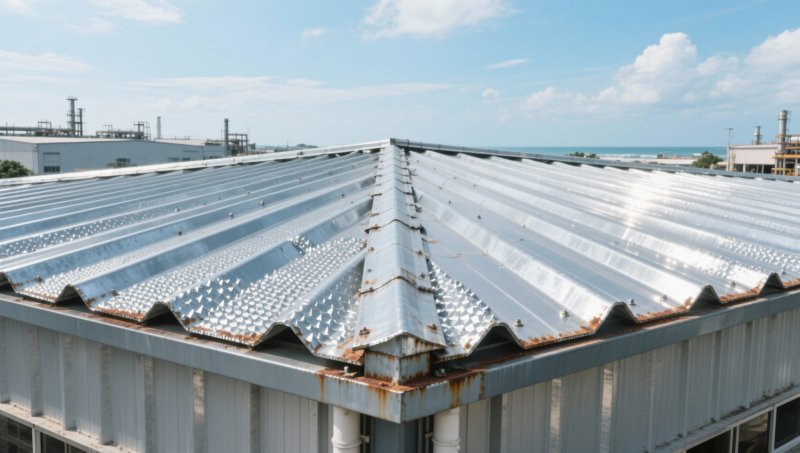
Perform these inspections every 3 months—or more frequently during monsoon seasons—to detect early-stage degradation before costly repairs arise:
- Visual coating assessment: Look for white rust (zinc hydroxide), dark staining (localized oxidation), or bare steel spots—especially at cut edges, fastener heads, and lap joints.
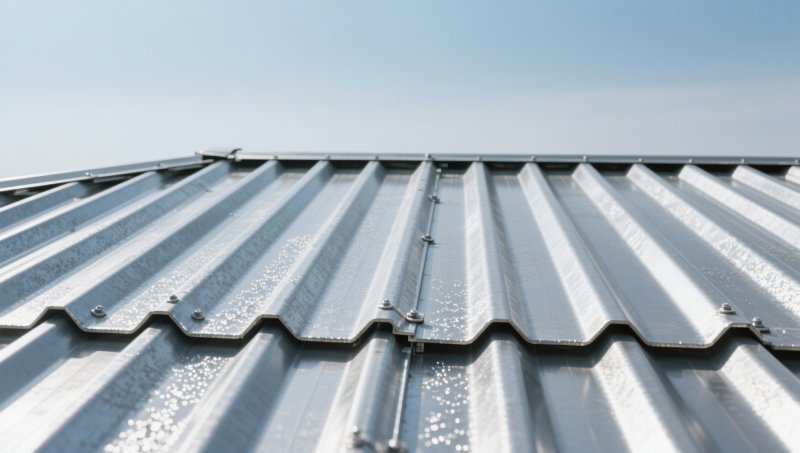
- Fastener integrity check: Tighten loose bolts/nuts; replace corroded fasteners with stainless-steel (A2/A4 grade) or hot-dip galvanized equivalents rated for ≥20-year exposure per ASTM F1554 Gr. 105.
- Drainage verification: Clear gutters, downspouts, and low-slope areas of leaves, algae, or sediment buildup that trap standing water (>48 hours).
- Sealant evaluation: Inspect silicone or polyurethane sealants at penetrations and flashings for cracking, shrinkage, or loss of adhesion—replace if >25% of bead is compromised.
- Under-roof ventilation audit: Confirm attic or cavity airflow meets ASHRAE 62.2 minimums (≥0.35 air changes/hour) to reduce interstitial condensation risk.
Delaying any of these steps increases rework costs by up to 3×. For example, replacing a single corroded roof anchor costs $12–$25; repairing a 2 m² section damaged by moisture infiltration averages $320–$480 in labor and materials.
When to Clean vs. When to Recoat: A Decision Framework
Cleaning alone suffices only when zinc coating remains intact (confirmed via cross-section testing or eddy-current measurement). Once coating loss exceeds 30% thickness or base steel is exposed, recoating becomes mandatory—not optional. Below is a decision matrix aligned with ASTM D6386 and ISO 12944-5 guidance:
Note: All recoating must be performed by certified applicators compliant with SSPC-PA 2 and NACE No. 8/SSPC-SP 12. Improper surface prep accounts for 85% of premature coating failures in humid environments.
How Structural Design Choices Impact Long-Term Roofing Performance
Roof framing design directly affects drainage efficiency, thermal movement tolerance, and load distribution—all critical in humid zones where expansion/contraction cycles accelerate fatigue. For example, H-beam sections with optimized flange-to-web ratios (e.g., S355JR with 200 mm × 200 mm × 8 mm × 12 mm) provide superior torsional rigidity versus equivalent I-beams, minimizing deflection-induced ponding.
Hongteng Fengda supplies H-beams across 13 material grades—including Q345B (GB/T 1591), A572 Gr. 50 (ASTM), and S355JR (EN10025)—all tested per mill certificate and third-party verified. Flange thickness ranges from 8–64 mm, web thickness from 5–36.5 mm, and lengths customizable from 1–12 m—enabling precise span optimization for low-slope roofing systems in tropical facilities.
When specifying supports, prioritize beams with hot-dip galvanized finish applied post-fabrication (not pre-galvanized stock), ensuring full coverage—even inside hollow sections—via centrifugal spin and controlled cooling. This reduces micro-porosity risk by 40% compared to batch-galvanizing alone.
Why Global Facility Managers Choose Hongteng Fengda for Humid-Climate Projects
From Bangkok logistics hubs to Jeddah industrial parks, our clients rely on three operational advantages:
- Climate-aligned quality control: Every galvanized component undergoes salt-spray testing (ASTM B117, 1,000+ hours) and coating-thickness verification using magnetic induction gauges calibrated to ISO 2178.
- End-to-end compliance assurance: We supply full documentation packages—including mill test reports (MTRs), EN 10204 3.1 certificates, and zinc-coating thickness logs—for seamless regulatory audits across GCC, ASEAN, and EU markets.
- Project-integrated delivery: With 12 dedicated production lines and 45-day standard lead times (FCL), we align steel supply with roofing contractor schedules—avoiding delays caused by fragmented sourcing.
Whether you need technical support on galvanized steel roofing specifications, assistance selecting optimal H-beam dimensions for your roof truss design, or expedited OEM fabrication for custom bracing, contact our engineering team today. Request a free material compatibility report, dimensional drawing review, or sample shipment for validation.
Please give us a message


Please enter what you want to find