Understanding ASTM A106 Gr.B equivalent grades is essential when comparing seamless carbon steel pipe standards for pressure and high-temperature applications. For cross-border steel sourcing, equivalent mapping now matters more than before.
Projects increasingly combine ASTM, EN, JIS, DIN, and GB specifications. That shift makes ASTM A106 Gr.B equivalent selection a practical issue, not only a technical reference.
When specifications are compared incorrectly, buyers may face substitution errors, delayed approvals, or performance gaps in service. A clear view of ASTM A106 Gr.B equivalent grades helps reduce these risks.
Why ASTM A106 Gr.B Equivalent Grades Matter More Today
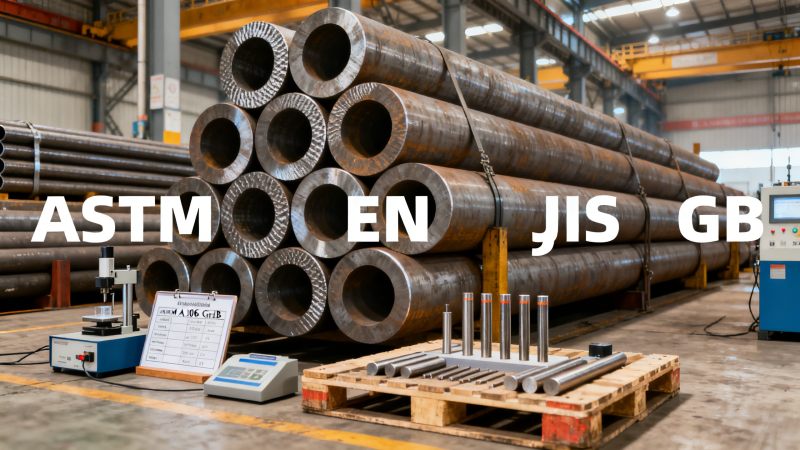
ASTM A106 Grade B is a seamless carbon steel pipe standard widely used in high-temperature and pressure service. It appears frequently in power, oil and gas, process plants, and mechanical systems.
The market is changing in two visible ways. First, more projects accept alternative standards after technical review. Second, global sourcing requires faster comparison across regional supply chains.
As a result, ASTM A106 Gr.B equivalent evaluation has become part of specification planning, cost control, and delivery management. It is no longer limited to engineering documentation alone.
The Main ASTM A106 Gr.B Equivalent Grades You Should Know
No global grade is perfectly identical in every detail. Still, several standards are commonly treated as close alternatives based on chemistry, mechanical properties, manufacturing route, and service scope.
These grades may serve as ASTM A106 Gr.B equivalent references, but acceptance depends on actual project code, temperature range, test requirements, and dimensional standard.
A53 Gr.B and SA106 Gr.B
A53 Gr.B is often compared with ASTM A106 Gr.B equivalent discussions. However, A53 is broader in service scope and includes welded pipe options. A106 focuses on seamless high-temperature service.
SA106 Gr.B is the ASME code version of A106 Gr.B. In boiler and pressure vessel projects, SA106 Gr.B is usually the closest formal code equivalent.
EN, DIN, JIS, and GB Alternatives
P235GH and P265GH are common European pressure pipe grades. STPG 370 is widely used in Japanese specifications. China often references 20# or 20G in practical sourcing conversations.
Still, an ASTM A106 Gr.B equivalent review should compare tensile strength, yield strength, heat treatment condition, and testing scope before substitution.
What Is Driving the Shift Toward Cross-Standard Comparison
Equivalent grade analysis is becoming more important because project teams now balance technical compliance with lead time and sourcing flexibility.
- Regional supply shortages push faster approval of alternative mills and standards.
- Energy and process projects increasingly combine international design and local procurement.
- Cost pressure encourages broader comparison of ASTM A106 Gr.B equivalent options.
- Digital documentation makes grade comparison easier, but also exposes specification gaps faster.
- Owners and EPC teams want lower sourcing risk without sacrificing code compliance.
This trend does not mean standards are interchangeable by default. It means market conditions are pushing more technical review before final material approval.
How ASTM A106 Gr.B Equivalent Choices Affect Real Projects
The impact of grade comparison appears across several business stages. Early specification mistakes can affect manufacturing, inspection, logistics, and installation later.
This is why ASTM A106 Gr.B equivalent decisions should be documented with clear technical justification, not only based on catalog naming or market habit.
In some projects, carbon steel systems may also sit beside stainless piping networks. For corrosion-sensitive lines, 316 Stainless steel pipe is often selected for petroleum, foodstuff, chemical industry, construction, electric power, nuclear, and energy applications.
Compared with base 304 tubing, it offers stronger corrosion resistance, high-temperature stability, and reliable mechanical properties. Common standards include ASTM A213, A312, A269, EN10216, and JIS G3459.
What to Check Before Accepting an ASTM A106 Gr.B Equivalent
Equivalent grades should be reviewed through actual data. A similar name alone is not enough for safe substitution.
- Chemical composition, especially carbon, manganese, phosphorus, sulfur, and silicon limits.
- Minimum tensile and yield strength values under the specified standard.
- Required manufacturing method, especially seamless versus welded.
- Heat treatment condition and whether normalization is required.
- Hydrostatic testing, NDT, flattening, and dimensional tolerance requirements.
- Applicable code, such as ASME, PED, or local regulatory acceptance.
For global steel sourcing, the best ASTM A106 Gr.B equivalent decision usually comes from comparing MTCs, project specifications, and end-use conditions together.
Where the Market Is Moving Next
The next phase is not simple standard replacement. The real direction is better material transparency and faster technical equivalency review.
More buyers now expect mills to provide complete documentation, cross-reference data, and stable compliance across ASTM, EN, JIS, and GB frameworks.
Reliable exporters are also expected to support mixed-demand projects, where structural steel, carbon steel pipe, and stainless solutions must align with one approval process.
For a structural steel manufacturer and exporter from China, this shift creates opportunity through quality consistency, international standard familiarity, and dependable delivery support.
Practical Next Steps for Better Material Decisions
To manage ASTM A106 Gr.B equivalent selection more effectively, focus on a few practical actions:
- Build a verified internal cross-reference list by project type.
- Check standard edition, not only grade name.
- Review seamless requirement first for high-temperature service.
- Confirm code acceptance before price comparison.
- Request full MTC and testing scope from qualified suppliers.
- Assess total sourcing risk, including lead time and approval time.
ASTM A106 Gr.B equivalent mapping is most useful when it improves compliance, reduces delays, and supports smarter sourcing choices across international steel supply chains.
If your project involves structural steel, pressure piping, or customized export supply, working with a partner familiar with ASTM, EN, JIS, and GB standards can simplify decisions and reduce uncertainty.
A careful understanding of ASTM A106 Gr.B equivalent grades is not just technical knowledge. It is a practical tool for stronger quality control, better procurement outcomes, and more reliable project execution.
Please give us a message


Please enter what you want to find