Choosing 321 stainless steel pipe for high-heat service can improve durability and performance, but common selection and handling mistakes often shorten service life.
In steel-intensive systems, small errors in grade choice, fabrication, and inspection often create cracking, scaling, distortion, or unexpected replacement costs.
A clear understanding of 321 stainless steel pipe helps reduce downtime, support safer operation, and improve long-term value in demanding thermal environments.
Basic Understanding of 321 Stainless Steel Pipe
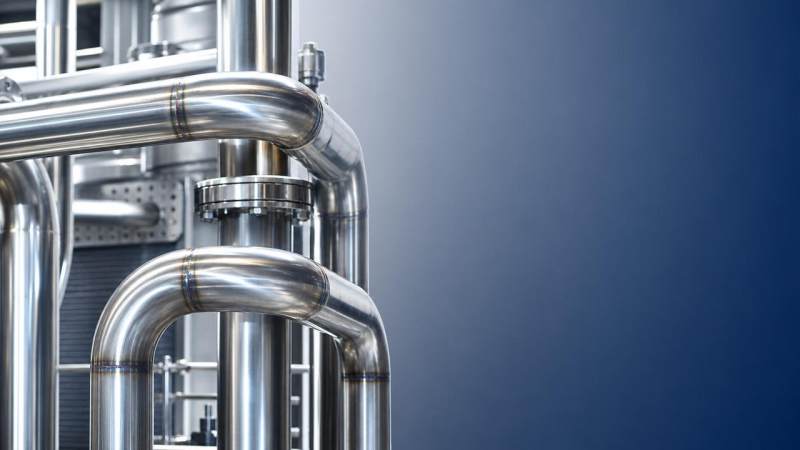
321 stainless steel pipe is an austenitic stainless steel pipe stabilized with titanium.
This stabilization helps resist chromium carbide precipitation during exposure to elevated temperatures.
Because of that feature, 321 stainless steel pipe is often selected for heat exchangers, exhaust systems, thermal process lines, and refinery equipment.
Compared with standard 304 grades, it offers better resistance to intergranular corrosion after heating in the sensitization range.
However, it is not a universal answer for every hot service condition.
Its real performance depends on temperature range, cyclic loading, media chemistry, weld quality, and support design.
Why it is used in high-heat systems
- Good oxidation resistance at elevated temperatures
- Improved structural stability after welding
- Useful strength retention in intermittent heat service
- Broad compatibility with industrial fabrication standards
Current Industry Concerns Around High-Heat Pipe Selection
Across steel and industrial processing sectors, thermal equipment is facing longer operating cycles and tighter maintenance windows.
This makes material misselection more expensive than before.
For 321 stainless steel pipe, most failures are not caused by the grade alone.
They usually result from poor matching between service conditions and actual pipe characteristics.
These pressures explain why understanding common missteps with 321 stainless steel pipe has become increasingly important.
Common Missteps with 321 Stainless Steel Pipe
1. Assuming every high temperature requires 321
One frequent mistake is choosing 321 stainless steel pipe simply because the system runs hot.
Temperature alone is not enough.
Atmosphere, sulfur content, chlorides, pressure fluctuation, and shutdown frequency also matter.
In some cases, other heat-resistant stainless grades or nickel alloys are more suitable.
2. Ignoring actual operating temperature bands
Designers sometimes specify a single maximum temperature and ignore normal operating range.
That can hide repeated exposure to sensitization zones or thermal fatigue conditions.
321 stainless steel pipe performs best when the full thermal profile is understood, not just the peak value.
3. Overlooking welding procedure quality
Welded areas are often the first locations to fail.
Poor heat input control, contamination, incorrect filler selection, or incomplete shielding can weaken the joint.
Even high-quality 321 stainless steel pipe can underperform if the weld procedure is not properly qualified.
4. Treating thermal expansion as a secondary issue
In long pipe runs, thermal expansion can create substantial movement.
If supports, anchors, guides, and loops are poorly designed, the pipe may bow, vibrate, or overload welded connections.
This is a system problem, not only a material problem.
5. Skipping surface protection during storage and installation
321 stainless steel pipe can still suffer contamination from carbon steel dust, chlorides, and site debris.
Improper storage may lead to rust staining or corrosion initiation before operation even begins.
Clean handling practices remain essential.
6. Relying only on nominal standards
A certificate alone does not confirm real suitability.
Heat treatment condition, wall thickness tolerance, weld seam quality, and traceability records deserve equal attention.
This is especially true in high-heat pipelines where deviations can multiply under stress.
Practical Value in Steel and Industrial Applications
When selected and installed correctly, 321 stainless steel pipe supports reliable operation in thermally demanding service.
Its value is not only corrosion resistance.
It also helps stabilize maintenance planning, reduce unplanned shutdowns, and improve lifecycle predictability.
In broader steel supply projects, related stainless products may also be needed for brackets, frames, supports, or custom parts.
For such auxiliary fabrication, 316L Stainless Square steel rod can be considered where corrosion resistance and shaped component production are required.
It is available under ASTM, AISI, JIS, GB, DIN, and EN related standards, with surface options like bright polished and No. 4 finishes.
Those supporting materials should still be matched carefully to the specific service environment.
Typical High-Heat Service Scenarios
The following scenarios show where 321 stainless steel pipe is commonly evaluated and where mistakes often appear.
Practical Recommendations for Better Results
Better performance from 321 stainless steel pipe usually comes from disciplined execution rather than complex theory.
- Verify the full service profile, including startup, shutdown, peak, and normal operating temperatures.
- Review the process media for chlorides, sulfur compounds, moisture, and deposits.
- Confirm product conformity beyond grade name, including dimensions, certificates, and heat traceability.
- Use qualified welding procedures suited to the pipe form and service requirement.
- Design supports and expansion control features before installation begins.
- Protect the surface from contamination during transport, storage, and fabrication.
- Plan periodic inspection at welds, bends, and high-movement zones.
Inspection points worth prioritizing
- Surface discoloration beyond expected heat tint
- Support wear or misalignment
- Distortion near welded joints
- Early signs of scaling, pitting, or cracking
Next-Step Considerations for Material Planning
321 stainless steel pipe can be an effective choice for high-heat service, but only when conditions are defined accurately and details are managed carefully.
The most common missteps come from assumptions, not from the material itself.
A practical review should cover thermal range, media chemistry, fabrication method, movement control, and inspection access.
For projects involving stainless pipe, structural steel, and custom components together, aligning standards, supply stability, and quality control early can reduce risk significantly.
If a system uses 321 stainless steel pipe in severe heat exposure, the next useful step is a line-by-line material check before procurement or replacement begins.
Please give us a message


Please enter what you want to find