Choosing among steel i beam manufacturers can directly affect product quality, delivery reliability, and long-term margins. In steel sourcing, small factory differences often create major project risks.
For structural applications, buyers need more than a price list. They need proof of stable production, consistent standards, and service that supports changing project demands.
This guide explains seven practical signs that help evaluate steel i beam manufacturers with greater confidence across construction, industrial, and export supply scenarios.
When Project Risk Is High, Reliable Steel I Beam Manufacturers Matter More
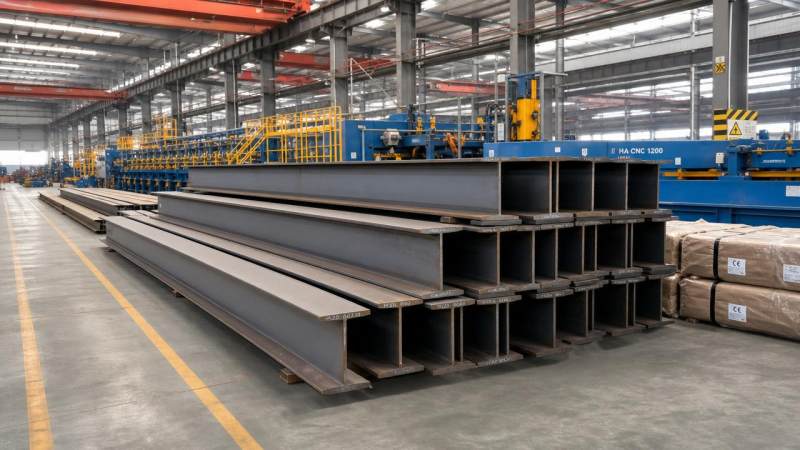
Not every sourcing situation has the same tolerance for error. A warehouse extension differs from a bridge package, and both differ from repeated export distribution orders.
In high-load structures, dimensional accuracy and material consistency become critical. In fast-moving distribution, lead time stability and documentation often matter just as much.
That is why the best steel i beam manufacturers are judged by production evidence, not promises. Reliable factories fit different usage scenarios without losing control over quality.
Scenario 1: Construction Projects Need Stable Mechanical Performance
In building frames, steel beams must meet load-bearing expectations over long service periods. Weak process control can lead to section deviation, weld issues, or coating inconsistency.
Reliable steel i beam manufacturers usually provide clear grade data, standard compliance, and traceable inspection records. ASTM, EN, JIS, and GB alignment shows stronger export readiness.
Sign 1: Standard Compliance Is Verified, Not Claimed
A dependable producer shares mill test certificates, chemical composition data, and dimensional inspection reports. These documents reduce disputes before cargo reaches the site.
If a supplier cannot explain tolerance ranges or testing frequency, the production system may be weak. Good steel i beam manufacturers answer technical questions directly and clearly.
Sign 2: Production Equipment Matches Structural Requirements
Structural steel quality depends heavily on forming, cutting, welding, straightening, and surface treatment equipment. Modern lines support more consistent geometry and lower rework rates.
This also applies to related steel products. For corrosion-sensitive environments, some projects combine beams with Galv Steel Tube systems for frames, supports, or fluid lines.
Scenario 2: Industrial Fabrication Requires Repeatable Dimensions and Fast Response
Machinery bases, workshops, platforms, and utility structures often involve repeated steel orders. In these scenarios, consistency between batches becomes a major selection factor.
A low initial price may look attractive. However, batch variation can increase machining adjustment, assembly delay, and downstream labor cost.
Sign 3: Quality Control Covers the Entire Manufacturing Flow
Reliable steel i beam manufacturers control raw material intake, process checkpoints, final inspection, and packing review. They do not depend only on final-stage sampling.
Ask whether inspection includes dimension checks, straightness, surface defects, and marking accuracy. Strong quality control protects both usability and export documentation.
Sign 4: Customization Capacity Supports Real Project Conditions
Many industrial jobs require cut-to-length beams, drilled components, welded assemblies, or bundled mixed profiles. The best steel i beam manufacturers can support these needs efficiently.
Customization should not damage schedule control. A capable factory balances OEM work with routine orders through organized planning and stable workshop capacity.
Scenario 3: Export and Distribution Orders Depend on Documentation and Delivery Control
For global shipments, production quality alone is not enough. Packing, marking, loading protection, and export paperwork can directly affect customs clearance and resale efficiency.
This is where experienced steel i beam manufacturers stand out. They know how to match cargo preparation with destination requirements and reduce preventable delays.
Sign 5: Delivery Performance Is Consistent Across Multiple Orders
A reliable supplier does not quote lead times based on best-case conditions. Instead, it provides realistic schedules based on material supply, line loading, and finishing requirements.
Check whether shipment records show consistency during busy seasons. Reliable steel i beam manufacturers maintain output discipline even when order volume rises.
Sign 6: Export Experience Reduces Communication Gaps
International business needs accurate labeling, specification confirmation, and standard interpretation. Suppliers with export experience usually respond faster and document requirements more carefully.
For example, corrosion-resistant support systems may include coated pipe products with standards such as AISI, ASTM, DIN, JIS, GB, SUS, or EN. One example is Galv Steel Tube, used across construction, transport, agriculture, and low-pressure pipeline scenarios.
How Different Sourcing Scenarios Change What to Check First
Different applications create different evaluation priorities. The table below helps compare what matters most when reviewing steel i beam manufacturers.
Seven Signs of Reliable Production in One Practical Checklist
Before placing an order, use this short checklist to compare steel i beam manufacturers in a structured way.
- Verified compliance with ASTM, EN, JIS, GB, or required standards.
- Modern equipment for cutting, forming, straightening, and finishing.
- Documented quality control from raw material to final packing.
- Ability to handle customized sizes or fabricated components.
- Stable lead times supported by real production planning.
- Clear export documentation and shipment preparation experience.
- Responsive communication when specifications or schedules change.
Common Misjudgments When Comparing Steel I Beam Manufacturers
One common mistake is focusing only on the lowest quote. A cheaper beam can become more expensive after delays, claims, repacking, or fabrication correction.
Another mistake is assuming all standards are interchangeable. Similar descriptions may still hide differences in chemistry, tolerance, or surface treatment expectations.
Some buyers also overlook production breadth. Steel i beam manufacturers with broader structural steel capability often manage bundled orders more smoothly.
Finally, communication speed should not be mistaken for operational reliability. Fast replies matter, but factory evidence matters more than sales language.
How to Match the Right Supplier to the Right Steel Scenario
Start by defining the real usage scenario. Is the priority load safety, batch repeatability, anti-corrosion performance, or export coordination?
Then request evidence that matches that scenario. For structural work, ask for test records. For repeat orders, check batch consistency. For exports, review packing and shipping samples.
A strong long-term partner should combine production stability, international standard understanding, and practical support for changing project requirements.
Hongteng Fengda, as a structural steel manufacturer and exporter from China, supports global construction and industrial supply with steel beams, channels, angles, cold formed profiles, and custom steel solutions.
When evaluating steel i beam manufacturers, the goal is not only to buy steel. It is to reduce sourcing risk, protect schedule performance, and improve long-term project confidence.
If current sourcing results are inconsistent, compare suppliers against these seven signs and request production proof before the next order decision.
Please give us a message


Please enter what you want to find