For enterprise buyers, knowing how stainless steel plate suppliers manage quality traceability is essential to reducing sourcing risks and ensuring project consistency. From raw material records to mill test certificates and production batch tracking, strong traceability systems help verify compliance, improve accountability, and support international project requirements. This article explains the key processes suppliers use and what decision-makers should evaluate before choosing a reliable steel partner.
Why quality traceability matters more than price alone
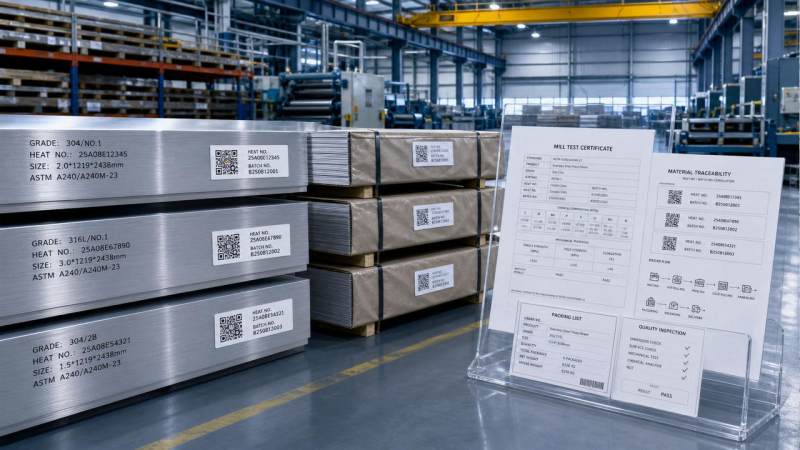
When buyers compare stainless steel plate suppliers, price is rarely the only real decision factor. Traceability often determines whether delivered material can be trusted in structural, industrial, or regulated applications.
For enterprise decision-makers, the core question is simple: can the supplier prove what was produced, where it came from, and whether it matches contract and standard requirements?
If that proof is weak, problems become expensive very quickly. Material disputes, delayed installation, failed inspections, warranty claims, and compliance issues can all begin with missing or incomplete traceability records.
Strong traceability reduces those risks by creating a verifiable chain from raw material sourcing to final shipment. It gives procurement teams better control and gives engineering teams more confidence.
In practice, reliable stainless steel plate suppliers use traceability not only as a quality tool, but also as a commercial protection mechanism for both sides of the transaction.
What enterprise buyers are actually trying to verify
Most B2B buyers are not looking for a theoretical explanation of quality systems. They want practical evidence that a supplier can deliver consistent material and defend every batch with documentation.
That usually includes confirmation of grade, heat number, thickness tolerance, surface condition, mechanical properties, chemical composition, and conformity to standards such as ASTM, EN, JIS, or GB.
Decision-makers also care about accountability. If a downstream issue appears after fabrication or installation, they need to know whether the supplier can identify affected lots quickly and accurately.
This is why the best evaluation focus is not only product quality at shipment, but the supplier’s ability to trace, isolate, and explain quality data across the whole production cycle.
How stainless steel plate suppliers build traceability from the start
Quality traceability begins long before the plate is cut, packed, or exported. It starts with incoming raw materials and the internal control methods used to register and monitor them.
At the raw material stage, suppliers typically record the steel mill source, heat number, coil or slab number, grade designation, and receiving inspection results. These records create the first traceability link.
After receipt, materials are usually assigned internal batch codes. Those codes connect warehouse inventory, production planning, testing activity, and final dispatch documents into one continuous record set.
Well-managed stainless steel plate suppliers also separate approved and nonconforming materials physically and digitally. That step helps prevent accidental mixing, which is one of the most common traceability failures.
For enterprise buyers, this early-stage discipline matters because traceability cannot be repaired at the end. If records are weak at intake, final certificates may look complete but still carry hidden risk.
Key systems used to track quality during production
Once production begins, traceability depends on process control. Suppliers need a way to connect each plate to the specific operations, equipment, inspections, and operators involved in manufacturing.
Many suppliers use ERP, MES, or integrated quality systems to manage this connection. Even where software varies, the goal is the same: maintain a consistent identity for each batch or plate.
Typical process records include rolling or cutting data, thickness checks, dimensional inspection, flatness review, surface examination, and any heat treatment or finishing information where applicable.
If plates are slit, cut-to-length, or otherwise processed from larger parent material, the system should preserve the parent-child relationship. That allows each finished piece to remain linked to original mill data.
Buyers should pay close attention here. A supplier may have acceptable certificates, but if in-process controls are weak, the risk of mixed materials or undocumented substitutions increases significantly.
Why heat numbers and batch identification are central
Heat number control is one of the clearest indicators of traceability quality. A heat number links the finished plate back to the original melt and to its chemical and mechanical test results.
Reputable suppliers mark or label material in a way that keeps heat identification visible through storage, processing, packing, and shipping. The marking method may be printed, tagged, stamped, or digitally recorded.
Batch identification adds another control layer. Even if several plates share one heat number, production batches can distinguish different processing runs, inspection dates, or order allocations.
For project buyers, this distinction is important. It supports targeted corrective action if a problem is found, instead of forcing quarantine or rejection of the entire shipment.
In other words, good identification systems do not only satisfy auditors. They directly reduce cost exposure when nonconformities need to be investigated quickly.
Mill test certificates: useful, but not enough on their own
Mill test certificates are often the first documents buyers request from stainless steel plate suppliers. They are important, but they should be treated as part of a larger verification system.
An MTC usually provides grade, heat number, size, chemical composition, mechanical properties, and referenced standards. For many buyers, this is the base document for acceptance and project filing.
However, a certificate alone does not prove that the shipped plate matches the certificate unless identification and batch control remain intact throughout handling and export preparation.
That is why sophisticated buyers compare certificate details with material markings, packing lists, production records, and third-party inspection data when available.
If there are inconsistencies in format, missing heat references, or vague standard descriptions, those should be treated as warning signs rather than administrative errors.
What third-party inspection adds to traceability confidence
For critical projects, independent inspection can strengthen confidence in a supplier’s traceability claims. It offers external confirmation that records, markings, dimensions, and test evidence align.
Third-party inspectors may witness testing, review certificates, verify quantity and identification, and check whether export goods correspond to approved specifications before shipment.
This is especially useful in international procurement, where distance limits direct oversight. External verification helps reduce disputes between procurement teams, project owners, and end users.
It also improves internal decision-making. Executives can approve larger orders or long-term contracts more confidently when traceability systems have been checked by an independent party.
For some buyers, combining supplier documentation with third-party review is the most effective balance between risk control and procurement efficiency.
How to evaluate stainless steel plate suppliers during supplier selection
Enterprise buyers should assess traceability capability before issuing large purchase orders, not after quality issues appear. The evaluation process should focus on evidence, not only on sales claims.
Start by asking how the supplier links raw materials to finished plates. Request sample records showing heat number management, in-process inspection logs, packing traceability, and final certification flow.
Then ask how the supplier handles nonconforming material. A mature operation should have clear isolation procedures, corrective action records, and documented approval controls for release decisions.
It is also useful to review labeling practices, digital record retention periods, and whether traceability can be maintained after cutting, machining, or mixed-container loading.
Buyers sourcing for multiple product categories may also prefer partners with broad quality discipline across materials. For example, suppliers handling coated products such as Galv Sheeting often apply similar documentation logic to standards, batch control, dimensions, and export records.
That matters because multi-product suppliers serving construction, transportation, energy, or industrial sectors usually need stronger internal systems to manage different specifications and customer compliance demands.
Questions decision-makers should ask before signing a contract
Practical questions reveal more than polished brochures. Ask whether every shipment can be traced by heat number and batch number, and whether that information appears consistently on documents and labels.
Ask which international standards the supplier regularly works with and whether they can provide matching certificates for ASTM, EN, JIS, or other required project specifications.
Ask how long traceability data is stored and how quickly the supplier can retrieve it. In real disputes, response speed is often just as important as record completeness.
Ask whether third-party inspection is supported, whether re-testing is possible, and how claims are handled if a discrepancy appears after delivery or fabrication.
Finally, ask for examples of customer industries served. A supplier experienced in global construction, manufacturing, and industrial supply chains is often better prepared for complex compliance expectations.
Common traceability weaknesses buyers should watch for
Some warning signs appear early. One is vague or inconsistent documentation, especially when certificates do not clearly match markings, quantities, or line items on the packing list.
Another is overreliance on manual records without cross-check controls. Manual systems are not automatically unreliable, but they become risky when order volume or processing complexity increases.
Buyers should also be cautious if a supplier cannot explain how cut pieces remain linked to original mill data. This gap is common and can undermine confidence in downstream fabrication work.
Frequent changes in document format, delayed certificate delivery, or uncertainty about nonconformance handling are also signals that internal control may be weaker than advertised.
In short, the real issue is not whether a mistake can happen. The issue is whether the supplier has a disciplined system to prevent, identify, and isolate mistakes quickly.
The business value of choosing traceability-driven suppliers
Strong traceability supports more than compliance. It improves procurement predictability, simplifies incoming inspection, reduces project delays, and lowers the cost of quality incidents over time.
For executives, that translates into better supplier accountability and lower sourcing risk. It also supports stronger customer confidence when your own business must document material quality downstream.
Reliable stainless steel plate suppliers help buyers build a more resilient supply chain. They make qualification easier, reordering faster, and dispute resolution more fact-based.
In long-term sourcing relationships, traceability also contributes to performance consistency. Data from previous orders can be reviewed, compared, and used to strengthen future purchasing decisions.
That is why traceability should be treated as a strategic procurement criterion, not as a minor technical detail delegated only to quality teams.
Conclusion
For enterprise buyers, the best stainless steel plate suppliers are not simply those offering competitive quotes. They are the ones that can prove material identity, control every batch, and support claims with clear records.
Effective quality traceability starts with raw material intake, continues through production and inspection, and ends with accurate certification and shipment control. Every step must remain connected.
When evaluating suppliers, focus on verification methods, heat number management, certificate reliability, nonconformance control, and document retrieval speed. Those factors reveal real operational strength.
In global steel procurement, traceability is one of the strongest indicators of whether a supplier can deliver consistent quality with lower commercial risk. For decision-makers, that makes it a buying priority.
Please give us a message


Please enter what you want to find