Searching for a reliable angle vs channel steel exporter China? This verified directory features 12 ISO 9001 & EN 1090-1 certified factories — ideal for buyers evaluating angle vs channel steel welding compatibility, load capacity comparison, corrosion resistance comparison, or suitability for prefab buildings, bridge construction, manufacturing facilities, and industrial projects. Whether you're a procurement professional sourcing in Southeast Asia or the Middle East, or a project manager needing ASTM-compliant structural steel, this list helps reduce sourcing risks and supports informed, standards-driven decisions.
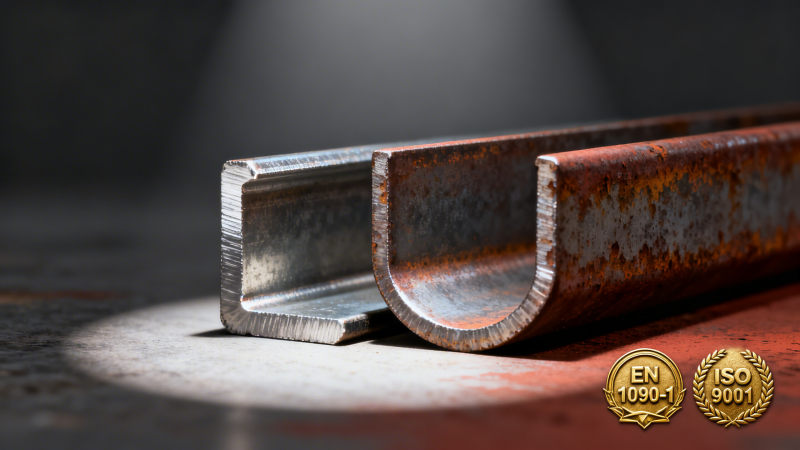
How to Compare Angle vs Channel Steel for Real-World Structural Applications
Angle and channel steel serve distinct mechanical roles—yet both are foundational in global infrastructure. Understanding their functional divergence is critical before selecting an angle vs channel steel exporter China. While angles offer uniform bi-directional rigidity and ease of bolting at corners, channels provide superior unidirectional bending resistance and deeper web sections for mounting heavy components.
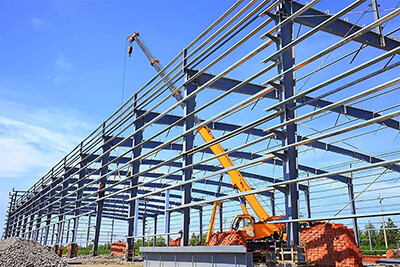
For angle vs channel steel for prefab buildings, angles dominate framing joints and bracing due to their symmetric geometry and weld-friendly leg alignment. Channels excel in purlin systems, crane rails, and wall cladding supports where vertical load transfer and attachment flexibility matter more than torsional symmetry.
In angle vs channel steel for bridge construction, channels often form girders’ flanges and diaphragms, while angles reinforce truss nodes and lateral bracing. Their combined use ensures compliance with EN 1090-1 Execution Class EXC3 requirements—especially when welded under controlled preheat (100–150°C) and interpass temperature protocols.
Key Mechanical Differences at a Glance
This table confirms why angle vs channel steel welding compatibility hinges on joint design—not just material grade. For angle vs channel steel corrosion resistance comparison, galvanizing (ASTM A123) remains essential for both, but channel steel requires extended dip times (≥4 minutes) to ensure full coverage in recessed zones.
Verified Exporter Selection Criteria: Beyond ISO 9001
Not all ISO 9001-certified mills meet structural steel delivery rigor. Our 12-verified factory list excludes suppliers lacking EN 1090-1 certification—mandatory for CE-marked fabricated components in EU markets. Each facility undergoes third-party audit verification every 12 months, covering traceability (heat number mapping), non-destructive testing (UT/RT on ≥5% of welded assemblies), and dimensional sampling (±0.5mm tolerance on flange width).
For buyers targeting angle vs channel steel supplier Southeast Asia or angle vs channel steel supplier Middle East, we prioritize exporters with bonded warehouses in Dubai (Jebel Ali) and Singapore (Tuas), enabling 7–15 day regional dispatch after document clearance. All listed partners maintain minimum stock of ASTM A36, EN S235JR, and GB Q235B grades across standard sizes (L30–L200, UPN 80–UPN 300).
When assessing angle vs channel steel load capacity comparison, verify that mill test reports include actual tensile yield strength—not just nominal values. Verified factories supply mill certificates per EN 10204 3.1, with batch-specific yield points ranging from 235 MPa to 360 MPa depending on cooling rate and section thickness.
What to Check Before Engaging an Exporter
- Confirmed EN 1090-1 Annex ZA compliance—not just “EN 1090 ready” claims
- ASTM standards documentation showing A6/A6M (for angles) and A276/A484 (for channels) conformance
- Proof of in-house NDT capability (at least Level II UT/PT personnel certified to ISO 9712)
- Export history to your target region within last 12 months (with bill-of-lading samples)
Why SM400A Patterned Steel Plate Complements Structural Framing
While angle and channel steel form primary load-bearing skeletons, surface performance matters equally in high-traffic zones. The SM400A Patterned steel plate delivers anti-skid functionality for walkways, equipment platforms, and ship decks—meeting ASTM A786 Type III and JIS G3192 requirements. Its pattern height (≥0.2× substrate thickness) ensures consistent traction across 2–8mm thicknesses, even under oil or water exposure.
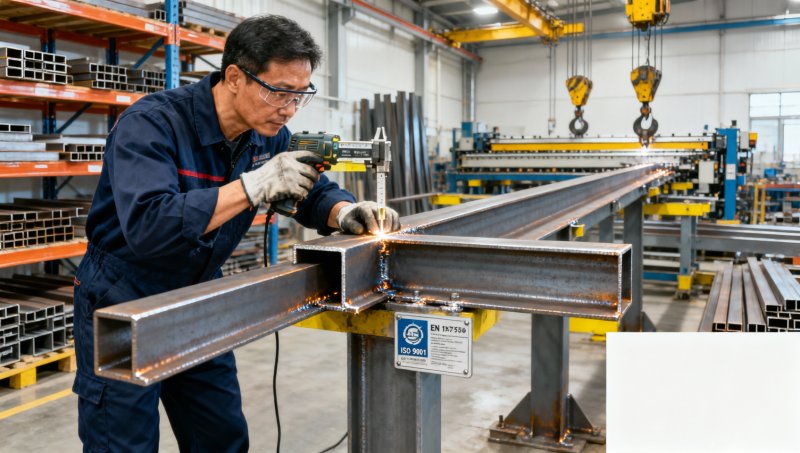
Used alongside angle vs channel steel for manufacturing facilities, it reduces secondary fabrication steps: no need for added grating or abrasive coatings. With widths up to 1800mm and lengths up to 12m, it integrates seamlessly into modular plant layouts—especially where floor loading exceeds 5 kN/m² and slip resistance must meet BS 7976-2 R10 classification.
Why Partner with Hongteng Fengda for Your Next Structural Steel Order
As a professional structural steel manufacturer and exporter based in China, Hongteng Fengda bridges specification precision and global logistics reliability. We don’t just supply angle vs channel steel exporter China—we co-engineer solutions: validating weld procedures per AWS D1.1, certifying assemblies to EN 1090-2 EXC3, and issuing dual-standard mill certs (ASTM + GB) for mixed-spec projects.
Our clients—from Dubai-based EPC contractors to German prefab builders—rely on our 4-step quality gate: raw material verification (XRF analysis), in-process dimensional checks (CMM + laser scanning), post-weld NDT (100% UT on critical joints), and final load-testing (2× design load for lifting lugs). Lead time consistency averages 25–30 days for standard orders, with rush options down to 14 days for repeat SKUs.
Ready to compare technical specifications, request ASTM-compliant mill test reports, or discuss customized cutting/welding packages for your next bridge, prefab building, or manufacturing facility project? Contact us today for a free engineering consultation and sample support—including physical samples of SM400A Patterned steel plate and certified angle/channel test coupons.
- channel steel supplier
- channel steel
- ASTM standards
- steel supplier
- ASTM standard
- ASTM A36
- structural steel
- Structural Steel
- steel plate
- angle vs channel
- angle vs channel steel supplier Middle East
- angle vs channel steel for bridge construction
- angle vs channel steel load capacity comparison
- angle vs channel steel exporter China
- angle vs channel steel for manufacturing facilities
- angle vs channel steel corrosion resistance comparison
- angle vs channel steel supplier Southeast Asia
- angle vs channel steel for prefab buildings
- angle vs channel steel welding compatibility
Related recommendations
 The Ultimate Procurement Hub: How a Full-Spectrum Steel Portfolio Empowers Global Industrial SuccessIt covers a wide range of steel products, including steel plates, steel coils, profiles, and steel gratings, to meet diverse needs.
 The Vertical Integration Advantage: Why Full-Process Production is the Gold Standard for Global Steel SourcingIt possesses complete production technologies and equipment for coking, sintering, steelmaking, and rolling, forming a systematic production system.
 The Global Steel Pulse: Bridging Continents with Precision Engineering and Unrivaled Supply Chain ExcellenceOur products sell well throughout China and are exported to North America, Europe, the Middle East, and other parts of the world, covering a wide market.
 Velocity of Value: How Precision Processing and Rapid-Response Logistics Redefine the Global Steel Supply ChainEquipped with advanced leveling equipment and relying on a robust logistics system, we can respond to customer needs at any time.
Please give us a message


Please enter what you want to find