When comparing Z-beam vs C-beam, the right choice depends on load capacity, installation method, and total beams weight in your project. For buyers and engineers sourcing Q235 steel, S235JR steel, or customized structural sections from a trusted Steel Plate Supplier or Steel Coil Supplier, understanding the performance differences between these profiles is essential for cost control, safety, and long-term structural reliability.
If you need a quick answer, here it is: a C-beam is usually the better choice for straightforward framing, support rails, wall girts, and applications where easy connection and stable installation matter most. A Z-beam is often the better option when overlapping installation, longer continuous spans, and material efficiency are priorities. The best decision is not about which profile is “stronger” in theory, but which one fits your load path, connection design, fabrication method, and budget with the lowest project risk.
What Is the Real Difference Between Z-Beam and C-Beam in Practical Use?
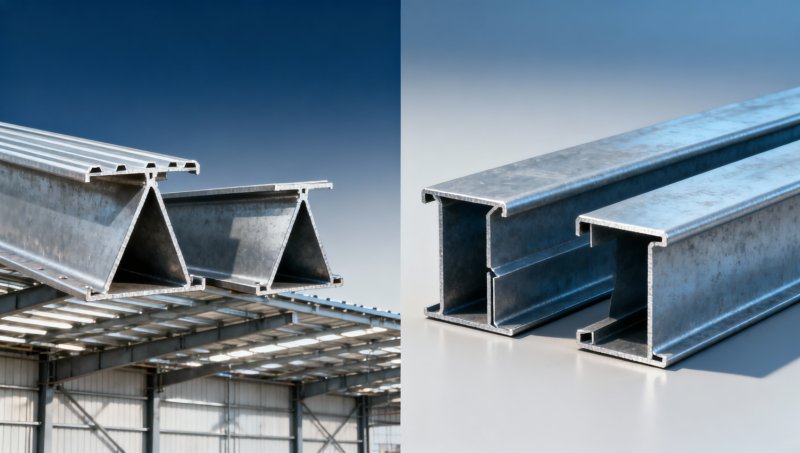
The main difference is the section shape and how that shape affects installation, structural behavior, and procurement efficiency.
C-beam has a channel-like cross-section with parallel or slightly tapered flanges. It is widely used because it is easy to handle, easy to connect, and familiar to fabricators, installers, and inspectors. In many steel construction and equipment support systems, C-beam is preferred for its simplicity.
Z-beam has flanges in opposite directions, creating a Z-shaped cross-section. This shape makes it especially useful in systems where members need to overlap at supports. That overlap can improve continuity and reduce the need for heavier sections in some purlin and girt layouts.
For most buyers and technical evaluators, the question is not just “What is the shape?” but:
- Which one gives the required strength with less steel consumption?
- Which one is easier and faster to install on site?
- Which one reduces total sourcing and fabrication cost?
- Which one better matches the project standard, span, and connection details?
That is where the comparison becomes meaningful.
When Should You Choose a C-Beam?
A C-beam is often the safer and more practical choice when you want a profile that is easy to fabricate, easy to bolt or weld, and predictable during installation.
It is commonly selected for:
- Secondary framing in buildings
- Wall supports and bracing systems
- Equipment frames
- Platforms and racks
- Industrial support structures
- Simple span applications without overlapping members
Why many project teams prefer C-beam:
- Simpler connections: The geometry often makes drilling, bolting, and welding more straightforward.
- Easier handling: Fabricators and site crews are usually more familiar with it.
- Stable alignment: In many standard installations, C-beams are easier to place and fix accurately.
- Broad availability: Standard sizes are commonly stocked, which may shorten lead time.
For procurement teams, C-beam can reduce hidden costs when the project requires standardization, fewer custom details, and faster shop drawing approval. For site managers, it may mean smoother installation and lower labor risk.
When Is a Z-Beam the Better Option?
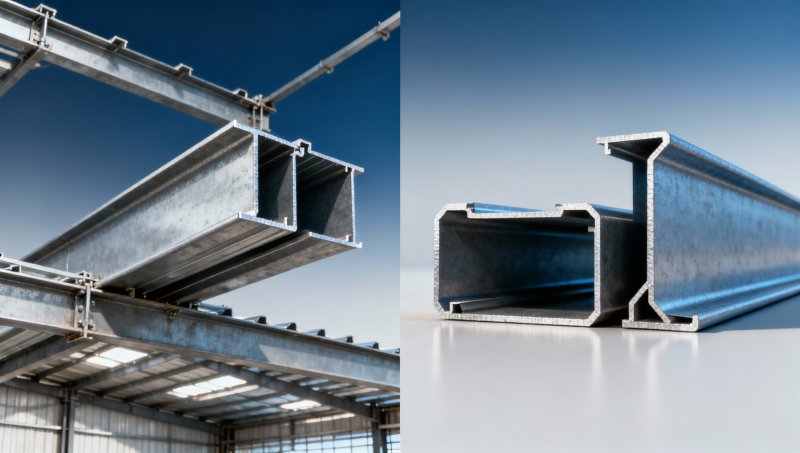
A Z-beam is usually the better choice when structural continuity and overlapping installation offer technical or economic advantages.
It is often used for:
- Roof purlins
- Wall girts
- Longer multi-span systems
- Pre-engineered steel buildings
- Projects where weight optimization matters
Why engineers often choose Z-beam:
- Overlapping capability: Z-sections can overlap at supports more naturally than C-sections, improving structural continuity.
- Material efficiency: In the right design, this can reduce required section thickness or total steel usage.
- Better for continuous spans: Z profiles are commonly favored in purlin systems spanning over several frames.
- Potential cost savings: Lower steel weight and optimized layout can reduce transport and installation costs.
However, Z-beam is not automatically the best answer. If your project has simple short spans, non-overlapping framing, or highly standardized connection details, a C-beam may still be more practical overall.
Which One Has Better Load Capacity?
This is one of the most searched questions, but the correct answer is: it depends on the span, support condition, orientation, section dimensions, steel grade, and connection method.
A larger or thicker C-beam can easily outperform a smaller Z-beam, and vice versa. So comparing profile names alone is not enough.
What actually affects load capacity:
- Section depth and flange size
- Thickness
- Yield strength of the steel, such as Q235 or S235JR
- Unbraced length
- Whether the member is simply supported or continuous
- Connection rigidity
- Load type: dead load, live load, wind load, point load, or dynamic load
In many roof and wall systems, Z-beams perform very well because continuity through overlap improves the overall system behavior. In many equipment frames or support structures, C-beams perform well because the connection geometry is more direct and easier to control.
For technical assessment, the right process is:
- Define span and support spacing
- Calculate design loads
- Check deflection limits
- Evaluate connection details
- Compare steel consumption, fabrication cost, and installation time
This approach is more reliable than asking which profile is “generally stronger.”
How Do Installation and Fabrication Affect the Choice?
For many projects, the final choice is decided less by theoretical section performance and more by fabrication and installation efficiency.
C-beam advantages in execution:
- Usually easier to cut, punch, drill, and weld
- Simple for bracket, base plate, and connection assembly
- Suitable for workshops using standard fabrication processes
Z-beam advantages in execution:
- Can simplify multi-span purlin layouts through overlapping
- May reduce the number of heavier individual members
- Can improve material utilization in large building envelopes
If labor cost is high or installation speed is critical, the beam that is easier for your crews to place and connect may be the better commercial choice, even if the theoretical steel saving of another section looks attractive on paper.
This is especially important for project managers and business evaluators. The lowest unit price per ton is not always the lowest total installed cost.
What Should Buyers, Quality Teams, and Decision-Makers Check Before Ordering?
Whether you choose Z-beam or C-beam, purchasing risk usually comes from unclear specifications, inconsistent quality, and mismatch between design intent and supplied material.
Before placing an order, confirm the following:
- Steel grade: Q235, S235JR, or other required grade
- Section dimensions: depth, flange width, lip, thickness, length tolerance
- Surface condition: black steel, galvanized, painted, or other finish
- Standard compliance: ASTM, EN, JIS, GB, or project-specific requirements
- Mechanical properties: yield strength, tensile strength, elongation
- Manufacturing method: hot rolled or cold formed
- Packing and export readiness: especially for overseas shipping
- Inspection documents: mill test certificate, dimensional inspection, coating reports if applicable
Quality control teams should also pay attention to straightness, edge condition, hole accuracy if pre-punched, and coating consistency. For safety managers, correct section identification and traceability are essential.
For distributors and repeat buyers, supplier reliability matters as much as section performance. Stable capacity, dependable lead times, and consistent dimensional accuracy can directly affect project delivery and customer satisfaction.
How to Compare Total Cost, Not Just Unit Price
A common mistake in steel sourcing is comparing only ex-factory ton price. A better comparison includes the full project cost impact.
Use this checklist:
- Material consumption per design option
- Fabrication complexity
- Installation labor time
- Connection hardware cost
- Transport efficiency and bundle weight
- Waste and cutting loss
- Coating or corrosion protection requirements
- Risk of rework due to dimensional inconsistency
For example, a Z-beam design may reduce steel weight in a long-span purlin system, but if the contractor is unfamiliar with the overlap layout, site execution risk may rise. On the other hand, a C-beam may cost slightly more in material for some layouts, but save money through easier installation and fewer errors.
That is why commercial evaluation should be tied to actual application, not profile name alone.
Material Selection Also Matters Beyond Beam Shape
Although beam comparison is mainly about structural profiles, many industrial and building projects also require complementary materials for cladding, equipment covers, processing environments, or corrosion-sensitive components. In such cases, material selection should be coordinated across the whole project rather than handled in isolation.
For example, if your project includes food processing, chemical equipment, transport systems, or high-temperature environments, stainless steel components may be required alongside carbon steel structural members. A product such as 304 Stainless Steel Plate can be used in applications including medical equipment construction, food industry equipment, ship parts, kitchen supplies, vehicles, conveyor belts, and screens. Typical specifications include thickness from 0.3mm to 200mm, multiple surface finishes such as BA, 2B, NO.1, NO.4, HL, and 8K, and compliance with standards such as ASTM, JIS, GB, EN, ISO, SGS, and BV.
From a technical standpoint, 304 grade offers tensile strength of at least 520MPa, yield strength of at least 275MPa, elongation of about 55–60%, density of 7.93g/cm³, and good overall corrosion resistance for a wide range of industrial uses. This kind of coordinated sourcing can help buyers reduce procurement complexity when projects involve both structural steel sections and stainless components.
So, Z-Beam vs C-Beam: Which One Should You Choose?
Choose C-beam if your priority is:
- Simple fabrication and connection
- Fast installation
- Standard framing and support applications
- Lower execution risk for common layouts
Choose Z-beam if your priority is:
- Overlapping installation
- Multi-span roof or wall systems
- Material efficiency
- Optimized weight in pre-engineered building applications
If you are a buyer, do not select based on section name alone. Compare design performance, total installed cost, quality consistency, lead time, and supplier support. If you are an engineer or project manager, verify span conditions, connection details, and deflection requirements before finalizing the section. If you are a business decision-maker, focus on total procurement risk and lifecycle value, not only initial tonnage price.
In short, C-beam is often better for simplicity, while Z-beam is often better for continuity and efficient multi-span systems. The right answer depends on how the beam will actually be used.
Working with an experienced structural steel manufacturer and exporter can make this decision easier by aligning section design, production quality, international standards, and delivery planning. That reduces sourcing risk and helps ensure the selected beam performs as expected in the field.
Please give us a message


Please enter what you want to find