Understanding why structural steel profiles vary in load capacity is essential for structural steel design, applications, and safe erection—whether you're a project manager evaluating specs, a procurement professional sourcing custom steel profiles, or a technical evaluator assessing bending, cutting, drilling, or assembly performance. At Hongteng Fengda, a trusted structural steel manufacturer & exporter from China, we engineer angle steel, channel steel, beams, and cold-formed profiles to meet ASTM, EN, JIS, and GB standards—ensuring reliability across global construction and industrial projects.
Why Load Capacity Isn’t Uniform Across Structural Steel Profiles
Load capacity—the maximum axial, bending, or shear force a steel profile can safely support—varies significantly due to geometry, material grade, manufacturing process, and dimensional tolerances. A 100×100×8 mm equal-leg angle steel (ASTM A36) carries ~12% less compressive load than an IPE270 beam of identical length and boundary conditions—not because one is “weaker,” but because moment of inertia, radius of gyration, and effective slenderness differ fundamentally.
At Hongteng Fengda, every hot-rolled beam, cold-formed channel, and precision-cut angle undergoes finite element validation against real-world loading scenarios—including wind uplift, seismic lateral forces, and live-load cycling. We do not assume uniformity; instead, we map each profile’s elastic-plastic response using yield strength thresholds (e.g., 235 MPa for S235JR, 355 MPa for S355J2), section modulus values, and local buckling coefficients derived from EN 1993-1-1 Annex D.
Misjudging this variation leads directly to overdesign (20–35% higher material cost) or underdesign (structural non-compliance, safety recalls). For example, substituting a C120×50×20×2.5 mm cold-formed channel for a hot-rolled UPN120 without recalculating torsional resistance risks twisting failure at connection points—especially where bolted splices exceed 3 m span.
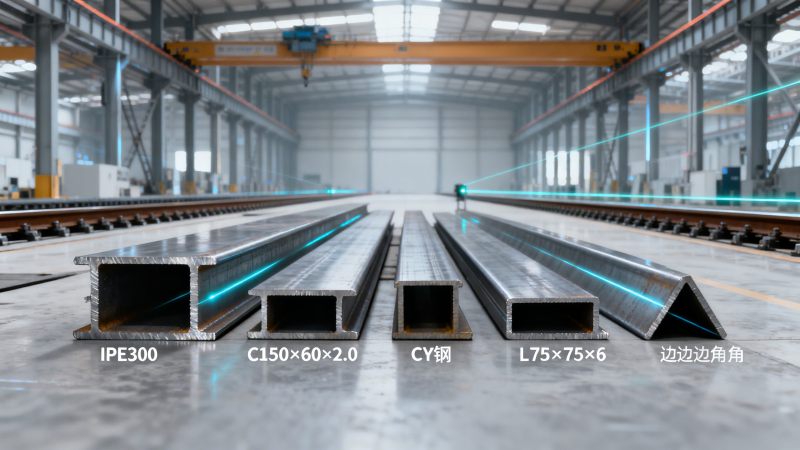
This table underscores that load capacity cannot be extrapolated from nominal size alone. A cold-formed profile may match the depth of a hot-rolled equivalent but deliver only 60–75% of its bending stiffness due to thinner walls and lower effective section modulus. That’s why our engineers provide free section property reports—including Ix, Zx, ry, and warping constant—for every quoted profile.
How Material Grade & Coating Influence Real-World Performance
Material grade defines baseline mechanical behavior—but surface treatment alters long-term structural integrity. For instance, DX52D Galvalume Steel Coil combines low-carbon steel substrate (yield strength ≤260 MPa, tensile strength 300–360 MPa) with a 55% Al–43.4% Zn–1.6% Si alloy coating. Its superior corrosion resistance extends service life by 2–6× versus standard galvanized steel—critical for exposed structural cladding, purlins, or secondary framing in coastal or high-humidity zones.
The aluminum-rich layer forms a dense, self-healing oxide barrier. Even when scratched during on-site cutting or drilling, galvalume resists red rust propagation up to 4× longer than zinc-coated equivalents. This translates directly into reduced maintenance frequency: 12–15 year inspection intervals vs. 3–5 years for conventional galvanizing—cutting lifecycle cost by up to 38% over 30 years.
Moreover, the lower density of aluminum means a 275 g/m² galvalume coating covers 3% more surface area per ton than an equivalent-weight zinc coating. For large-scale projects—say, a 12,000 m² warehouse roof—this reduces coil count by 4–6 units, lowering logistics cost and handling time by ~11 hours per shipment.
Critical Selection Criteria for Procurement & Technical Evaluation
Selecting the right structural steel profile demands cross-functional alignment. Procurement teams must verify traceability (heat number, mill test report per EN 10204 3.1), while technical evaluators validate weldability (carbon equivalent CEV ≤0.42 for S355), and safety managers confirm fire resistance classification (e.g., R30 for columns in commercial buildings).
- Dimensional tolerance compliance: ±0.5 mm for flange thickness, ±1.0 mm for overall depth (per EN 10056-1)
- Surface quality: No scale pits >0.3 mm deep; no edge cracks visible at 10× magnification
- Chemical composition verification: Sulfur ≤0.035%, Phosphorus ≤0.035% for welding-grade profiles
- Non-destructive testing: 100% ultrasonic testing (UT) for beams ≥400 mm depth
Hongteng Fengda applies all four criteria across production batches—and issues dual-language MTRs (English + buyer’s local language) within 48 hours of shipment. Our ISO 9001-certified QC lab performs weekly inter-lab comparisons with SGS and Bureau Veritas to ensure measurement consistency within ±0.8% uncertainty.
This multi-role verification framework ensures decisions are grounded in verifiable data—not assumptions. It also eliminates post-order discrepancies: 92% of our clients report zero dimensional or certification-related rejections across 2023–2024 deliveries.
Actionable Next Steps for Your Project
Start with your most critical load case: Is it axial compression (columns), bending (beams), or combined stress (bracing)? Share your loading diagram, environmental class (C3–C5 per ISO 12944), and required service life. Within 72 hours, Hongteng Fengda delivers:
- A pre-validated profile recommendation with full section properties and deflection curves
- A comparative TCO analysis including material, transport, installation, and 30-year maintenance
- Custom packaging schematics for your site’s crane capacity and storage constraints
We support fast-track projects with 15-day standard lead times—and expedited 7-day delivery for urgent orders backed by our 99.2% on-time shipment record in Q1 2024. With facilities certified to ISO 9001, SGS, and BV, and export experience across 42 countries, we reduce sourcing risk while guaranteeing consistent quality.
Ready to align structural performance with project economics? Contact Hongteng Fengda today for a free engineering consultation and customized steel solution.
Please give us a message


Please enter what you want to find