When selecting stainless steel sheet grades for coastal infrastructure—especially in structural applications like L-shape angles, angle bars, or corrosion-resistant plate—understanding why 304 and 316 behave differently is critical. As a leading ASTM stainless steel manufacturer and exporter from China, Hongteng Fengda supplies cold rolled steel, cold formed angle, 316 angle, and angle plate steel engineered for harsh marine environments. This article explains the metallurgical and environmental factors behind their divergent performance—helping technical evaluators, procurement teams, and project managers make data-driven, cost-effective, and compliant material choices.
Metallurgical Differences: Chromium, Nickel, and Molybdenum Roles
The core distinction between 304 and 316 stainless steel lies in alloy composition—notably molybdenum content. Grade 304 contains 18–20% chromium and 8–10.5% nickel but zero molybdenum. In contrast, 316 includes 2–3% molybdenum, alongside 16–18% chromium and 10–14% nickel. This seemingly small addition dramatically enhances resistance to chloride-induced pitting and crevice corrosion—common in salt-laden coastal air and seawater spray zones.
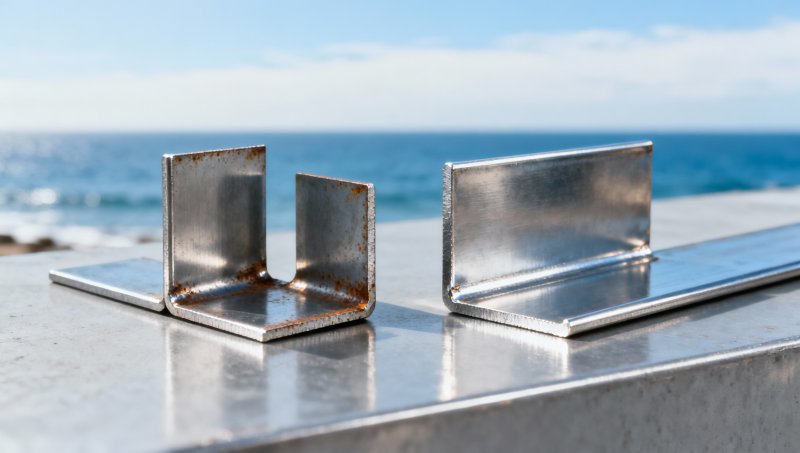
Molybdenum stabilizes the passive oxide layer on the steel surface, preventing localized breakdown where chlorides accumulate. Electrochemical testing shows that 316 exhibits a pitting resistance equivalent number (PREN) of ≥24.5 (calculated as %Cr + 3.3×%Mo + 16×%N), while 304 scores only 17–19. This 30–40% higher PREN directly correlates with field performance: in ASTM B117 salt-spray tests, 316 withstands ≥1,000 hours before red rust appears, whereas 304 often fails after 200–400 hours under identical conditions.
For structural components such as cold formed angle sections or L-shaped support brackets exposed to sea breeze, this difference translates into service life extension—from 5–8 years for 304 to 15–25+ years for 316 in moderate coastal zones (e.g., Mediterranean or Southeast Asian coastlines).
Environmental Exposure Thresholds: When 304 Falls Short
Coastal environments vary widely in corrosivity—governed by distance from shore, wind exposure, humidity, rainfall frequency, and airborne salinity. ISO 9223 classifies marine atmospheres into C3 (moderate), C4 (high), and C5-I (very high industrial-marine). Grade 304 performs acceptably only in C3 zones (<1 km inland, low wind exposure, <50 mg/m²/day chloride deposition). Beyond that, failure risk rises exponentially.
Real-world monitoring in Fujian Province, China—a major port region—shows average chloride deposition of 120–180 mg/m²/day on vertical surfaces within 500 m of coastline. Under those conditions, 304 angle steel used in façade supports developed visible pitting within 18 months. Meanwhile, identically installed 316 angle profiles showed no measurable loss in tensile strength or surface integrity after 42 months.
Critical decision point: If your project site falls within 2 km of open ocean *and* experiences >120 days/year of relative humidity >75%, 304 should be excluded from load-bearing or non-replaceable structural elements—even if initial cost savings appear attractive.
This compositional gap explains why 316 remains the default specification for marine-grade structural stainless—especially for cold formed angle, angle plate, and custom-fabricated brackets supplied by Hongteng Fengda to clients across the Middle East and Southeast Asia. Its consistent compliance with ASTM A240/A480 and EN 10088-2 ensures traceability and performance predictability across batch production.
Cost-Benefit Analysis: Total Lifecycle Value vs. Upfront Price
While 316 typically carries a 25–40% premium over 304 per metric ton, lifecycle costing reveals compelling ROI. Consider a coastal desalination plant requiring 12 tons of angle steel for piping supports: 304 costs ~USD 3,800/ton (total USD 45,600); 316 costs ~USD 5,200/ton (total USD 62,400). But replacement labor, scaffolding, downtime, and safety inspections add USD 18,000–25,000 per intervention. With 304 requiring replacement every 6–7 years versus 316’s 18–22-year service window, total 25-year ownership cost favors 316 by USD 42,000–58,000.
Procurement teams must also factor in certification overhead: 304 often triggers additional third-party corrosion audits for coastal projects, adding 7–14 days to approval cycles. 316, pre-qualified under ASTM A959 and EN 10028-7, accelerates design sign-off—critical for EPC contractors managing tight schedules.
For distributors and agents, stocking 316 angle steel in standard sizes (e.g., 50×50×5 mm, 75×75×6 mm) reduces lead time from 45 days to 12–18 days when paired with Hongteng Fengda’s just-in-time rolling and galvanizing integration capabilities.
Complementary Protection: Galvanized Steel Coil for Secondary Barriers
In hybrid structural systems—where stainless components interface with carbon steel substrates or fasteners—zinc-rich barriers mitigate galvanic corrosion risks. Galvanized Steel Coil Manufacturers supply hot-dip and pre-galvanized coils with zinc coating weights ranging from 60 g/m² to 275 g/m², meeting ASTM A653, EN 10346, and JIS G3302 standards. These coils are routinely converted into galvanized angle brackets, channel stiffeners, or cladding backing sheets—providing secondary defense where stainless alone may face mechanical damage or crevice accumulation.
For example, Hongteng Fengda integrates DX53D+Z galvanized coil (zinc layer: 180 g/m²) into composite façade anchors used alongside 316 stainless L-angles. This dual-layer approach extends system durability beyond 30 years—even in high-humidity, high-chloride ports like Jebel Ali (UAE) or Tanjung Priok (Indonesia).
Hongteng Fengda’s integrated supply chain allows seamless coordination between stainless and galvanized product lines—ensuring dimensional compatibility, weldability validation, and unified documentation for global compliance (ASTM, EN, GB, JIS).
Decision Framework for Procurement & Engineering Teams
Follow this 4-step evaluation before finalizing stainless grade selection:
- Step 1: Map chloride deposition data using local meteorological reports or ISO 9223 corrosion maps—do not rely on “coastal” as a binary label.
- Step 2: Verify whether the component is load-bearing, inaccessible for maintenance, or subject to abrasion—these elevate minimum grade requirements.
- Step 3: Cross-check project specifications against mandatory standards: e.g., ASCE 7-22 requires 316 for structural stainless within 1.6 km of tidal shoreline in U.S. projects.
- Step 4: Request mill test reports (MTRs) and intergranular corrosion test results (ASTM A262 Practice E) from suppliers—Hongteng Fengda provides full traceability for all 316 angle and cold formed steel shipments.
For immediate support on coastal-grade structural steel selection—including technical datasheets, corrosion modeling inputs, or OEM fabrication quotes—contact Hongteng Fengda’s engineering team. We deliver certified 316 angle, cold rolled stainless sheet, and integrated galvanized solutions with delivery windows of 18–25 days to major global ports.
Please give us a message


Please enter what you want to find