Why a Galvanized Steel Profile Can Reduce Rework
For operators and site teams, rework often starts with material issues—poor fit, surface corrosion, inconsistent dimensions, or difficult installation.
A galvanized steel profile helps reduce these problems by combining reliable structural performance with long-lasting corrosion protection and stable fabrication quality.
When profiles arrive ready for accurate assembly and durable use, teams spend less time correcting defects and more time protecting schedules.
Understanding how the right galvanized steel profile supports handling, installation, and maintenance is key to improving construction and industrial efficiency.
What Makes a Galvanized Steel Profile Different?
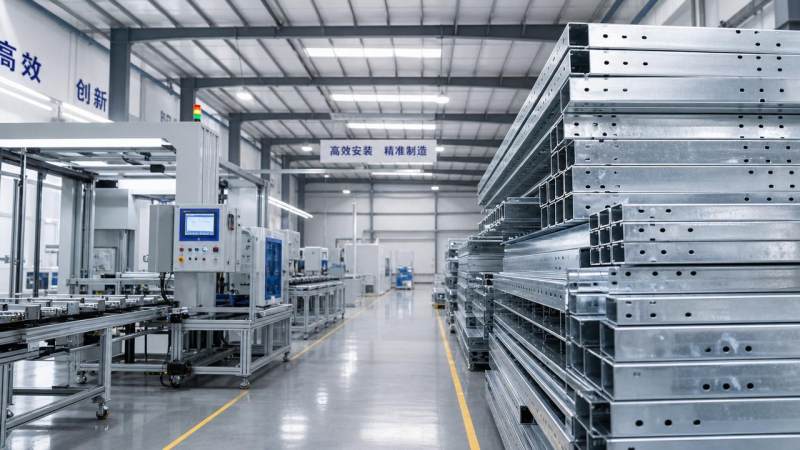
A galvanized steel profile is a shaped steel section protected by a zinc coating.
The coating acts as a barrier against moisture, oxygen, and many site contaminants.
This protection helps the steel maintain its appearance and performance during storage, transport, and installation.
Profiles may include channels, angles, beams, cold formed sections, and custom structural components.
Their value is not only corrosion resistance.
A high-quality galvanized steel profile should also offer consistent thickness, straightness, hole position, and edge condition.
These details directly affect whether parts align smoothly on site.
Poor alignment may require grinding, drilling, cutting, or replacement.
Each correction increases labor time, creates waste, and may delay follow-up work.
For structural steel projects, small dimensional errors can quickly become costly installation problems.
How Does a Galvanized Steel Profile Reduce Rework on Site?
A galvanized steel profile reduces rework by solving several common failure points before installation begins.
The first is surface durability.
Unprotected steel may rust during outdoor storage, especially in humid, coastal, or rainy environments.
Rust often requires cleaning, repainting, or rejection before use.
A galvanized steel profile limits this risk by providing factory-applied corrosion protection.
The second factor is handling resistance.
Profiles may be lifted, stacked, unloaded, and moved many times before final installation.
A durable zinc layer helps reduce damage from normal handling when proper procedures are followed.
The third factor is fabrication reliability.
Accurate forming, cutting, punching, and drilling improve fit-up at the assembly stage.
When a galvanized steel profile follows agreed drawings and standards, connection work becomes more predictable.
- Less surface cleaning before installation.
- Fewer corrections caused by early corrosion.
- Better alignment at bolted or welded joints.
- Lower chance of replacing damaged components.
- More stable progress during phased construction.
Where Is a Galvanized Steel Profile Most Useful?
A galvanized steel profile is especially useful where steel faces moisture, outdoor exposure, or frequent handling.
Common applications include building frames, solar mounting systems, warehouse structures, support brackets, fencing, platforms, and industrial racks.
It also works well for infrastructure components where maintenance access is limited.
In modular construction, consistent steel profiles help repeated assemblies stay accurate.
This is important when many identical units must connect quickly and safely.
In industrial projects, a galvanized steel profile may support equipment, cable trays, walkways, and process-area structures.
The coating can help extend service life where cleaning, chemicals, or humidity are present.
Material choice should still consider load, environment, coating thickness, fabrication method, and applicable standards.
For decorative or specialized corrosion-resistant surfaces, stainless materials may also be considered.
For example, 430 Stainless Steel Coil is used in countertops, kitchenware, outdoor decoration, automotive parts, and food industry applications.
It is available in 430 and 201 materials, with BA, 2B, NO.1, NO.4, 4K, HL, and 8K finishes.
Typical dimensions include 2.5mm-10.0mm thickness, 610mm-2000mm width, and lengths such as 2000mm, 3000mm, or 6000mm.
This comparison shows why project requirements should guide material selection, not habit alone.
How Should a Galvanized Steel Profile Be Selected?
Choosing a galvanized steel profile starts with defining the service environment.
Indoor dry areas, outdoor urban sites, coastal locations, and industrial atmospheres require different protection levels.
The next step is confirming the structural role.
A load-bearing profile needs suitable grade, section size, wall thickness, and mechanical performance.
A support or secondary frame may need different tolerances and connection details.
Standards are also important.
Projects may require ASTM, EN, JIS, GB, DIN, ISO, SGS, or BV-related documentation.
Clear certification helps reduce acceptance disputes after delivery.
Drawings should identify length, hole pattern, end cut, bending radius, slot position, and coating requirements.
Ambiguous drawings often create avoidable rework.
A reliable galvanized steel profile supplier should review specifications before production.
This review can reveal conflicts between profile geometry, galvanizing method, and final assembly needs.
Selection Checklist
What Mistakes Increase Rework Even With Galvanized Steel?
A galvanized steel profile can reduce rework, but only when specified and handled correctly.
One common mistake is ignoring coating damage after cutting or drilling.
Exposed edges may need suitable repair, depending on the project standard and environment.
Another mistake is assuming all galvanized products perform the same.
Coating thickness, surface uniformity, steel chemistry, and fabrication accuracy can vary significantly.
Poor storage is also a frequent problem.
Wet stacking may cause white rust or surface staining.
Profiles should be stored with ventilation, drainage, and separation from aggressive materials.
A galvanized steel profile should not be selected only by the lowest unit price.
Low-cost material may create higher total cost through delays, repairs, claims, and site inefficiency.
- Do not accept unclear tolerances for critical assemblies.
- Do not mix incompatible materials without checking galvanic corrosion.
- Do not leave damaged coating untreated in severe environments.
- Do not overlook packaging for export transportation.
How Do Cost, Lead Time, and Quality Control Affect Results?
Rework reduction depends on planning across cost, lead time, and quality control.
A galvanized steel profile may cost more than uncoated steel at purchase.
However, it can reduce expenses related to site painting, rust removal, and early maintenance.
Lead time also matters.
If production drawings are approved late, even good material may arrive under schedule pressure.
Rushed installation increases the risk of damage, poor inspection, and repeated adjustments.
Quality control should begin before shipment.
Inspection may cover dimensions, coating condition, straightness, marking, packaging, and documentation.
For export projects, clear packing lists and traceability help simplify receiving inspection.
Hongteng Fengda supplies structural steel products and customized solutions from China for global construction and industrial projects.
Products include angle steel, channel steel, steel beams, cold formed profiles, and customized structural steel components.
With manufacturing control and international standard support, a suitable galvanized steel profile can be produced for project-specific requirements.
FAQ: Practical Questions About Galvanized Steel Profile Use
Conclusion: A Better Profile Means Fewer Corrections
A galvanized steel profile reduces rework by improving corrosion resistance, dimensional reliability, handling durability, and installation predictability.
Its value becomes clear when projects involve outdoor storage, repeated assembly, strict schedules, or limited maintenance access.
The best results come from matching the profile to load, environment, standards, and connection requirements.
Before ordering, confirm drawings, tolerances, coating needs, documentation, and packaging with the supplier.
For structural steel sourcing, Hongteng Fengda can support standard and customized galvanized steel profile solutions for global projects.
A careful specification today can prevent expensive corrections tomorrow.
Please give us a message


Please enter what you want to find