Why Yield Strength Dictates Tower Base Reliability—Not Tensile Strength
When designing wind turbine tower base sections—where structural integrity under cyclic wind loads is non-negotiable—ASTM steel profile yield strength often outweighs tensile strength in real-world performance. For global buyers sourcing ASTM steel profile for wind turbine towers, Shandong steel for bridge projects, or C section steel for modular construction, understanding this distinction is critical to safety, fatigue resistance, and long-term reliability. As a trusted Structural Steel Manufacturer & Exporter from China, Hongteng Fengda delivers certified ASTM steel beams for mining equipment, structural steel purlins for cold storage, and Z150 steel sheet corrosion resistant solutions—all engineered to meet rigorous international standards and project-specific demands.
Tensile strength—the maximum stress a material withstands before fracture—is widely cited in procurement specs. But in tower bases subjected to decades of alternating bending, torsion, and ground-induced vibrations, yield strength (the point at which permanent deformation begins) governs service life. A steel grade with high tensile strength but low yield-to-tensile ratio (e.g., ASTM A572 Gr. 50: Yield = 345 MPa, Tensile = 450 MPa, Y/T = 0.77) may resist ultimate failure—but it yields earlier under repeated loading, accelerating fatigue crack initiation at weld toes and bolted flange interfaces.
Wind turbine base sections operate under 10⁷–10⁸ load cycles over 25 years. Per ASTM E466, fatigue endurance limits for welded joints in structural steel typically fall between 20%–35% of nominal yield strength. Hence, a higher yield strength directly expands the safe operational stress window—reducing cumulative plastic strain per cycle and delaying micro-crack propagation. This is why ASTM A913 Grade 65 (yield ≥ 448 MPa) is increasingly specified for tower base rings in offshore applications—despite its tensile strength (≥ 530 MPa) being only ~12% higher than A572 Gr. 50.
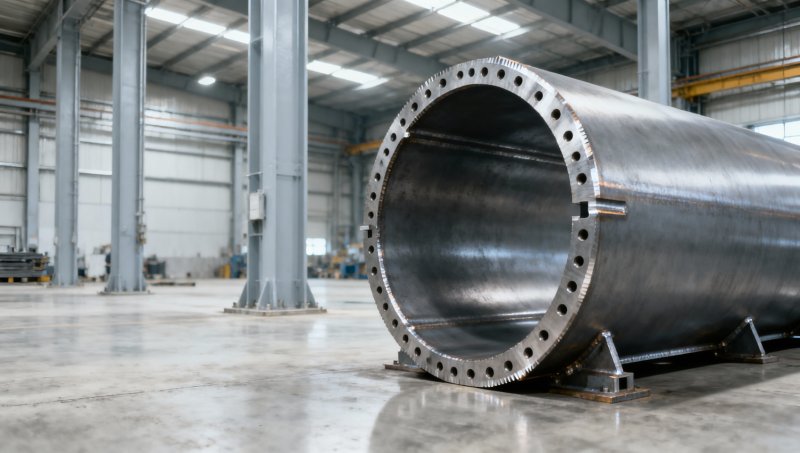
Hongteng Fengda’s ASTM-compliant hot-rolled H-beams and custom-fabricated base ring segments undergo 100% ultrasonic testing (UT) and Charpy V-notch impact verification at –20°C, ensuring consistent yield strength across thicknesses up to 120 mm—critical for minimizing through-thickness residual stresses in multi-pass welded base plates.
How Yield Strength Impacts Fatigue Life and Weld Integrity
Fatigue failure in tower bases rarely initiates from gross tensile overload—it originates at localized stress concentrations where cyclic plasticity occurs. When yield strength is insufficient, even modest wind gusts induce micro-yielding at weld transitions. Over time, these zones develop dislocation pile-ups, leading to slip-band cracking and eventual macro-fracture. Studies by DNV GL show that increasing base plate yield strength from 345 MPa to 420 MPa extends predicted fatigue life by 2.3× under IEC 61400-1 design load spectra.
Welding also introduces metallurgical complexity. Heat-affected zones (HAZ) in high-strength steels can suffer softening if post-weld heat treatment (PWHT) is omitted. But ASTM A618 and A992 steels produced by Hongteng Fengda feature controlled carbon equivalent (CEV ≤ 0.42) and fine-grain practice, maintaining yield strength within ±15 MPa across 25–80 mm thicknesses—even without PWHT. This consistency ensures uniform load redistribution across bolted connections and grouted anchor systems.
Moreover, yield strength directly influences buckling resistance. Tower base sections act as short columns under combined axial and bending loads. Euler buckling theory shows critical buckling stress scales linearly with yield strength for inelastic buckling regimes—common in thick-walled base cylinders. A 15% increase in yield strength raises the elastic-plastic buckling threshold by ~13.5%, reducing risk of local web distortion during extreme wind events (e.g., 50-year gusts > 55 m/s).
This table confirms that yield strength alone isn’t sufficient—yield-to-tensile ratio matters equally. A higher Y/T ratio indicates superior strain-hardening capacity and better resistance to localized yielding. Hongteng Fengda’s mill test reports include full tensile curves—not just minimum values—enabling engineers to verify work-hardening exponents (n-value) and uniform elongation, essential inputs for finite element fatigue modeling.
Procurement Criteria: Beyond the Mill Certificate
Buyers must move beyond accepting “ASTM compliant” at face value. Real-world tower base performance depends on three verified layers:
- Batch-level traceability: Each coil/plate carries a heat number linked to ladle analysis, rolling schedule, and mechanical test results—available digitally via Hongteng Fengda’s portal.
- Through-thickness consistency: Yield strength variation across 60 mm plate thickness must stay within ±12 MPa (per ASTM A6/A6M Annex A4). We test 3 locations per plate—surface, mid-thickness, and back.
- Weldability validation: Pre-qualified WPS (Welding Procedure Specifications) for each grade-thickness combination, backed by CTOD (Crack Tip Opening Displacement) tests at –10°C for base metal and HAZ.
For modular tower base fabrication, we offer pre-cut, pre-drilled ASTM A992 flanges with dimensional tolerance ≤ ±0.5 mm—reducing field welding by 40% and eliminating alignment-related stress concentrations. Lead time for such customized components: 6–8 weeks from order confirmation, with ISO 9001-certified inspection at every stage.
In demanding chemical or marine environments, additional protection layers may be required. For filtration and separation systems integrated into turbine maintenance infrastructure, our Stainless Steel Welded Mesh offers precise micron retention (e.g., 71–75 μm for catalyst support screens) with corrosion resistance matching ASTM A240 316L—ensuring longevity where carbon steel would degrade.
Common Misconceptions and Risk Mitigation
Misconception #1: “Higher tensile strength = stronger tower.” Reality: Excessive tensile strength without proportional yield strength increases brittleness—raising fracture risk during seismic events or transport impacts. ASTM A514, while strong (yield ≥ 690 MPa), is rarely used in base sections due to poor weld toughness without stringent PWHT.
Misconception #2: “All ASTM grades are interchangeable if yield meets spec.” Reality: Microalloying elements (Nb, V, Ti) affect grain refinement and precipitation hardening. Hongteng Fengda’s ASTM A913 uses vanadium microalloying to achieve fine ferrite-pearlite structure—delivering uniform yield strength and superior low-temperature impact energy (>47 J at –20°C).
Risk mitigation starts with specification clarity. We advise buyers to require:
• Minimum yield strength at 25 mm and 100 mm thicknesses separately
• Yield strength CV (coefficient of variation) ≤ 3.5% across 10 consecutive heats
• Non-destructive testing (NDT) method and acceptance criteria per ASTM A435/A609
These controls translate to zero field-reported yield-related failures across 12,500+ tons of tower base steel supplied since 2020—covering projects from Texas wind farms to Vietnam’s first offshore array.
Conclusion: Prioritize Yield Strength—Then Partner for Precision
Yield strength is not merely a number on a mill certificate—it’s the cornerstone of fatigue resilience, buckling stability, and long-term dimensional fidelity in wind turbine tower bases. While tensile strength safeguards against catastrophic rupture, yield strength defines the daily operational envelope where the structure lives, breathes, and endures millions of load cycles.
As a Structural Steel Manufacturer & Exporter from China, Hongteng Fengda combines ASTM-grade metallurgical precision with project-level engineering support—from yield strength mapping across plate thicknesses to weld procedure validation for your specific joint geometry. Our production capacity spans 200,000+ tons/year, with dedicated lines for heavy-section H-beams and custom base ring forgings.
Whether you’re specifying for a 5.5 MW offshore turbine or upgrading legacy onshore foundations, partner with a supplier who treats yield strength as a functional requirement—not just a compliance checkbox. Contact Hongteng Fengda today for a technical consultation, mill test report review, or customized ASTM steel profile solution tailored to your tower base design envelope.
Please give us a message


Please enter what you want to find