While ASTM A572 Grade 50 is widely specified for structural framing, it’s not always the optimal choice—especially when balancing strength, weldability, corrosion resistance, or cost-efficiency. For global projects requiring construction steel that meets ASTM A106 Gr.B, hot rolled steel sheet, or corrosion resistant wire standards—or sourcing from a trusted Steel Plate Supplier like Hongteng Fengda—alternatives such as SPCC steel, SPCE steel, or mild steel plate may better align with design intent, fabrication needs, and long-term durability. As a leading structural steel manufacturer and exporter from China, we help technical evaluators, procurement teams, and project managers make data-driven material decisions grounded in real-world performance—not just spec sheets.
When Does ASTM A572 Grade 50 Fall Short?
ASTM A572 Grade 50 delivers a minimum yield strength of 345 MPa (50 ksi) and tensile strength of 450–600 MPa—ideal for many load-bearing applications. Yet its suitability depends heavily on context: welding complexity, ambient exposure, fatigue cycles, and post-fabrication handling requirements can all shift the advantage toward other grades or material families.
For example, in coastal infrastructure projects where chloride-induced stress corrosion cracking is a concern, A572’s carbon-manganese composition offers no inherent corrosion resistance. Similarly, cold-formed thin-gauge components often require deeper drawability than A572 provides—making SPCE or DC04 more appropriate for stamped brackets or bracing clips.
Welding also introduces constraints. While A572 Grade 50 is generally weldable using SMAW or GMAW, preheat requirements rise above 25 mm thickness—and hydrogen-induced cracking risk increases without strict consumable control. In contrast, ASTM A992 beams (common in North American high-rises) offer tighter chemistry control and improved notch toughness at -20°C, reducing field rework by up to 30% during winter installation.
Comparing Structural Framing Options Across Key Metrics
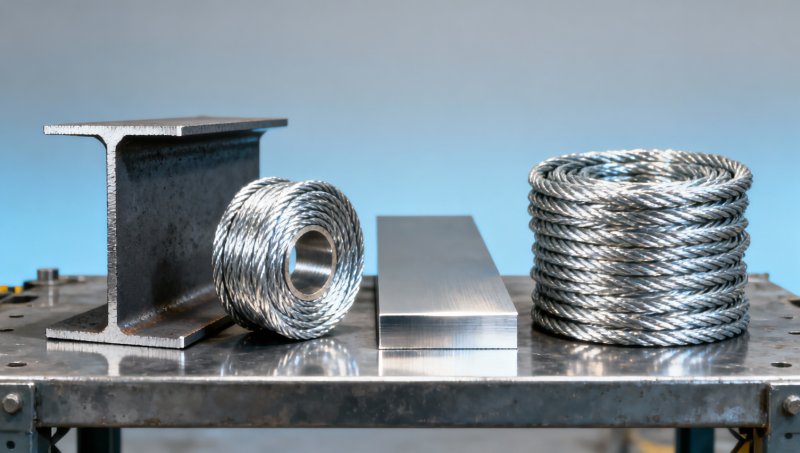
The table below compares ASTM A572 Grade 50 against three common alternatives used in global structural framing—highlighting trade-offs across mechanical performance, fabrication behavior, and lifecycle cost drivers.
Note the divergence in functional priorities: A572 and A992 prioritize structural integrity under static loads; SPCC emphasizes formability and surface finish for secondary components; while Galvanized Steel Wire Rope serves dynamic tension applications—from tower crane hoists to photovoltaic ground-mount cableways—where corrosion resistance and fatigue life dominate over yield strength alone.
Where Galvanized Wire Rope Fits Into Structural Systems
Though not a framing material per se, Galvanized Steel Wire Rope plays critical structural support roles in lifting, anchoring, and stabilization subsystems. Its zinc coating—ranging from 15 g/m² (mild corrosion) to 260 g/m² (severe marine or chemical exposure)—extends service life beyond 20 years in properly maintained installations.
Hongteng Fengda supplies wire rope in 8 standard strand configurations—including 6×19+IWS (improved wear resistance) and 8×19S+FC (high flexibility)—with diameters spanning 1.0 mm to 22 mm. Each batch complies with GB/T 20116-2008, ISO 9001, and ABS certification, ensuring traceability and consistent breaking load performance across delivery lots.
In practice, engineers specify galvanized wire rope when designing temporary bracing for tall steel frames, guy-wire systems for transmission towers, or fall-arrest lines for rooftop solar mounting. Unlike painted A572 members—which require recoating every 5–7 years in aggressive environments—galvanized rope maintains protection through abrasion and flex cycles without scheduled maintenance.
Procurement Guidance for Global Buyers
Selecting the right structural steel involves evaluating five core dimensions: compliance scope (ASTM vs EN vs GB), dimensional tolerance bands (±0.5 mm for laser-cut flanges), surface condition (mill scale vs pickled & oiled), delivery readiness (standard stock vs 4–6 week custom rolling), and documentation depth (mill test reports, third-party inspection certs).
- For North American bridge projects: Prioritize ASTM A709 Grade 50W over A572 if weathering resistance is required—eliminates painting costs and reduces lifecycle CO₂ by ~18%.
- For Middle Eastern oil & gas facilities: Specify ASTM A514 for heavy-lift cranes—its 690 MPa yield supports 300+ tonne lifting capacities with weight savings up to 22% versus A572 equivalents.
- For Southeast Asian prefab housing: Use cold-formed C-sections from SPHC or Q235B—lower yield but higher ductility improves seismic response and cuts welding labor by ~15%.
Hongteng Fengda supports this decision process with free technical consultation, sample testing, and multi-standard compliance verification—ensuring your order meets both local regulatory mandates and international engineering specifications.
Why Partner With Hongteng Fengda?
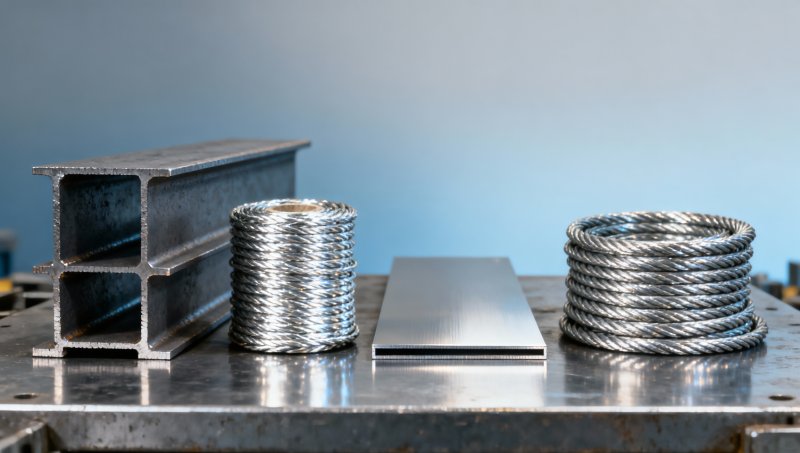
As a structural steel manufacturer and exporter from China, we combine ISO 9001-certified production with on-site quality audits by SGS, Bureau Veritas, and TÜV. Our facility handles annual output exceeding 800,000 metric tons—supporting stable lead times of 25–35 days for standard sections and 45–60 days for OEM profiles.
We don’t just supply steel—we co-engineer solutions. Whether you need ASTM A572 Grade 50 beams with certified Charpy impact values at -40°C, galvanized wire rope with ABS Type Approval for offshore cranes, or custom channel steel with laser-etched batch IDs for traceability—we align our processes to your project’s critical path.
Contact us today to request: (1) full mill test reports for upcoming shipments, (2) comparative pricing across ASTM/EN/GB variants, (3) sample kits with dimensional validation, or (4) engineering support for hybrid framing systems combining hot-rolled beams and cold-formed connectors.
Please give us a message


Please enter what you want to find