Z-beam is widely used where strength, light weight, and efficient support matter most in structural steel projects. From purlins and framing systems to industrial platforms, understanding where Z-beam performs best helps buyers, engineers, and contractors compare it with Q235 steel sections, steel beams, and other profiles. This guide explains practical applications, load considerations, and how the right structural steel supplier can improve project cost, durability, and efficiency.
For project managers, technical evaluators, procurement teams, and distributors, the real question is not whether a Z-beam is useful, but where it delivers the best balance of load performance, material efficiency, fabrication convenience, and corrosion protection. In many steel structures, choosing the wrong profile can increase dead weight by 10%–20%, complicate installation, or shorten service life in humid and industrial environments.
Because Z-shaped sections are often used as secondary structural members, roofing supports, wall girts, and light framing components, they are frequently evaluated alongside channel steel, I-beams, and cold formed steel profiles. Their value becomes clearer when engineers match span, spacing, wind load, and connection requirements to the right section depth and steel grade.
For global buyers sourcing from China, another practical issue is supply reliability. A manufacturer with stable production capacity, custom processing capability, and compliance with ASTM, EN, JIS, and GB standards can reduce procurement risk, improve delivery predictability, and support both standard and OEM structural steel requirements.
Where Z-Beam Delivers the Most Structural Advantage
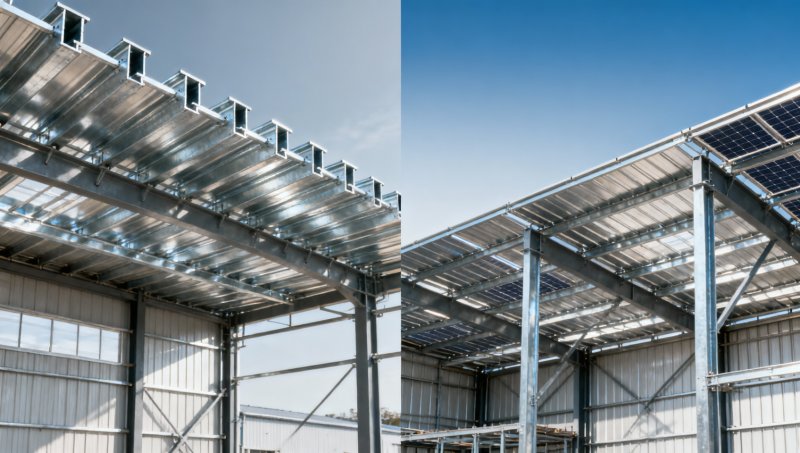
Z-beam works best in projects that require efficient load transfer with reduced steel weight. In practical construction, it is commonly selected for roof purlins, wall girts, mezzanine supports, cladding rails, equipment frames, and solar support structures. Compared with heavier hot-rolled steel beams, a well-designed Z section can lower material consumption while maintaining the stiffness needed for moderate spans.
One major advantage is geometry. The Z profile provides good bending performance in one primary direction, making it useful in long, repetitive framing lines. In industrial buildings, purlin spacing often falls within 1.0 m to 2.5 m, while spans may range from 4 m to 12 m depending on roof load, local wind pressure, snow requirements, and panel type. In these ranges, Z-beams often provide a practical balance between strength and fabrication economy.
Another advantage is lapped continuity. In multi-bay steel buildings, Z purlins can be overlapped at supports, improving structural continuity and reducing mid-span deflection. This is one reason they are widely used in warehouses, workshops, logistics buildings, agricultural sheds, and light industrial plants. The overlap method can improve frame efficiency without introducing the full cost of heavier primary beams.
For contractors and operators, handling matters as much as design. Because Z-beams are lighter than many traditional rolled sections, lifting, transport, and rooftop installation can become faster, especially where labor access or crane time is limited. On projects with hundreds or thousands of repeated members, reducing individual member weight can save significant installation time over a 2–6 week erection schedule.
Typical Applications by Project Type
The following comparison helps clarify where Z-beam is usually the better choice and where another structural steel section may be more suitable.
The key takeaway is simple: Z-beam is strongest as a secondary structural solution. It performs especially well in repetitive layouts, long building lines, and projects where steel weight, installation speed, and corrosion-resistant finishing all affect total project cost.
Key Selection Signals
- Choose Z-beam when the project includes repeated member spacing, such as 1.2 m, 1.5 m, or 2.0 m modules.
- Consider it when reducing dead load improves the performance of the primary frame and foundation system.
- Use caution when point loads are high, connections are highly eccentric, or the member must act as a major primary beam.
Load, Span, and Section Choice: How Engineers Evaluate Z-Beam Performance
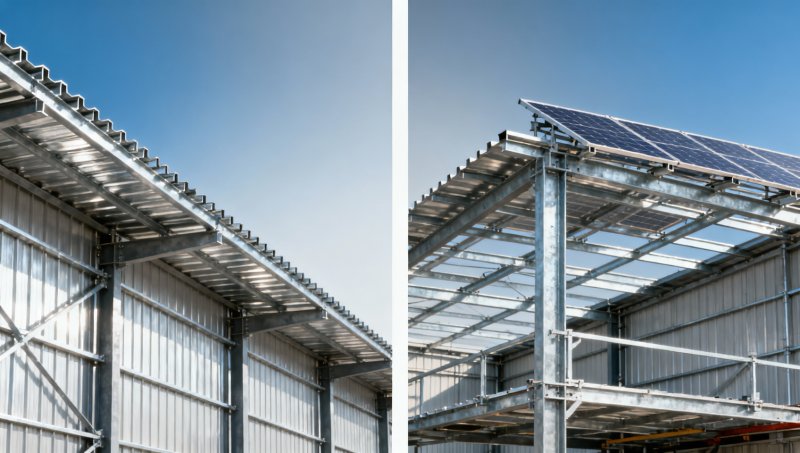
A Z-beam should never be selected by shape alone. Its performance depends on section depth, flange geometry, steel grade, support spacing, and service environment. Technical evaluators usually begin with three variables: design load, span length, and allowable deflection. In roofing applications, live load, wind uplift, snow accumulation, and maintenance foot traffic all influence the final selection.
As a practical rule, lighter Z sections can perform well in low to moderate load conditions, but the design must account for local code requirements and connection behavior. A small increase in section depth can significantly improve moment resistance, while poorly detailed bolt holes or unsupported flanges can reduce actual field performance. This is why fabrication accuracy and installation method matter as much as the nominal steel strength.
Buyers comparing Z-beams with Q235 steel sections or other cold formed profiles should also consider finish and lifecycle cost. An untreated section may be acceptable indoors, but exposed roofing and wall systems often require galvanized or coated steel. Corrosion can start at cut edges, fastener points, and moisture traps, especially in coastal, agricultural, or chemical environments where maintenance cycles may be shortened from 5–8 years to 2–4 years if protection is inadequate.
For procurement and finance teams, the right comparison is total installed value rather than unit price alone. A profile that costs 5% less per ton may still increase total cost if it requires more pieces, heavier lifting equipment, additional bracing, or earlier replacement. A supplier able to provide custom punching, exact lengths, and consistent tolerances can reduce waste and simplify assembly on site.
Common Evaluation Criteria
The table below outlines the main engineering and purchasing criteria used to assess whether a Z-beam is suitable for a given steel structure.
In practice, the best results come from aligning structural design, manufacturing capability, and site installation method. That alignment is especially important when projects involve export logistics, mixed standards, or customized punched and cut profiles.
Three Frequent Mistakes to Avoid
- Using a secondary Z profile where a primary beam is required for concentrated loads.
- Ignoring uplift and lateral restraint in high-wind regions.
- Comparing section prices without including coating, cutting, hole processing, and installation efficiency.
Why Surface Protection Matters in Real Z-Beam Applications
In many building systems, Z-beams are not isolated elements. They work together with roof sheets, wall panels, decking, and accessories that are all exposed to moisture, temperature cycling, and airborne contaminants. That is why corrosion resistance should be treated as part of structural performance, not as a separate finishing detail. In coastal warehouses, livestock facilities, and humid manufacturing plants, the wrong surface treatment can shorten usable service life and increase maintenance interruptions.
Where galvanization and coated sheet systems are combined correctly, the entire steel envelope performs better. For roofing and cladding packages, many buyers pair cold formed Z profiles with Coil Coated Galvanized Steel to improve moisture resistance and extend system life. This material is available in G90 and related specifications, with thickness from 0.12mm to 3.5mm, width from 600mm to 1500mm, and zinc layer options such as hot galvanizing at 60–275g/m².
For purchasers evaluating complete steel building packages, these numbers matter. Yield strength of ≥240–380 MPa, tensile strength of ≥270–500 MPa, and elongation of ≥22% support reliable forming and service performance in many panel and support applications. Common grades such as DX51D+Z, SGCC, S250GD+Z, S350GD+Z, and S550GD+Z allow engineers to choose the balance between formability and strength needed for different building environments.
The broader lesson is that Z-beam performance is strongest when the surrounding steel system is also selected carefully. A durable support member paired with weak cladding, or a coated roof attached to poorly protected framing, creates uneven lifecycle performance. Coordinating profiles, coatings, and standards from one experienced structural steel supplier can simplify inspection, reduce compatibility issues, and help distributors or contractors manage export procurement more efficiently.
Protection and Material Matching Guide
The following table shows how buyers often match structural use conditions with protective steel solutions in practical projects.
When building systems are designed as a package rather than as separate parts, maintenance planning becomes easier and long-term replacement costs are more predictable. That is a major advantage for commercial evaluators and enterprise decision-makers responsible for total asset value.
Procurement, Quality Control, and Delivery Planning for Global Buyers
Once the technical fit is confirmed, buyers still need to manage three commercial risks: inconsistent quality, delivery uncertainty, and mismatch between drawings and manufactured goods. In export structural steel supply, these risks often appear in projects that combine standard sections with custom punched holes, exact cut lengths, or mixed-surface treatments. A supplier that handles both standard steel products and OEM structural steel components can reduce coordination errors across the full order.
For example, a procurement plan for Z-beams should normally review 6 checkpoints: steel grade, section dimensions, coating type, hole position, bundle identification, and inspection documents. If just one of these items is unclear before production, site installation can slow down or rework may occur. On projects with 500 to 5,000 repeated members, even a small error rate can affect the entire construction schedule.
Hongteng Fengda serves global buyers with structural steel manufacturing and export support for construction, industrial, and manufacturing projects. With experience in angle steel, channel steel, steel beams, cold formed steel profiles, and customized structural steel components, the company supports customers who need both compliance and practical supply reliability. For projects across North America, Europe, the Middle East, and Southeast Asia, stable production capacity and dependable lead times are often as important as nominal material specification.
From a project management viewpoint, a realistic lead time for standard structural steel orders may be around 2–4 weeks depending on specification, while customized processing, packaging, or mixed-container export orders may require longer coordination. The best procurement outcomes usually come from early drawing confirmation, sample review where needed, and a clearly defined inspection standard before mass production begins.
Practical Procurement Checklist
- Confirm design standard first, such as ASTM, EN, JIS, or GB, before requesting quotation.
- Specify whether the Z-beam requires plain supply, galvanized finish, or custom processing including punching and cutting.
- Request packing and marking details for easier receiving, counting, and site distribution.
- Align delivery schedule with installation sequence to avoid long on-site storage exposure.
- Ask for dimensional tolerance and quality control checkpoints in advance, especially for repeat projects.
FAQ for Buyers and Technical Teams
How do I know if Z-beam is better than channel steel?
If the member functions mainly as a purlin or girt in a repetitive framing layout, Z-beam often offers better lapping efficiency and weight control. If the member faces high local impact, torsion, or special connection constraints, channel steel may be easier to detail.
What standards should export buyers check?
At minimum, confirm the applicable material and dimensional requirements under ASTM, EN, JIS, or GB, and ensure the supplier can match the project documentation to those standards without substitution risk.
How much does coating affect lifecycle cost?
In exposed environments, proper zinc coating and compatible cladding materials can greatly reduce early corrosion risk. The cost increase at purchase stage is often lower than the cost of premature maintenance, production downtime, or replacement work later.
What should quality teams inspect on arrival?
Check member count, tag identification, dimensions, hole position, coating condition, and visible deformation. These 6 inspection points are usually enough to identify most receiving issues before installation begins.
Z-beam works best where projects need efficient secondary structural support, manageable steel weight, repeatable installation, and good compatibility with modern roofing and wall systems. Its strongest applications are purlins, girts, and light framing across warehouses, workshops, industrial buildings, and other steel structure projects where span, spacing, and corrosion protection are properly matched to the design.
For buyers, engineers, and decision-makers, the right result depends on more than section shape. It requires coordinated evaluation of load conditions, protective finish, fabrication accuracy, delivery planning, and supplier capability. Hongteng Fengda supports global customers with structural steel manufacturing, export experience, customized solutions, and reliable quality control for standard and OEM requirements.
If you are comparing Z-beams, steel beams, channel steel, or coated steel solutions for an upcoming project, contact us to get technical guidance, product details, or a customized structural steel sourcing plan.
Please give us a message


Please enter what you want to find