An A36 carbon steel I-beam can be a practical choice for a welded support frame when its strength, section geometry, and weldability match the project’s design requirements. It is often worth considering for equipment bases, industrial platforms, and stationary support structures operating under ordinary service conditions. The decision becomes less straightforward when the frame faces significant vibration, long unbraced spans, low temperatures, or aggressive corrosion.
For project managers, the real question is not simply whether A36 is strong enough. It is whether the complete frame can be fabricated, inspected, delivered, and operated without avoidable redesign. A relatively inexpensive beam can become an expensive choice if the connections need rework or the material documentation does not satisfy the project specification.
Where an A36 carbon steel I-beam makes sense
ASTM A36 is a structural carbon steel specification covering shapes, plates, and bars. For structural shapes, its specified minimum yield strength is generally 36 ksi, approximately 250 MPa, with a tensile strength range of 58–80 ksi, approximately 400–550 MPa. These are material properties, not the allowable load of a finished beam or frame.
An A36 beam is a reasonable candidate when the structural engineer can satisfy strength, stability, and serviceability requirements using an available section, without needing unusually heavy members or complicated reinforcement.
These applications are not automatic approvals. A pump skid, for example, may have modest static weight but demanding vibration limits. A pipe support may carry little gravity load while receiving substantial horizontal forces from thermal expansion. The equipment and process data must come before the material decision.
Separate the steel grade from the beam designation
“I-beam” describes a general cross-sectional form; it does not establish a material grade or dimensional standard. Buyers may use the term for American standard beams, wide-flange sections, or other regional beam profiles. Those sections can differ in flange shape, web thickness, dimensions, and published section properties.
A purchase description such as “A36 I-beam, 200 mm” leaves too much open to interpretation. The engineer and supplier need an exact section designation, dimensional standard, length, and material specification. A beam with a similar overall depth may have very different bending resistance or connection geometry.
This is especially important when sourcing internationally. A grade supplied under EN, JIS, or GB should not be accepted as ASTM A36 merely because a comparison chart calls it similar. Chemical limits, mechanical properties, testing requirements, and certification can differ. Any alternative requires documented review and approval.
For procurement, keep these two questions separate: Is this the correct steel grade? and Is this the correct beam section? Both must be answered before cutting starts.
The frame calculation matters more than the grade label
A welded support frame behaves as a system. Its beams, columns, braces, base plates, welds, and anchors all participate in carrying loads. Selecting an A36 carbon steel I-beam by equipment weight alone overlooks several common failure mechanisms.
Check every meaningful load condition
The design basis should include dead loads, operating loads, maintenance loads, and applicable wind or seismic actions. Equipment supports may also need startup, shutdown, impact, or cyclic loading checks. Transportable frames require separate consideration of lifting and shipping conditions, which can produce load paths unlike those in normal service.
Ask equipment vendors for support reactions and permissible movements, not just total mass. A centrally stated weight does not reveal whether one mounting point takes a disproportionate load or whether the equipment applies torsion to the frame.
Do not confuse strength with stiffness
A beam may pass a strength check and still deflect too much for connected equipment. A36 and common higher-strength structural steels have approximately the same elastic modulus. Changing to a higher yield-strength grade therefore does not, by itself, meaningfully reduce elastic deflection for the same section and loading.
If stiffness controls, a deeper section, shorter span, additional support, or revised frame arrangement may be more effective than a grade upgrade. This distinction can prevent a procurement change that adds cost without solving the actual problem.
Confirm restraint and concentrated-load details
An I-shaped beam can be vulnerable to lateral-torsional buckling when its compression flange is insufficiently restrained. Local flange bending, web yielding, or web crippling may also govern where loads enter through small equipment feet or brackets. Stiffeners and load-spreading plates should follow the engineer’s calculations rather than workshop habit.
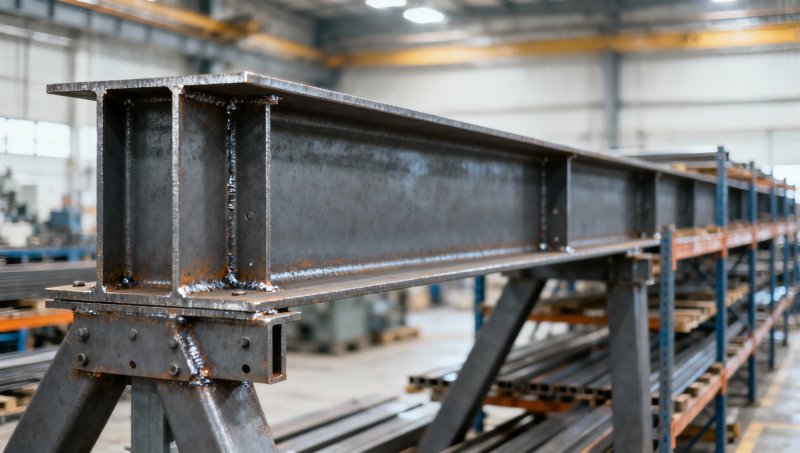
A useful frame drawing should make these details visible: load application points, lateral restraints, stiffener positions, connection plates, and weld locations. When those features are left ambiguous, the fabricator ends up making decisions that belong in the structural design.
Good weldability does not remove the need for welding control
A36 is commonly welded using established structural welding processes. That makes it attractive for fabricated support frames, but “weldable” is not the same as “any weld will do.” Joint configuration, member thickness, restraint, consumables, and working conditions all influence the finished connection.
The project should establish the applicable welding code and a suitable welding procedure specification. For projects using American structural practice, AWS D1.1 may apply, subject to the contract and jurisdiction. Preheat requirements must be determined from the relevant code and procedure, considering factors such as material composition, thickness, and hydrogen control.
- Design the joint for access: The welder needs room to achieve the specified weld, and inspectors need access to examine it.
- Specify weld size and extent: Larger welds are not automatically better; unnecessary weld metal increases heat input, distortion, and fabrication time.
- Plan the welding sequence: Tack arrangement, balanced welding, and assembly fixtures can help maintain frame geometry.
- Set inspection requirements: Visual inspection and any required nondestructive testing should be defined before production.
Distortion deserves particular attention on machinery frames. A structurally acceptable assembly may still be unsuitable if mounting surfaces are out of plane or bolt locations no longer match the equipment. Agree on dimensional tolerances and whether machining or other corrective operations are required.
When a different grade—or a different frame layout—is preferable
A36 should not remain the default simply because it appeared on a previous project. When strength governs and weight reduction matters, a higher-strength structural grade may offer an advantage. ASTM A992 is commonly specified for wide-flange building shapes in US practice, while ASTM A572 Grade 50 may be relevant for suitable products and applications. Availability and project requirements should guide the comparison.
Neither option eliminates the need to check deflection, buckling, weld details, or connection capacity. Compare the fabricated system, not just the yield-strength figures.
Other service conditions require a different kind of review:
- Low-temperature or impact-sensitive service: ASTM A36 alone does not establish the required notch toughness. Specify impact-testing requirements or a suitable alternative where the design demands them.
- Repeated or vibrating loads: Fatigue performance depends heavily on stress ranges and welded detail categories, not merely on a higher-strength grade.
- Elevated-temperature exposure: Room-temperature properties are insufficient for evaluating hot-service or fire conditions.
- Corrosive environments: A stronger grade does not solve section loss. Protective systems, drainage, accessibility, and maintenance remain essential.
Sometimes the best answer is not another material. Adding bracing, moving a support, or changing the load path can produce a more buildable solution than increasing member strength.
Plan corrosion protection around the complete assembly
For indoor frames in controlled environments, a suitable paint system may be sufficient. Outdoor, humid, or chemically exposed installations need a coating specification tied to actual exposure and expected maintenance. Avoid details that trap water around stiffeners, base plates, and closely spaced attachments.
If hot-dip galvanizing is selected, coordinate assembly size, venting and drainage where applicable, dimensional sensitivity, and subsequent repair requirements with the galvanizer. Welding through zinc coatings presents fume and weld-quality concerns; use an approved preparation and repair procedure rather than treating coated steel like clean, bare material.
Some support-frame projects also include tension elements or lifting-related equipment. Where appropriate, Galvanized Steel Wire Rope can be considered as a separately specified component, not as a direct substitute for a rigid brace. Available product options include several strand constructions and diameters from 1.0 mm to 22 mm, but selection must address rope construction, breaking force, terminations, corrosion exposure, and application-specific requirements. Rope wire tensile strength is not the allowable working load of the assembled rope, and lifting duties require separately verified ratings.
What project managers should confirm before fabrication release
The most useful procurement package makes the engineer’s intent clear enough that neither the supplier nor the fabricator has to guess. Before releasing an order, confirm the following:
- Approved design basis: Loads, service conditions, design code, equipment interfaces, and movement limits are recorded.
- Complete material description: ASTM specification, exact section designation, dimensional standard, quantities, and lengths are stated.
- Traceable documentation: Required mill test reports identify the supplied material and relevant chemical and mechanical test results.
- Approved fabrication drawings: Welds, stiffeners, connection plates, holes, tolerances, and inspection hold points are defined.
- Finished-condition requirements: Coating, surface preparation, marking, packing, and any critical mounting-surface requirements are agreed.
- Controlled substitutions: Alternative grades or sections require approval before purchasing or fabrication, not after delivery.
Hongteng Fengda, a structural steel manufacturer and exporter based in China, supplies beams, angles, channels, cold-formed profiles, and customized structural components. For an international support-frame order, the useful starting point is an approved drawing package and a clear standard requirement. Buyers should request confirmation of the specific grade, section availability, documentation, and fabrication scope rather than assume every product carries the same compliance basis.
Ultimately, an A36 carbon steel I-beam suits a welded support frame when the calculations support it, the connections are practical, and the service environment does not demand properties beyond the specified material. That is a more reliable decision than choosing by price alone—and a better way to keep fabrication, installation, and project handover on track.
Please give us a message


Please enter what you want to find