Steel Wire strength and performance depend on material grade, carbon content, heat treatment, coating such as Galvanized, and manufacturing precision. For buyers and engineers comparing steel products from Steel Beam to Steel Sheet Pile, understanding these factors helps improve safety, durability, and cost control. This guide explains what matters most when selecting reliable steel solutions for demanding structural and industrial applications.
In real procurement and engineering work, steel wire is rarely judged by tensile strength alone. Operators care about flexibility and fatigue life, quality teams focus on consistency and coating integrity, and project managers need predictable delivery and compliance with ASTM, EN, JIS, or GB standards. A wire that performs well in one environment may fail early in another if the grade, treatment, or dimensional control is not matched to service conditions.
For B2B buyers, the practical question is not simply which wire is stronger, but which wire offers the right balance of load capacity, corrosion resistance, manufacturability, and total cost. This is especially important in construction, lifting, reinforcement, mesh production, automotive components, and industrial fastening systems where a small deviation in chemistry or processing can create large downstream risks.
Core Material Factors That Determine Steel Wire Strength
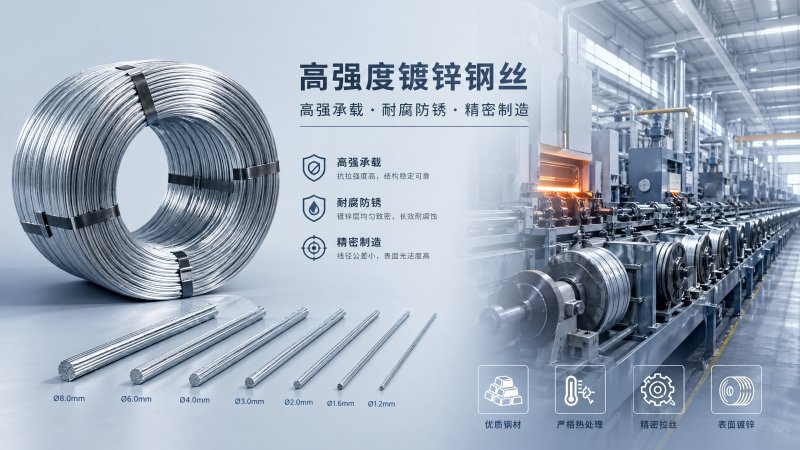
The first driver of steel wire strength is base material selection. Low-carbon wire typically offers better ductility and formability, while medium- and high-carbon wire usually delivers higher tensile strength after drawing and heat treatment. In many industrial applications, carbon content differences within a range such as 0.08% to 0.85% can significantly change hardness, elongation, and bending behavior.
Alloying elements also matter. Manganese can improve hardenability, silicon may increase strength, and chromium or nickel may support corrosion resistance in specific grades. However, higher alloy content does not automatically mean better performance. The correct choice depends on whether the wire will be bent, welded, tensioned, braided, or exposed to moisture, salt, chemicals, or cyclic loading.
Microstructure is another overlooked factor. Two wires with similar nominal chemistry can perform differently if one has a more uniform pearlitic structure or cleaner grain flow after processing. For this reason, serious buyers often review not only the material designation, but also mill test data, tensile range, yield behavior, elongation, and surface condition before approval.
Why carbon level changes performance so much
As carbon increases, tensile strength and hardness generally rise, but ductility and ease of welding usually decline. A low-carbon wire may be preferred for forming, tying, or mesh production, while high-carbon wire is more suitable for springs, prestressing, or high-load tension applications. Choosing the wrong carbon level can lead to cracking during bending or insufficient load capacity in service.
Typical material comparison
The table below shows how common material categories influence wire behavior in practical use. These are typical selection tendencies rather than fixed values, because exact performance still depends on diameter, processing route, and final specification.
The main takeaway is that strength must be matched with use conditions. A stronger wire is not always the safer or more economical choice if the application requires repeated bending, field welding, or corrosion exposure over 10 to 20 years.
How Processing, Heat Treatment, and Coating Affect Performance
Manufacturing route has a direct effect on steel wire performance. Drawing reduction, annealing, patenting, quenching, tempering, and straightening each influence final strength and stability. For example, cold drawing increases tensile strength by work hardening, but excessive reduction in a single stage can reduce ductility and increase the chance of surface damage or residual stress concentration.
Heat treatment is especially important when wire must combine strength with controlled elongation. Annealed wire is softer and easier to shape, while patented or heat-treated wire can achieve more stable performance for springs, ropes, and prestressed uses. In many production settings, a difference of even 20 to 40 HV in hardness can affect downstream forming speed, wear on tools, and acceptance rates.
Coating selection protects wire from corrosion and extends service life. Galvanized steel wire is widely used where outdoor exposure, humidity, or contact with concrete and rainwater is expected. Coating thickness, adhesion, and uniformity all matter. A wire with poor zinc coverage may show early red rust even if its base steel strength is acceptable.
Surface quality and dimensional precision
Wire performance is also affected by dimensional tolerance and surface finish. Diameter variation beyond a practical range such as ±0.02 mm to ±0.10 mm, depending on wire size and use, can create uneven load sharing, poor machine feeding, or unstable winding tension. Surface defects such as seams, laps, scratches, and decarburization may become crack initiation points under dynamic load.
Processing factors buyers should verify
Before confirming an order, technical and procurement teams should compare the process-related items below. These checkpoints help reduce quality disputes and improve fit for use.
- Confirm whether the wire is as-drawn, annealed, galvanized, or heat-treated for a specific mechanical target.
- Check tensile strength range, elongation, and hardness rather than asking only for a nominal grade.
- Review zinc coating mass or coating type if the wire will be used outdoors or in humid facilities.
- Ask for diameter tolerance, coil weight range, and surface inspection method to support machine compatibility.
For long-term projects, these process details often matter as much as base chemistry. They influence installation efficiency, maintenance frequency, and the probability of failure during the first 6 to 24 months of service.
Application Matching: Choosing Wire for Structural and Industrial Use
Selecting steel wire should begin with the real load path and service environment. Static load, impact, vibration, bending radius, corrosion exposure, and joining method all affect the required performance profile. A warehouse tie wire, a bridge-related cable component, and an automotive spring wire may all be made from steel, but their strength targets and failure modes are completely different.
This application-based thinking applies across the broader steel industry as well. Engineers comparing wire with structural sections often look for the same decision logic: material grade, dimensional consistency, standard compliance, and performance under real operating conditions. For example, when projects also require beams or fabricated members, buyers often evaluate section efficiency, grade availability, and lead-time stability together rather than in isolated product categories.
A practical example is H Girder selection in steel structures, shipbuilding, bridging, mechanical manufacture, and automobile chassis support systems. Available in H-beam form with materials such as Q235, Q345B, Q460C, SS400, S275JR, S355JR, A572, A992, and stainless options like 304 or 316, it is commonly chosen for strong bending resistance, light weight, and cost-saving construction efficiency. Typical dimensions include flange thickness from 8 mm to 64 mm, web thickness from 5 mm to 36.5 mm, lengths from 1 m to 12 m, flange width from 50 mm to 400 mm, and web width from 100 mm to 900 mm.
How standards and dimensions influence application fit
Whether the product is steel wire or a structural section, compliance with JIS G3101, EN10025, ASTM A36, ASTM A572, or ASTM A992 supports consistent engineering review. Buyers should verify not only the standard name but also the exact grade, tolerances, mechanical values, and inspection items required for the destination market. This becomes more important when sourcing for North America, Europe, the Middle East, or Southeast Asia, where project specifications may differ significantly.
Typical application mapping
The table below links performance priorities with common use scenarios, helping buyers align specification with real operational needs.
This comparison shows why application matching is the center of good sourcing. It helps avoid overspecification, reduces unnecessary material cost, and lowers the risk of production stoppage or field replacement.
Procurement, Quality Control, and Risk Reduction for Global Buyers
For procurement teams and business decision-makers, steel wire performance is only part of the equation. Supply stability, production capability, inspection discipline, and lead-time reliability also affect total project cost. A lower unit price can become expensive if the supplier cannot maintain consistent chemistry, coating quality, or packaging performance across repeated batches.
A disciplined sourcing process usually includes 4 key checkpoints: specification review, sample or trial confirmation, production monitoring, and pre-shipment inspection. For repeat industrial orders, buyers often define acceptable ranges for tensile strength, diameter tolerance, coating mass, coil weight, and packaging condition before mass production begins. This is more effective than relying on final visual inspection alone.
Quality control teams should also consider how wire will be processed after delivery. If it will go through straightening, weaving, welding, or spring forming, hidden issues such as residual stress or coating brittleness may appear only during conversion. That is why test items should reflect the end-use process rather than only warehouse acceptance standards.
A practical supplier evaluation framework
The following checklist can help importers, distributors, and project managers compare suppliers more objectively, especially when sourcing from multiple countries or planning annual volume contracts.
- Verify production scope: confirm whether the supplier handles standard grades, custom diameters, OEM packaging, and multi-product steel supply.
- Check standards coverage: ensure alignment with ASTM, EN, JIS, or GB requirements specified by the project or end customer.
- Review quality documents: request mill test certificates, inspection records, and coating or mechanical test details where relevant.
- Assess delivery discipline: confirm realistic production cycle, batch consistency, and packaging suitable for sea freight over 2 to 6 weeks.
Common sourcing risks and controls
The table below summarizes frequent risks in steel purchasing and the control measures that reduce claims, delays, and hidden cost escalation.
For global buyers looking for broader structural steel support, working with a manufacturer that also supplies angles, channels, beams, cold formed profiles, and customized components can simplify procurement and reduce coordination cost across multiple SKUs.
Selection Tips, Common Mistakes, and FAQ for Decision-Makers
Many steel wire failures are not caused by poor raw material alone, but by mismatch between specification and use. A common mistake is focusing on the highest strength value without considering bending, fatigue, corrosion, or weldability. Another is approving samples from one batch and assuming the same consistency over the next 3 to 12 months without clear quality controls.
Decision-makers should compare steel wire in terms of total operating value. This includes initial price, expected service life, processing efficiency, rejection rate, and maintenance burden. In many cases, a wire with better dimensional stability and coating uniformity reduces downtime enough to offset a moderate increase in purchase cost.
For project managers and financial approvers, the most reliable path is to combine technical review with supply chain review. That means confirming performance targets, standards, packaging, documentation, and lead times before order release rather than solving issues after cargo arrival.
How do I choose the right wire for outdoor use?
Start with the exposure level. For rain, humidity, and general external use, galvanized wire is usually preferred. Then confirm coating quality, service life expectations, and whether the environment includes salt spray or industrial chemicals. In severe corrosion zones, buyers should ask for more detailed coating and maintenance guidance instead of choosing only by base grade.
Which indicators matter most during technical evaluation?
At minimum, review 5 items: material grade, tensile strength range, elongation or ductility, diameter tolerance, and surface or coating condition. If the wire will be formed or dynamically loaded, also review hardness, fatigue-related suitability, and any heat-treatment condition listed by the supplier.
What is a reasonable lead-time expectation?
For standard steel products, common manufacturing lead times can range from 7 to 25 days depending on grade, quantity, and finishing requirements. Export shipment planning may add another 2 to 6 weeks based on destination. Custom packaging, OEM marking, or mixed container orders usually require earlier coordination to avoid schedule pressure.
Final decision checklist
- Match wire strength to the actual load and forming requirement, not just to a higher number.
- Confirm heat treatment and coating details when durability or downstream processing is critical.
- Request standards-based documentation and measurable tolerances before placing volume orders.
- Choose suppliers with stable production, strict QC, and the ability to support both standard and custom structural steel needs.
Steel wire strength and performance are shaped by chemistry, processing, coating, dimensional precision, and application fit. For buyers seeking dependable steel sourcing from China, Hongteng Fengda supports global construction, industrial, and manufacturing projects with stable production capacity, international standard compliance, and customized structural steel solutions. If you need help comparing specifications, evaluating project requirements, or sourcing related steel products, contact us to get a tailored solution and detailed product support.
Please give us a message


Please enter what you want to find