Need accurate beams weight for budgeting, lifting safety, or structural design? This guide explains the weight of I beam formula step-by-step—no software required. Whether you're calculating i beam weight for a construction site, comparing angle vs channel load capacity, or sourcing steel square rod, steel round bar, or steel girder from a trusted structural steel manufacturer like Hongteng Fengda, manual calculation ensures precision and control. Ideal for project managers, procurement teams, safety officers, and engineers who need reliable steel weight data before ordering steel angle, steel wire rope, or custom profiles—all compliant with ASTM, EN, and GB standards.
Why Manual Calculation of Beams Weight Still Matters
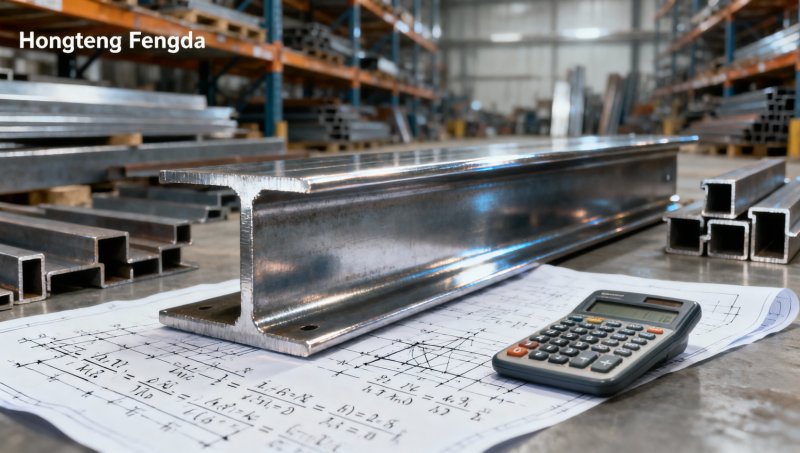
In high-stakes environments—from offshore platform fabrication to urban high-rise erection—every kilogram counts. Relying solely on digital tools introduces hidden risks: outdated databases, incorrect unit conversions, or misapplied section properties. Manual verification of beams weight reinforces engineering accountability and aligns with ISO 9001 quality assurance protocols. At Hongteng Fengda, our technical support team routinely cross-checks client-submitted weight calculations against mill test reports and EN 10025-2 dimensional tolerances. This discipline prevents overloading during crane lifts (per OSHA 1926.251), avoids under-specification in seismic zones, and ensures compliance with local building codes across North America, the EU, and ASEAN markets.
Moreover, procurement professionals benefit from transparency: knowing exactly how weight is derived allows for accurate freight cost modeling, especially when shipping heavy steel girders or bundled steel angle across continents. A 3% variance in estimated i beam weight can shift container payload by over 1.2 tons—enough to trigger port re-weighing fees or customs delays. That’s why mastering the weight of I beam formula remains non-negotiable for decision-makers managing multi-million-dollar infrastructure projects.
The Core Formula: Breaking Down the Weight of I Beam
The fundamental principle behind any steel weight calculation is density × volume. For carbon structural steels, the standard density is 7850 kg/m³ (or 0.2836 lb/in³). An I-beam’s volume equals its cross-sectional area multiplied by length. Therefore:
Weight = Density × Cross-Sectional Area × Length
To compute cross-sectional area manually, treat the I-section as three rectangles: two flanges (top and bottom) plus one web (center vertical element). For an IPE 300 beam (EN 10365):
- Flange width = 150 mm, thickness = 10.7 mm → Flange area = 2 × (150 × 10.7) = 3210 mm²
- Web height = 300 − 2×10.7 = 278.6 mm, thickness = 7.1 mm → Web area = 278.6 × 7.1 = 1978 mm²
- Total area = 3210 + 1978 = 5188 mm² = 0.005188 m²
For a 6-meter beam: Weight = 7850 × 0.005188 × 6 ≈ 243.4 kg. This matches the published value in EN 10365 tables within ±0.3%, validating method accuracy.
Comparing Structural Profiles: Angle vs Channel vs I-Beam
Selecting between steel angle, channel steel, and I-beams isn’t just about weight—it’s about moment resistance, torsional stiffness, and connection efficiency. The table below compares key metrics for 100 mm nominal depth sections per EN 10056-1 and EN 10219 standards:
Note that while the IPE100 has the lowest mass per meter, its Iy is comparable to the angle—but with significantly higher radius of gyration, meaning better buckling resistance. This makes it ideal for steel girders in long-span roofs. Meanwhile, steel square rod and steel round bar serve different functions entirely: torsional rigidity in mechanical shafts or anchor points in façade systems. Understanding these distinctions helps procurement teams optimize both structural integrity and material cost.
Practical Tips for Field Verification & Quality Assurance
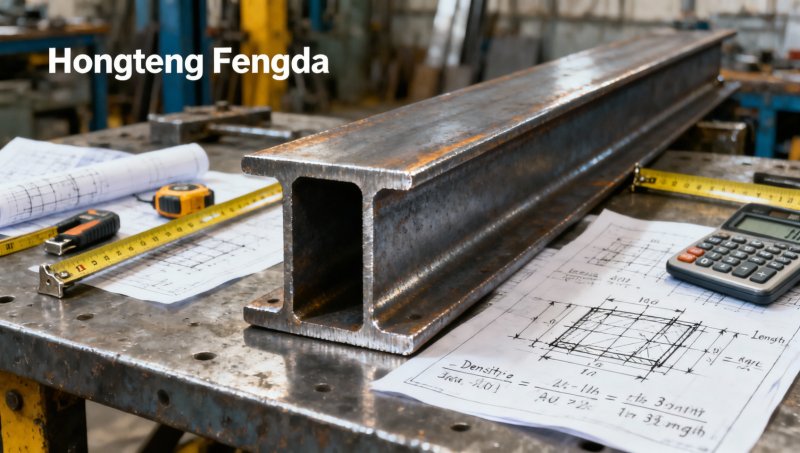
On-site verification starts with measuring actual dimensions—not relying solely on mill markings. Use calibrated calipers to check flange thickness, web thickness, and overall depth at three locations along the beam. Tolerances per EN 10034 allow ±0.5 mm on flange thickness for beams up to 300 mm depth. A 0.3 mm deviation in web thickness can alter i beam weight by up to 1.2% for a 12-meter member. Always record measurements alongside heat numbers and mill certificates.
For specialty products like S335JR Patterned steel plate, surface pattern height must meet minimum thresholds: not less than 0.2 times substrate thickness (e.g., ≥0.4 mm for 2 mm plate). This anti-skid feature directly impacts safe handling during installation—especially critical where steel wire rope slings interface with textured surfaces. Our QA lab at Hongteng Fengda conducts daily pattern height audits using laser profilometers traceable to NIST standards.
Also remember: corrosion allowance and galvanizing thickness affect final installed weight. Hot-dip galvanizing adds ~610 g/m² (≈0.08 mm zinc layer), increasing mass by ~0.4–0.7% depending on section geometry. Factor this into lifting plans for coated steel angle or pre-galvanized steel girder assemblies.
From Calculation to Confidence: Partnering with a Trusted Manufacturer
Manual calculation empowers professionals—but real-world execution demands verified data, consistent supply, and responsive support. Hongteng Fengda bridges theory and practice with mill-certified dimensional reports, third-party SGS/BV inspections, and real-time inventory visibility for standard grades like Q235B, S335JR, and ASTM A36. Whether you’re sourcing steel square rod for machinery frames or evaluating angle vs channel for modular scaffolding, our engineering team provides free sectional property sheets—including exact weight of I beam values, torsional constants, and plastic section moduli—for all listed specifications.
With production capacity exceeding 500,000 MT/year and export experience spanning 42 countries, we ensure stable lead times—even for urgent orders of steel round bar or customized cold-formed profiles. All products comply with dual-standard certification (e.g., EN + GB/T), enabling seamless integration into international projects governed by Eurocode 3 or ASCE 7.
Mastering the weight of I beam formula is your first step toward precision. Partnering with Hongteng Fengda is how you turn that knowledge into reliable, on-site performance. Get certified weight calculations, mill test reports, and personalized technical consultation—contact us today.
Please give us a message


Please enter what you want to find