When evaluating structural materials, selecting the right steel Profile is critical for ensuring integrity and maximizing load-bearing performance. For technical evaluators, understanding the precise grades and load-bearing specifications of each Profile is essential to mitigate risks and guarantee compliance with global standards like ASTM and EN. This guide breaks down the technical parameters of structural steel profiles, empowering you to make informed, data-driven material selections for your next construction or manufacturing application.
Decoding Steel Profile Grades: Beyond the Basic Designations
Technical evaluators often start with the grade designation, but stopping at the name can lead to costly misalignments in structural design. Take the widely used ASTM A992 for wide-flange beams in North America, or the EN 10025 S355 standard in Europe. While both are high-strength low-alloy structural steels, their chemical compositions, specific mechanical requirements, and testing protocols differ significantly.
Yield strength is usually the primary driver in structural design, dictating the point at which the material begins to deform plastically. However, relying solely on yield strength is a common pitfall. The tensile strength and the elongation percentage are equally vital for assessing how the steel will behave under extreme, unexpected loads or seismic events. Furthermore, the stress-strain curve provides a much clearer picture of the material's ductility and strain-hardening behavior than a single yield value.
When evaluating grades for projects in harsh environments, fracture mechanics become paramount. If a project specifies Charpy V-notch testing at -20°C or -40°C, a standard grade that meets room-temperature yield requirements might fail the technical evaluation entirely. The transition temperature of the steel must be verified to ensure it remains tough and resistant to brittle fracture under the specific operational conditions of the structure.
Load-Bearing Specifications: The Intersection of Geometry and Material
Material grade only tells half the story. The actual load-bearing capacity of a steel Profile is a function of both its material properties and its cross-sectional geometry. Parameters like the moment of inertia, the section modulus, and the radius of gyration dictate how a beam or column will resist bending, shear, and buckling.
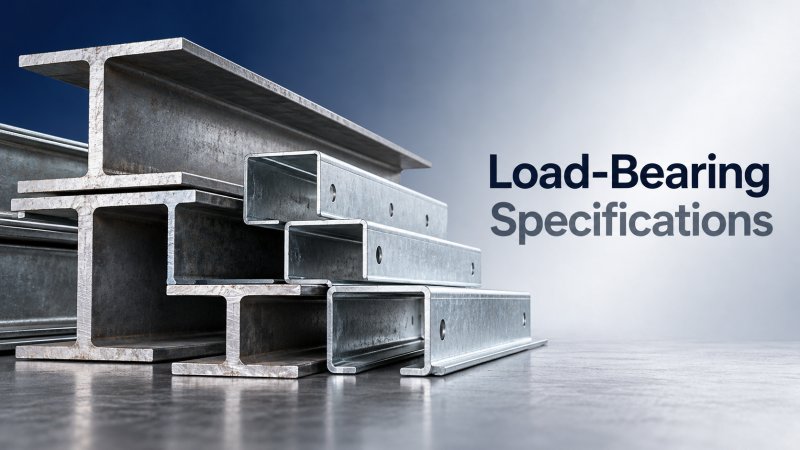
This is where the distinction between hot-rolled sections and cold formed steel profiles becomes highly relevant for technical calculations. Hot-rolled beams typically have thicker webs and flanges with generous root radii, making them ideal for heavy, static load-bearing applications where global buckling is the primary concern.
Cold formed profiles, on the other hand, are created by bending sheet or strip steel at room temperature. This process increases the yield strength at the corners due to strain hardening. For technical evaluators, this means cold formed profiles can offer a higher strength-to-weight ratio. However, their load-bearing calculations must carefully account for local buckling in thin-walled elements and the specific geometric tolerances inherent in the cold forming process. The reduced ductility at the bend radii also means that these areas cannot be relied upon for significant plastic redistribution of stresses.
Corrosion Protection and Long-Term Load Integrity
A structural design is only as good as its durability. Load-bearing specifications assume a certain cross-sectional area throughout the design life of the structure. If corrosion eats away at that area over time, the actual load capacity drops below the design threshold, leading to premature structural degradation.
This is why specifying the right protective coating is a technical necessity, not just an aesthetic choice. In many modern manufacturing and construction applications, using pre-galvanized or hot-dip galvanized materials is standard practice. When producing custom cold formed components, starting with high-quality Steel Coil Galvanized ensures that the zinc layer acts as a physical barrier while also providing cathodic protection. The zinc decomposes first to protect the underlying steel, significantly extending the service life.
Technical evaluators must verify the zinc coating mass (e.g., 60-275g/m² for hot galvanizing) and ensure that the forming process doesn't compromise the coating's adhesion. It is also crucial to consider how the coating thickness affects the final dimensions. In precision cold formed profiles, the added thickness of the zinc layer must be factored into the geometric calculations, especially when dealing with structural grades like S350GD+Z or S550GD+Z where tight tolerances are expected.
Navigating Global Standards and Sourcing Realities
Global supply chains mean that a project designed in Europe might source materials from Asia or the Middle East. This introduces the challenge of cross-standard compliance. Technical evaluators must often map local specifications to international equivalents, ensuring that the mill test certificates align perfectly with the project's governing codes.
Dimensional tolerances add another layer of complexity. A profile might meet the correct material grade, but if it is manufactured to a tolerance standard that allows wider deviations (such as certain commercial tolerances versus strict structural tolerances in EN 10034 or ASTM A6), the actual section properties might fall short of the design assumptions.
This is where partnering with a versatile and technically competent manufacturer becomes a strategic advantage. As a professional structural steel manufacturer and exporter based in China, Hongteng Fengda understands the friction caused by standard mismatches. By specializing in angle steel, channel steel, steel beams, and cold formed steel profiles, the company supplies both standard specifications and OEM solutions. Their modern manufacturing facilities and strict quality control ensure that products comply with major international standards, including ASTM, EN, JIS, and GB. For technical evaluators, having a supplier that can provide precise mill certificates and accommodate customized structural steel components reduces the risk of receiving materials that are technically compliant on paper but fail in practical application.
Practical Verification Steps for Technical Evaluators
When reviewing material submissions, a few critical checks can prevent downstream failures and ensure the structural integrity of the final build.
First, verify the dimensional tolerances against the specific structural standard required. A steel beam might meet the correct grade, but if the flange thickness is at the absolute minimum of the allowable negative tolerance, the section modulus drops, directly affecting the load-bearing capacity.
Second, review the welding compatibility. If the steel Profile is going to be welded on-site, the carbon equivalent (CE) value must be checked. High-strength grades with higher carbon equivalents might require pre-heating or specific welding consumables to prevent cold cracking in the heat-affected zone.
Finally, assess the delivery condition and traceability. Some high-strength profiles are delivered thermomechanically rolled (TMR) or normalized. Cutting or welding these profiles without respecting the heat-affected zone limitations can alter the localized mechanical properties, effectively downgrading the material in critical stress areas. Always ensure that the mill test certificates (such as EN 10204 3.1 or 3.2) provide full traceability from the heat number to the specific batch of profiles delivered to the site.
Selecting and verifying steel profiles is a multidimensional task that goes far beyond simply matching a grade name to a structural drawing. It requires a deep understanding of material behavior, geometric properties, environmental factors, and manufacturing realities. By paying close attention to the intersection of these elements, technical evaluators can ensure that every structure they assess is not only compliant on paper but resilient in the real world. Always cross-reference specific project parameters with the latest material certifications and tolerance standards before finalizing your technical approvals.
Please give us a message


Please enter what you want to find