Confused about whether steel iron angle and metal angle plate are interchangeable? They’re often mistaken for the same product—but differences in material composition (e.g., carbon steel angle iron vs. galv steel angle), cross-section geometry (L-shape angle iron vs. flat metal angle plate), manufacturing standards (ASTM/EN/GB), and application requirements (architectural steel angle, steel angle trim, or angle bars with holes) make them functionally distinct. For procurement teams, engineers, and project managers sourcing from China, understanding these nuances ensures structural integrity, compliance, and cost efficiency—especially when specifying products like metal angle bars or steel plate angle for global construction projects.
Material Composition & Metallurgical Behavior Define Functional Limits
“Steel iron angle” is a colloquial term often used in trade contexts to refer to hot-rolled carbon steel angle sections—typically conforming to Q235, Q345, or ASTM A36 specifications. These profiles feature consistent tensile strength (370–500 MPa for Q235; 470–630 MPa for Q345), controlled carbon content (0.12–0.22%), and predictable weldability. In contrast, “metal angle plate” usually denotes flat steel plates cut and bent into L-shaped configurations—commonly sourced from SS400, S235J2, or ST37-2 grades—but with variable grain orientation, residual stress distribution, and no standardized flange-to-web thickness ratio.
This distinction directly impacts load-bearing capacity. For example, a 75×75×6 mm hot-rolled angle iron (Q235) delivers uniform torsional rigidity across its full length due to controlled rolling temperature (≈950°C) and slow cooling. A comparable bent plate angle may exhibit localized micro-cracks at the bend radius (R ≥ 2× thickness required per EN 10025-2), reducing fatigue life by up to 35% under cyclic loading in industrial structures.
Corrosion resistance further diverges: galvanized steel angle iron undergoes post-rolling hot-dip galvanizing (Zinc coating ≥ 610 g/m² per ASTM A123), whereas metal angle plates are typically coated only after fabrication—leaving cut edges and weld seams unsealed unless re-treated. This leads to accelerated pitting in coastal or high-humidity environments.
For structural applications requiring long-term dimensional stability—such as steel angle trim in façade systems or architectural steel angle supports—hot-rolled sections remain the benchmark. Bent plates serve well where custom geometry outweighs precision demands, e.g., non-load-bearing brackets or temporary fixturing.
Cross-Section Geometry: Why L-Shape Isn’t Just About Appearance
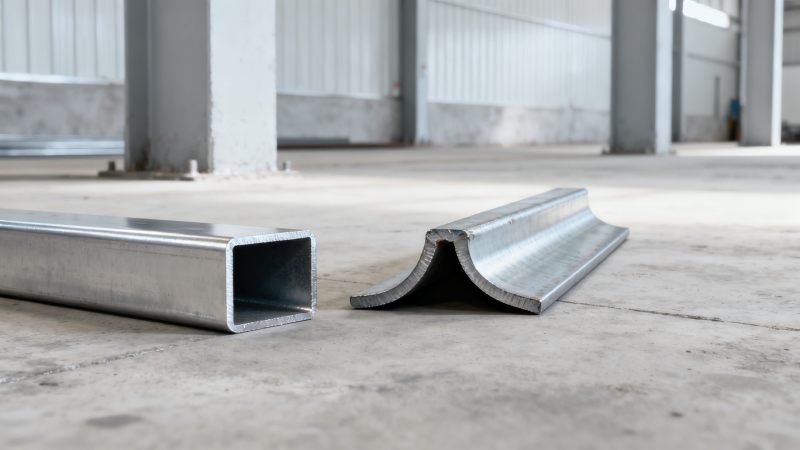
The L-shaped profile of standard angle iron follows strict geometric ratios defined in ASTM A6/A6M and GB/T 706. Flange width, web thickness, and root radius are interdependent—ensuring predictable moment of inertia (Ix = 125 cm⁴ for 80×80×8 mm Q235) and section modulus (Wx = 31.2 cm³). Metal angle plates, however, lack such design integration: their “L” is a mechanical approximation—not an engineered section.
Consider a 100×100×10 mm specification. Hot-rolled angle iron maintains a consistent 12–15 mm internal radius, distributing stress smoothly during bending. A bent plate version—cut from 10 mm thick SS400 plate—requires minimum 20 mm bend radius to avoid cracking; the resulting external corner becomes 30–35 mm wide, altering bolt-hole alignment and connection stiffness by up to 22% in shear-critical joints.
Moreover, hot-rolled angles support standardized hole patterns (e.g., 28 mm diameter holes on 60 mm centers per ASTM A325), while bent plates require secondary punching—introducing positional tolerance stacking (±0.7 mm per operation × 2 = ±1.4 mm cumulative error).
Standards Compliance: When Certification Defines Liability
Procurement decisions hinge on traceable conformity—not just nominal grade labels. Hongteng Fengda’s angle steel products are certified to ASTM A6/A6M, EN 10025-2, JIS G3101, and GB/T 706, with mill test reports (MTRs) verifying chemical composition, tensile properties, and Charpy impact values at −20°C (for S235J2). Metal angle plates rarely carry full MTR coverage unless specified as “structural-grade bent plate”—a designation requiring additional ultrasonic testing (UT) and third-party witness inspections.
A critical gap emerges in fire-rated assemblies: EN 1993-1-2 mandates that structural angles retain ≥60% of ambient yield strength at 600°C. Hot-rolled Q345 meets this via controlled Nb/V microalloying; generic bent SS400 plates do not—requiring costly intumescent coating upgrades that add 1.2–1.8 kg/m² mass and extend installation time by 3–5 days per 1,000 m².
For global buyers, inconsistent certification creates compliance risk—especially in North America, where IBC 2021 Section 1705.2 requires third-party verification of all structural steel components. Using uncertified metal angle plates may invalidate insurance coverage or trigger mandatory re-inspection—delaying handover by 2–4 weeks.
Application-Specific Selection: Matching Form to Function
Architectural steel angle trim demands surface consistency, tight angular tolerance (±0.5°), and minimal scale residue—features inherent to hot-rolled production. Steel angle bars with pre-punched holes (e.g., for cable tray supports) rely on precise hole-to-edge distances (±0.3 mm) achievable only through integrated roll-forming tooling—not post-fabrication drilling.
Conversely, metal angle plates excel where rapid prototyping or field adaptation matters: e.g., custom bracing for modular equipment skids, where 6–8 mm SS355JR plates can be laser-cut and bent onsite within 48 hours—avoiding 3-week lead times for bespoke hot-rolled sections.
When structural continuity is paramount—as in multi-story industrial frames—I Shaped Beams provide superior load transfer. Their optimized flange-web geometry (flange width 100–400 mm, web thickness 6–28 mm) delivers up to 40% higher bending resistance per unit weight versus equivalent angle assemblies.
Hongteng Fengda supports this decision logic with free technical consultation—including BIM-ready Revit families, connection design checklists, and ASTM/EN cross-reference tables—all accessible upon request.
Procurement Best Practices for Global Buyers
Avoid specification ambiguity: Replace vague terms like “steel iron angle” with precise callouts—e.g., “ASTM A6/A6M Grade A36, 60×60×5 mm, hot-rolled, galvanized per ASTM A123, Class B, with MTRs.” Require mill certificates listing actual tensile strength, elongation, and sulfur/phosphorus limits—not just grade names.
Leverage China-based manufacturing advantages without compromising control: Hongteng Fengda offers pre-shipment inspection (PSI) at Ningbo port, with third-party reports (SGS/BV) covering dimensional checks, coating thickness (±5 µm tolerance), and visual defect mapping. Lead time for standard angle iron is 15–25 days from PO confirmation; custom OEM orders average 35–45 days—with 98.7% on-time delivery rate over 2023–2024.
For cost-sensitive projects, consider hybrid solutions: use hot-rolled angles for primary connections and bent plates for non-critical brackets—reducing total material cost by 12–18% while maintaining structural accountability.
FAQ: Clarifying Common Sourcing Questions
Q: Can I substitute galvanized metal angle plate for hot-dip galvanized angle iron in exterior applications?
A: Not without recalculating corrosion allowance. Galvanized plates have uneven coating at bends (often <300 g/m² vs. required ≥610 g/m²)—leading to 2.3× faster zinc depletion at corners per ISO 1461 testing.
Q: What’s the minimum order quantity (MOQ) for customized angle iron with pre-drilled holes?
A: MOQ is 5 metric tons for standard grades (Q235/Q345); 10 tons for ASTM A36 or EN S235J2. Hole pattern programming incurs no extra fee for orders ≥20 tons.
Q: Do you supply I Shaped Beams with non-standard flange widths?
A: Yes—we routinely produce custom I Shaped Beams with flange widths from 100 mm to 400 mm and web heights up to 900 mm, compliant with ASTM A6, EN 10034, or GB/T 11263.
Understanding the functional, metallurgical, and regulatory distinctions between steel iron angle and metal angle plate isn’t merely technical—it’s foundational to structural safety, project economics, and long-term asset performance. At Hongteng Fengda, we bridge specification clarity with manufacturing precision—delivering certified, traceable, and globally compliant structural steel solutions from our ISO 9001-certified facilities in China. Request your free engineering support package today—including dimensional drawings, load capacity calculators, and regional compliance guidance.
Please give us a message


Please enter what you want to find