Selecting the right steel wire rope demands precise understanding of load capacity—directly tied to diameter, construction type, and applied safety factor. Whether you're calculating beams weight for structural integrity, comparing angle vs channel for framing, or specifying steel square rod or steel round bar for custom fabrication, accurate load data prevents failure and ensures compliance. As a trusted structural steel manufacturer & exporter from China, Hongteng Fengda supports global project managers, safety officers, and procurement teams with ASTM/EN-certified products—including steel angle, steel girder, and I beam weight calculations. Learn how to measure a steel beam correctly and why steel wire rope selection is as critical as your weight of i beam specs.
Understanding Steel Wire Rope Load Capacity: The Three Critical Variables
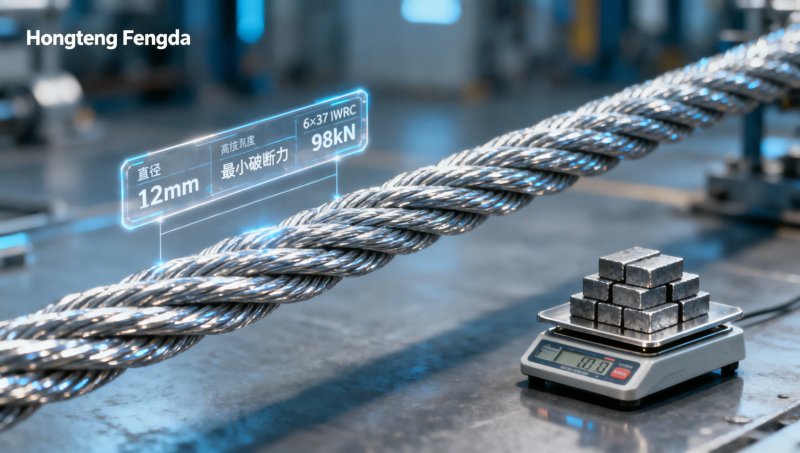
Load capacity isn’t a fixed number—it’s a calculated outcome shaped by three interdependent variables: nominal diameter, strand and core construction, and the applied safety factor. For instance, a 12 mm diameter 6×37 IWRC (Independent Wire Rope Core) rope may have a minimum breaking force (MBF) of 98 kN, while the same diameter in 6×19 FC (Fiber Core) drops to ~72 kN—nearly 26% lower. This difference stems from internal geometry: more wires per strand (e.g., 37 vs. 19) increase flexibility and fatigue resistance but reduce abrasion tolerance, directly influencing working load limits under dynamic conditions.
Diameter alone is insufficient without referencing standardized tensile strength grades. EN 12385-4 specifies minimum tensile strengths for different classes: 1570 MPa for general-purpose ropes, 1770 MPa for high-strength variants. A 16 mm 6×36 WS (Wire Strand) rope rated at 1770 MPa carries ~25% higher MBF than its 1570 MPa counterpart—critical when designing lifting systems for heavy steel girder installation. Meanwhile, the safety factor bridges theoretical strength and real-world risk: ISO 4308 recommends SF = 5.0 for general cargo hoisting, but SF = 7–10 is mandated for personnel lifts or nuclear-grade applications. Misalignment here risks catastrophic under-specification—or unnecessary cost inflation from over-engineering.
How Construction Type Impacts Performance in Real Projects
Construction defines how wires are laid into strands and strands into rope—and dictates behavior across bending cycles, crushing resistance, and rotation tendency. Common configurations include 6×19, 6×37, and 8×19 Seale or Warrington patterns. In crane rigging for structural steel erection, 6×37 FC offers superior flexibility around sheaves—ideal when handling irregular loads like bundled steel angle or cut-to-length steel round bar. Conversely, 6×19 IWRC excels in static tension applications such as guy-wire anchoring for temporary tower supports during high-rise I Shaped Beams placement—where minimal stretch and high crush resistance matter most.
Core type further refines capability. Fiber cores (FC) provide elasticity and shock absorption but degrade faster under heat or UV exposure. Steel cores (IWRC orWSC) boost temperature tolerance and support higher axial loads—making them preferred for multi-layer drum winding in port cranes moving prefabricated beams weight up to 28 tonnes. Notably, Hongteng Fengda’s certified supply chain includes traceable rope batches tested per ASTM A1023, ensuring documented compliance for audited infrastructure projects across Europe and North America.
Integrating Wire Rope Data with Structural Steel Specifications
Load calculations don’t exist in isolation. They must align with the mechanical properties of supporting elements—especially when selecting lifting points on fabricated components. Consider an I Shaped Beams section designated for a 12 m span carrying distributed live loads: its i beam weight (e.g., 69.8 kg/m for HEA 300 in S355JR) informs dead-load contribution, while flange width and web thickness determine weldable lifting lug geometry. If a 20 mm diameter 6×37 IWRC rope (MBF = 245 kN) is used with SF = 5, its safe working load is 49 kN—but that assumes perfect vertical lift. Angular lifts introduce side-loading: at 60°, effective load rises to 98 kN, exceeding capacity unless re-rated.
This integration extends to material compatibility. Galvanized ropes resist corrosion when handling steel square rod stored outdoors pre-erection—but zinc reacts adversely with stainless fasteners. Similarly, polymer-coated ropes prevent surface marring on precision-machined how to measure a steel beam reference surfaces. Hongteng Fengda provides coordinated technical documentation—spanning weight of i beam tables, allowable deflection charts, and compatible lifting hardware specs—to eliminate specification gaps between rope suppliers and structural fabricators.
Why Certification Alignment Matters Across Your Supply Chain
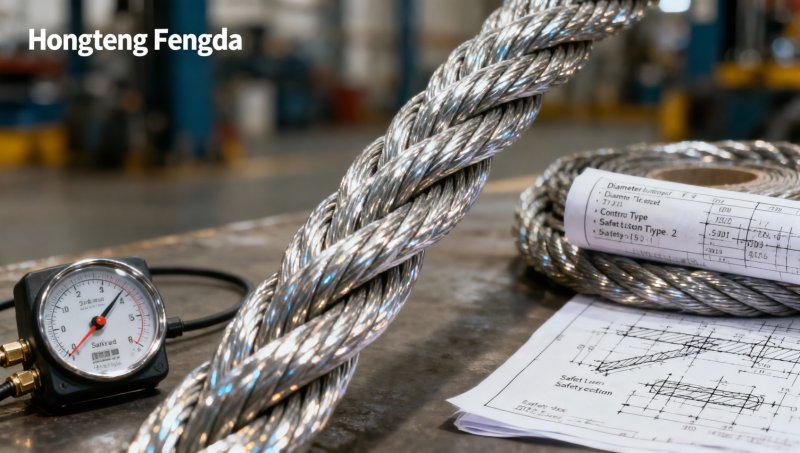
Global infrastructure projects demand harmonized certification—not just for individual components, but across interfaces. A rope certified to EN 12385-4 means little if the lifting lugs welded onto your steel girder lack EN 1090-2 Execution Class EXC3 documentation. Hongteng Fengda bridges this gap: every I Shaped Beams batch ships with mill test reports (MTRs) traceable to raw material heats, dimensional inspection records aligned to EN 10034 tolerances (±1%), and third-party verification against ASTM A6/A6M for beams weight consistency. This end-to-end traceability reduces non-conformance risk during client audits—particularly vital for contractors managing multiple subcontractors across Middle Eastern megaprojects or Southeast Asian power plants.
Moreover, our engineering team supports cross-referencing: converting how to measure a steel beam dimensions into moment-of-inertia values, validating angle vs channel torsional stiffness for bracing design, and verifying that specified steel wire rope diameters match hook throat clearances per ASME B30.26. This collaborative approach transforms procurement from transactional sourcing to integrated engineering partnership.
Final Recommendations for Safe, Compliant Selection
Begin with application context: Is the rope used for repetitive lifting (fatigue-critical), static support (strength-critical), or environmental exposure (corrosion-critical)? Then match diameter and construction—never rely solely on catalog MBF values without confirming tensile grade and core type. Always apply the correct safety factor per ISO, OSHA, or local regulatory frameworks. Finally, verify full certification alignment: rope certificates must correspond to structural component MTRs, especially when calculating combined system reliability for high-risk operations.
As a structural steel manufacturer & exporter from China with over 15 years serving North America, Europe, and the Gulf Cooperation Council, Hongteng Fengda delivers more than certified steel angle, steel round bar, and I beam weight-verified sections. We deliver confidence—through documented quality, responsive engineering support, and supply chain transparency engineered for complex global projects. Need help selecting the optimal steel wire rope for your next beams weight calculation or validating how to measure a steel beam against international tolerances? Immediately contact our technical sales team for customized load capacity guidance and certified product documentation.
Please give us a message


Please enter what you want to find