Choosing the right steel tubing for construction directly affects structural safety, fabrication efficiency, and long-term project cost. For technical evaluators, understanding key specifications such as material grade, wall thickness, dimensional tolerance, and standard compliance is essential when comparing suppliers and verifying performance. This article outlines the critical factors that influence project results and helps buyers make more reliable sourcing decisions.
What does “steel tubing for construction” usually include, and why is it evaluated so carefully?
In practical sourcing, steel tubing for construction is not a single product category. It may refer to structural hollow sections, round tubes, square tubes, rectangular tubes, cold-formed sections, and project-specific fabricated tubing components used in frames, supports, bracing systems, platforms, equipment bases, warehouses, industrial buildings, and infrastructure works. Technical evaluators pay close attention because tubing performance affects not only load-bearing capacity, but also welding quality, fit-up accuracy, corrosion resistance, installation speed, and future maintenance cost.
Compared with open structural shapes, tubing often offers favorable strength-to-weight efficiency, cleaner appearance, and better torsional behavior. However, these advantages only hold when the specification is correct. A tube with unsuitable steel grade, inconsistent wall thickness, poor straightness, or loose tolerance can create site rework, welding defects, unstable connections, or underperformance under design loads. That is why steel tubing for construction is usually assessed through both mechanical properties and manufacturing consistency rather than price alone.
For global buyers, another reason for strict evaluation is standard conversion. A project may be designed under ASTM, but a supplier may produce according to EN, JIS, or GB equivalents. Technical teams must verify whether yield strength, tensile strength, chemical composition, test method, and tolerance class truly align with project documents. In other words, equivalent naming does not automatically mean equivalent service performance.
Which specifications most directly affect project performance?
When reviewing steel tubing for construction, technical evaluators usually focus on a short list of high-impact specifications. These are the parameters most likely to influence structural reliability, fabrication productivity, and acceptance at inspection.
Among these, material grade and wall thickness are often the first screening criteria. If the actual mechanical performance is lower than specified, the issue can compromise structural capacity. If thickness variation is excessive, the problem may spread across welding procedure qualification, bolt detailing, and corrosion life calculations. For this reason, experienced buyers ask not only for nominal dimensions, but also for negative tolerance limits, inspection methods, and batch consistency records.
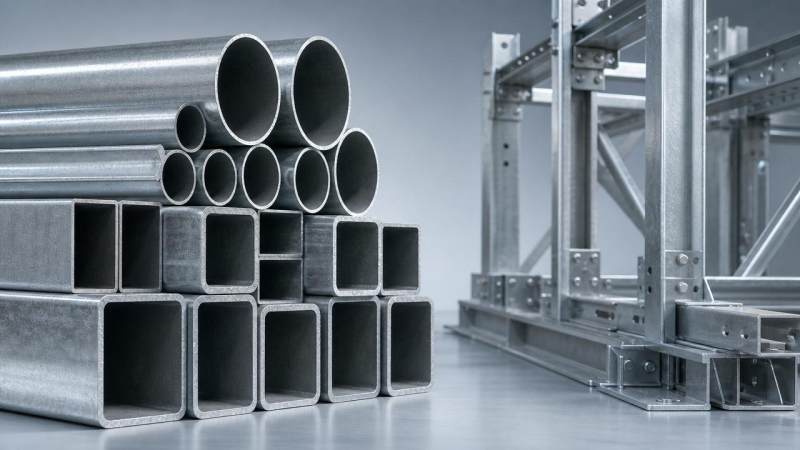
How do material grade and manufacturing method change the behavior of steel tubing for construction?
Material grade defines more than strength. In steel tubing for construction, it also influences ductility, cold-forming behavior, weld heat input sensitivity, and suitability for seismic or dynamic applications. A higher strength grade may reduce theoretical steel consumption, but if it complicates fabrication or requires stricter welding control, the total project benefit may be smaller than expected. Technical evaluation should therefore compare the whole process, not just the yield number on paper.
Manufacturing method is equally important. Seamless tubing may be preferred for certain pressure-related or high-integrity applications, while ERW or cold-formed hollow sections are widely used in structural frameworks where dimensional consistency and cost efficiency matter. Hot-finished and cold-formed products also differ in residual stress profile, corner properties, and code treatment in some regions. If the project design assumes one production route, substituting another without engineering review can create compliance issues.
Buyers should also verify chemical composition limits, especially carbon equivalent, when extensive welding is expected. Good weldability can improve workshop efficiency and reduce the risk of cracking, especially in heavy joints or winter installation conditions. For large export projects, asking the supplier to confirm matching international standards such as ASTM, EN, JIS, or GB with supporting test documentation is a practical control step.
In some mixed-material projects, procurement teams also source lifting and installation accessories alongside structural steel. For example, heavy assemblies used in marine, mining, crane, drilling, or foundation environments may require corrosion-resistant wire rope products in parallel with tubing packages. In such cases, evaluators may also review Galvanized Steel Wire Rope for applications such as cranes, elevators, cableways, or oil and gas handling, paying attention to tensile strength from 1470Mpa to 1960Mpa, available constructions like 6X19+IWR, and coating options including electro galvanized or hot dipped galvanized. Although it is not a tubing product, this kind of related sourcing often affects the same project schedule, quality approval path, and corrosion management plan.
Why are dimensional tolerance and wall thickness control so critical during supplier comparison?
Tolerance is one of the most underestimated factors in steel tubing for construction. On drawings, a few millimeters may look minor. On a fabrication line or modular site assembly, that same deviation can force recutting, misalignment, shimming, weld gap correction, and repeated inspection. Technical evaluators therefore need to check dimensional tolerance in a manufacturing context: outer diameter or section size, wall thickness variation, length tolerance, end squareness, straightness, and twist.
Wall thickness deserves special attention because nominal and actual values are not the same. Some low-cost offers appear attractive until the negative thickness tolerance is understood. A lighter actual section may reduce delivered weight, but it also reduces design margin. For corrosion-exposed projects, thinner-than-expected walls accelerate long-term performance loss. For welded structures, thickness inconsistency can affect heat input control and joint penetration quality.
A reliable supplier should be able to explain how tolerance is controlled during forming, welding, sizing, cutting, and final inspection. Ask whether measurements are taken per piece, per bundle, or per heat; whether calibrated instruments are used; and whether records can be linked to the material certificate. In high-volume projects, consistency is often more valuable than isolated best-case samples.
What role do surface finish, galvanizing, and corrosion conditions play in service life?
Steel tubing for construction may operate indoors, outdoors, in industrial atmospheres, coastal climates, or chemically aggressive environments. The correct surface treatment depends on the actual corrosion category, expected design life, maintenance access, and whether the tubing will be welded, painted, or bolted after delivery. Bare black steel may be suitable for protected indoor structures with post-fabrication coating. Pre-galvanized or hot-dip galvanized tubing may be more appropriate where exposure is continuous and maintenance is difficult.
Technical evaluators should confirm coating type, thickness, adhesion expectations, and post-processing limitations. For example, if steel tubing for construction will be cut and welded on site, exposed edges may require repair treatment. If appearance matters, coating uniformity and surface cleanliness before painting become important. If the project is in a severe marine or industrial setting, simply requesting “galvanized” may be too vague; the zinc layer and the process route should be specified clearly.
This corrosion logic is common across steel project materials. In wire rope systems, for example, zinc coating groups may be selected for mild, medium, or severe corrosion conditions, and the same performance-based thinking helps buyers choose suitable protection levels for structural tubing. The key is to link coating choice to the real service environment instead of using a generic finish description.
What are the most common mistakes when evaluating steel tubing for construction?
One common mistake is treating all standards as interchangeable. Similar dimensions do not guarantee the same chemistry, mechanical properties, or tolerance class. Another frequent error is comparing quotations only by ton price without adjusting for actual wall thickness, coating scope, inspection level, and packaging requirements. Lower upfront price can easily become higher total installed cost if rejection, rework, or project delay follows.
A second mistake is underestimating document quality. For export construction projects, steel tubing for construction should be backed by mill test certificates, heat traceability, dimensional inspection results, and if required, third-party testing or factory audit evidence. In many tenders, the approval process fails not because the steel is unusable, but because the documentation is incomplete or inconsistent with project specifications.
A third mistake is ignoring fabrication compatibility. The tubing may meet strength requirements but still perform poorly in production if straightness, squareness, or weld seam quality causes cutting or fit-up problems. Evaluators should involve engineering, fabrication, and quality teams together instead of making a decision from purchasing data alone.
How should technical evaluators compare suppliers beyond the basic datasheet?
A strong supplier comparison for steel tubing for construction should balance product capability, quality assurance, and delivery reliability. Start with standard compliance and material range: can the supplier provide the exact sections, grades, and finishes required, or only approximate alternatives? Then assess production capability: are there modern forming lines, stable raw material channels, and clear in-process controls? Finally, review export support: packaging, marking, documentation, lead time discipline, and communication response.
For technical buyers working with a structural steel manufacturer and exporter from China, it is useful to prioritize suppliers that can support both standard products and customized steel components under internationally recognized standards such as ASTM, EN, JIS, and GB. This is especially relevant for projects that combine tubing with angle steel, channel steel, steel beams, or cold formed profiles in one package, because coordination across product lines can reduce sourcing risk and simplify quality control.
A practical review checklist includes the following points:
- Can the supplier prove repeatable dimensional accuracy at the required volume?
- Are mechanical properties and chemical composition verified by traceable documents?
- Does the coating solution match the project corrosion class and fabrication sequence?
- Can customized cutting, punching, or fabricated assemblies be supplied if needed?
- Is the delivery schedule realistic, and does the supplier have export experience in your target region?
What should be confirmed before final procurement or long-term cooperation?
Before placing an order for steel tubing for construction, technical evaluators should align all key variables in writing: applicable standard, steel grade, section size, wall thickness tolerance, length range, coating requirement, testing scope, marking format, and document package. If the project includes fabricated components, also confirm hole tolerances, weld preparation, and surface treatment sequence. These details reduce the chance of commercial disputes and site-level interpretation gaps.
For long-term sourcing, it is wise to request sample inspection records, previous export references, and a clear explanation of how nonconforming material is handled. Consistent quality, dependable lead times, and transparent communication often create more value than the cheapest single shipment. In construction procurement, the strongest result usually comes from a supplier that understands structural requirements, international standards, and the timing pressures of project execution.
If you need to further confirm a specific steel tubing for construction solution, the most useful discussion points are grade equivalency, actual thickness control, corrosion environment, fabrication method, quantity schedule, required standards, and whether customized structural steel components should be supplied together. Clarifying these items early helps technical teams compare offers more accurately, control sourcing risk, and move from evaluation to reliable project delivery.
Please give us a message


Please enter what you want to find