For quality and safety teams, choosing a reliable steel sheet manufacturer is one of the most effective ways to reduce supply risk. From raw material inspection to dimensional testing and compliance verification, strong quality checks help prevent defects, delays, and costly project issues. This article outlines the key controls that support safer sourcing and more dependable steel supply.
In steel procurement, supply risk rarely comes from one visible problem. More often, it develops through a chain of small failures: inconsistent chemistry, poor flatness control, unclear heat traceability, missing test records, or late discovery of coating and thickness deviations. For quality managers and safety officers, these issues can affect structural performance, fabrication efficiency, inspection acceptance, and site safety.
A capable steel sheet manufacturer reduces those risks through disciplined process control, measurable inspection points, and transparent documentation. This matters even more in projects with multi-country supply chains, 2–4 week fabrication windows, tight dimensional tolerances, and compliance requirements linked to ASTM, EN, JIS, or GB standards. In those settings, quality checks are not an administrative step; they are a practical tool for protecting delivery schedules and reducing downstream nonconformities.
Why Quality Checks Matter in Steel Sheet Supply
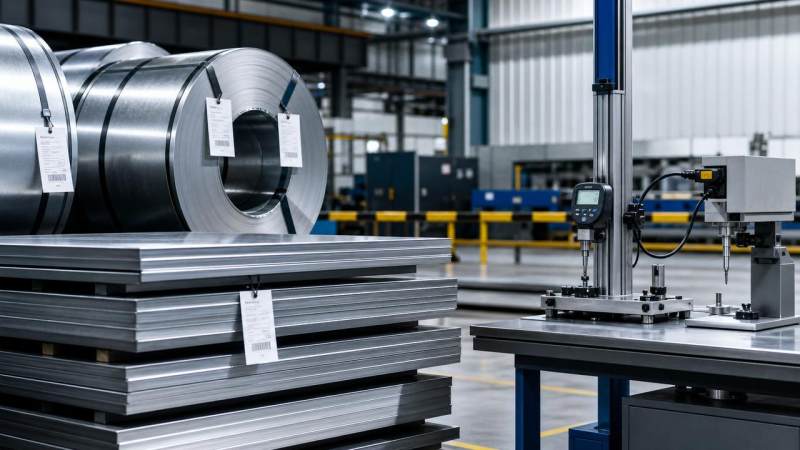
For B2B buyers, the value of quality control is easiest to see when a project is under pressure. A batch that arrives with thickness variation beyond tolerance, edge defects, or wrong grade markings can stop cutting, welding, forming, or installation within hours. In safety-sensitive applications, even a 1% dimensional deviation or an incorrect material substitution may trigger re-inspection, rework, or rejection.
A reliable steel sheet manufacturer should therefore control risk at three levels: incoming material, in-process production, and pre-shipment verification. These 3 stages help identify whether the steel meets required chemistry, mechanical properties, dimensions, surface condition, and documentation rules before it enters your operation or project site.
The Main Sources of Supply Risk
Quality and safety teams typically focus on 4 recurring risk categories. First is material mismatch, such as incorrect grade or uncontrolled substitution. Second is dimensional inconsistency, including thickness, width, length, camber, or flatness variation. Third is document nonconformity, where MTCs, packing lists, and inspection records do not match the actual shipment. Fourth is delivery instability, often caused by poor production planning or weak final release procedures.
- Grade and chemistry inconsistency that affects forming, welding, or load performance
- Surface defects such as scale, pitting, scratches, laminations, or coating irregularity
- Traceability gaps between heat number, bundle mark, and test certificate
- Late detection of defects, leading to rework cycles of 3–7 days or more
What Good Factory Controls Should Look Like
The most dependable suppliers do not rely on one final inspection to prove quality. They build repeatability into daily operations. That usually includes incoming raw material verification, calibrated measuring tools, inspection plans by batch or heat, process checkpoints every shift, and documented release approval before loading. For import buyers, visibility into these controls can reduce uncertainty well before goods reach the port.
The table below shows how common quality checks map directly to supply-risk reduction in steel sourcing.
For buyers, the key point is that each check removes a different failure mode. A steel sheet manufacturer that can explain the frequency, method, and records behind these inspections is usually easier to qualify than one that only promises general quality.
The Critical Inspection Points Quality Teams Should Verify
When evaluating a steel sheet manufacturer, quality teams should move beyond marketing claims and review the exact control points. In practice, there are 6 inspection areas that have the strongest impact on supply reliability: raw material identity, chemistry, mechanical properties, dimensions, surface condition, and packing traceability. If any one of these is weak, the chance of downstream claims rises sharply.
1. Raw Material and Heat Traceability
Heat traceability is the foundation of accountable steel supply. Every bundle, sheet, or cut piece should link to a heat number and corresponding mill test record. This is especially important when one order includes multiple thicknesses, several grades, or mixed processing routes such as slitting, leveling, shearing, or coating.
What to verify
- Heat number marking on product, tags, or bundle labels
- Consistency between heat number, MTC, packing list, and invoice
- Segregation controls for different grades or customer orders
- Retention period for records, often 12 months or longer in export supply
2. Chemistry and Mechanical Testing
Chemical composition affects weldability, strength, toughness, and forming behavior. Mechanical testing confirms that the supplied steel falls within the required range for yield strength, tensile strength, and elongation. For project safety teams, these tests are essential when steel will be cut, bent, welded, or used in structural assemblies.
In many export programs, test frequency is managed by heat, batch, or production lot. A disciplined steel sheet manufacturer should be able to explain whether verification is done per heat, per coil, or per finished lot, and how retesting is handled if a result falls near the lower acceptance boundary.
3. Dimensional Accuracy and Tolerance Control
Dimensions influence processing speed and assembly quality. Even small variation can create large downstream problems in laser cutting, nesting, automated feeding, or welded fit-up. Thickness tolerance, length tolerance, width control, flatness, and edge condition should all be part of inspection planning. In many projects, acceptable tolerance may be as strict as ±1% or tighter depending on the specification and end use.
This principle also applies across related structural steel products. For example, in rail-related components used for transport infrastructure or fabricated railing systems, dimensional consistency is equally important. A supplier with broader structural steel capability may also offer Rail products in carbon steel or medium manganese steel, with typical length ranges of 12m–30m, thickness from 3mm to 24mm, rail height of 134–170mm, and tolerance around ±1%. For quality teams, this shows whether a manufacturer can maintain precision across different profiles, not just flat products.
4. Surface Condition and Visual Inspection
Visual and surface checks matter more than many buyers expect. Surface defects can interfere with coating adhesion, welding quality, and cosmetic acceptance. Inspection should cover rust level, scratches, edge cracks, roll marks, laminations, and coating appearance where applicable. If steel is supplied oiled, black, galvanized, or painted, acceptance criteria should be defined before production release.
5. Packing, Identification, and Shipping Release
Final quality control does not stop at the steel itself. Damage during loading, poor moisture protection, weak strapping, or missing labels can turn a conforming order into a receiving claim. For overseas shipments lasting 15–45 days, packing quality should be treated as part of product quality. Clear marking by item, heat, quantity, and destination helps receiving teams verify shipments faster and reduce warehouse confusion.
How to Assess a Steel Sheet Manufacturer Before You Place an Order
Pre-qualification is often the most cost-effective stage for risk reduction. Before issuing a purchase order, quality teams should review not only product capability but also process discipline, export readiness, and response speed. A competent steel sheet manufacturer should be able to provide evidence instead of broad assurances.
A Practical 5-Point Supplier Review
- Confirm supported standards such as ASTM, EN, JIS, or GB for your required grade.
- Review inspection scope, including chemical, mechanical, dimensional, and visual checks.
- Check document control: MTC format, heat traceability, marking rules, and packing list accuracy.
- Ask about lead time stability, batch planning, and handling of urgent schedule changes within 7–10 days.
- Evaluate communication quality, including response time to NCRs, photos, and pre-shipment reports.
Questions That Reveal Real Capability
The right questions can quickly separate a dependable manufacturer from a trading source with limited process visibility. Ask how they control mixed orders, what measuring tools are calibrated, how often in-process checks are performed, and whether third-party inspection can be supported before shipment. Answers should be specific and operational, not only commercial.
The following comparison can help quality and safety teams score supplier readiness in a structured way.
This kind of review is useful because supply risk is rarely visible in product photos alone. A supplier that performs well in all 4 evaluation areas is usually better prepared to support repeat orders, custom specifications, and project-driven delivery schedules.
Why Export Experience and Process Discipline Matter
For overseas buyers, manufacturing capability must be matched by export discipline. Even if the steel meets specification, unclear documents, weak packaging, or poor response to inspection comments can create avoidable delays. This is where experienced structural steel exporters often bring added value to quality and safety teams.
Hongteng Fengda operates as a structural steel manufacturer and exporter from China, supplying angle steel, channel steel, steel beams, cold formed profiles, and customized structural steel components for buyers in North America, Europe, the Middle East, and Southeast Asia. For procurement teams managing multiple product categories, this broader capability can simplify vendor coordination while keeping quality control aligned to major international standards.
Benefits for Quality and Safety Teams
- Better consistency across repeated orders and specification revisions
- Faster issue containment through documented inspection and release steps
- Improved support for OEM and customized structural steel requirements
- Reduced chance of cross-order confusion in mixed export shipments
Common Mistakes Buyers Should Avoid
Choosing on price alone
A lower unit price may hide higher total cost if the supplier has weak inspection control or unstable lead times. Re-inspection, claim handling, fabrication delays, and schedule slippage can easily outweigh a small price difference per ton.
Accepting generic certificates
Certificates only create value when they correspond to actual heat numbers, dimensions, and shipped quantities. Generic paperwork without batch linkage increases compliance risk and weakens accountability.
Overlooking pre-shipment communication
A supplier should confirm inspection status, packing details, marking method, and dispatch timing before loading. This final 24–72 hour communication window is often where document errors or quantity mismatches can still be corrected.
Building a Lower-Risk Steel Sourcing Process
The most effective approach is to treat supplier quality as a process, not a one-time approval. Define acceptance criteria before production, require traceable records, review inspection data before shipment, and keep a short feedback loop after receiving. Over 2 or 3 order cycles, this creates a practical performance record that is more useful than general supplier claims.
For quality and safety teams, the best steel sheet manufacturer is usually not the one making the broadest promises. It is the one that consistently controls chemistry, dimensions, surface condition, traceability, and delivery release with evidence at each step. That level of discipline helps reduce claims, stabilize project execution, and support safer downstream fabrication and installation.
If you are evaluating a steel sheet manufacturer or broader structural steel supply partner, Hongteng Fengda can support your sourcing review with clear product information, quality-focused communication, and customized export solutions. Contact us today to discuss specifications, request documentation details, or get a tailored solution for your next steel project.
Please give us a message


Please enter what you want to find