Choosing the right steel beam for bridge projects means balancing structural performance, span requirements, weight efficiency, and total cost. For project managers and engineering leaders, understanding these tradeoffs is essential to reduce procurement risks, stay on schedule, and meet design standards. This guide explains the key factors that influence beam selection and how reliable structural steel sourcing can support better project outcomes.
In bridge construction, beam selection affects far more than structural calculations. It influences fabrication complexity, transport planning, erection speed, crane capacity, coating requirements, and long-term maintenance budgeting. A poor decision at the procurement stage can create cascading delays of 2–6 weeks, increase field welding, or force design revisions after shop drawings are already in progress.
For B2B buyers managing public infrastructure, industrial access bridges, pedestrian bridges, or rail-related structures, the right steel beam for bridge applications should match the required span, loading conditions, corrosion environment, and project schedule. It should also come from a supplier that can meet ASTM, EN, JIS, or GB requirements with dependable dimensional control and export-ready documentation.
How Span, Load, and Beam Depth Interact in Bridge Design
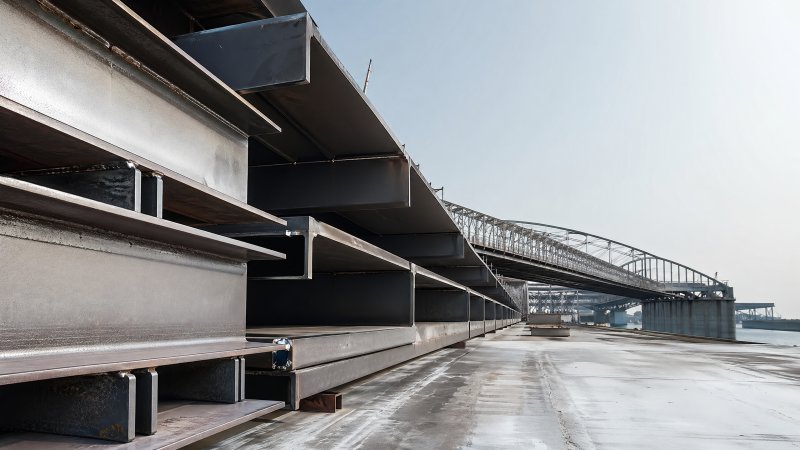
The first question in selecting a steel beam for bridge work is not price, but structural demand. Span length, live load, dead load, dynamic effects, and serviceability criteria all influence the final section choice. In many projects, a 10 m pedestrian bridge and a 30 m vehicular bridge may both use structural steel, but their beam depth, flange thickness, and fabrication details differ dramatically.
As span increases, required section modulus and stiffness rise quickly. This often leads to deeper beams, heavier unit weight, or a move from standard rolled sections to fabricated girders. For project managers, this matters because each design step changes procurement lead time, transport limits, and site installation planning. A heavier beam may reduce deflection, but it can also require larger cranes and higher freight cost per ton.
Bridge designers also evaluate vibration, fatigue, and lateral stability. For example, a beam that meets basic strength criteria may still need additional stiffness if repeated traffic loading or pedestrian comfort limits control the design. In practical terms, a lower initial steel tonnage does not always mean a lower total project cost if the beam needs extra bracing, diaphragms, or deck support members.
Typical tradeoffs by span range
The table below outlines common beam selection considerations by bridge span. These are general planning ranges rather than design values, but they help procurement teams understand where cost and weight usually begin to change.
The key takeaway is that beam depth and beam weight should be evaluated together. A lighter section may save 5%–10% on steel tonnage, but if it increases deck vibration, connection count, or erection time, total installed cost can rise instead of fall.
Key checks before finalizing the beam section
- Confirm design load type: pedestrian, service vehicle, highway, or rail-related loading.
- Verify span condition: simple span, continuous span, or multi-span arrangement.
- Review deflection and vibration limits, not only yield strength.
- Check transport constraints such as 12 m, 18 m, or over-length shipment limits.
- Match beam selection to available fabrication and coating capacity.
Weight Efficiency vs Total Installed Cost
A common mistake in bridge procurement is focusing too heavily on price per ton. For a steel beam for bridge procurement package, total installed cost is often a better metric than unit steel price. This includes steel weight, cutting and welding hours, splice design, transport cost, lifting equipment, coating system, and on-site erection duration.
In many export projects, a beam that is 8% heavier may still be the better commercial option if it reduces fabrication steps by 15%–20% or avoids field splicing. Project managers should compare at least 4 cost layers: raw material, shop fabrication, logistics, and site installation. This method is especially useful when choosing between standard rolled beams and customized welded girders.
Weight also affects hidden cost categories. A heavier member increases sea freight, inland transport permits, and crane selection, but a very light section can demand tighter tolerances, more secondary framing, or stricter erection sequencing. The best choice is usually the section that minimizes total project friction rather than minimizing tonnage alone.
Cost comparison framework for project teams
Before releasing a purchase order, it helps to compare options in a structured way. The matrix below can support internal review between engineering, procurement, and site management teams.
For procurement planning, ask suppliers to quote not only section weight and price, but also lead time, coating options, cut length tolerance, welding scope, and packing method. This makes commercial comparison more realistic and reduces the risk of variation orders after award.
Practical ways to control cost without reducing quality
- Standardize beam lengths where possible to reduce shop waste and simplify transport.
- Use internationally recognized grades and standards to avoid requalification delays.
- Minimize unnecessary section variation within the same bridge package.
- Coordinate connection details early so beam supply and fabrication drawings align.
Specification, Standards, and Mid-Project Compatibility Risks
Another major issue in steel beam for bridge sourcing is compatibility between structural design, fabrication capability, and site accessories. Even when the primary beam design is correct, project delays happen when connection plates, guardrail systems, or rail-related components are not aligned with the overall structure package.
For bridge projects that include maintenance walkways, deck edge protection, or transport infrastructure integration, related steel products should be reviewed at the same time as the main beams. This is especially important when different standards, coatings, or dimensional tolerances are involved. A mismatch of only ±1% in critical rolled parts can create assembly issues when multiple suppliers are used.
As an example, some bridge or deck railing packages may require rail sections for guidance, protection, or rail-linked systems. In such cases, buyers often look for products like Rail that are available in carbon steel or medium manganese steel, with lengths from 12 m to 30 m, thickness from 3 mm to 24 mm, and common specifications such as 22 kg/m, 30 kg/m, 43 kg/m, 50 kg/m, QU70, QU80, QU100, or QU120.
Why accessory coordination matters
When related steel components are sourced together, project teams can better control finish consistency, logistics timing, and inspection workflow. For instance, deck railings or bridge handrail support systems may need matching surface conditions such as black, oiled, galvanized, or painted finishes. They may also require quality systems such as ISO9001-2008 and ISO14001:2004 for supplier process control.
This does not mean every item must come from a single factory, but it does mean documentation should be coordinated from the start. Material certificates, standard references, and tolerance expectations should be locked before production begins. For bridge packages with mixed components, this can reduce rework risk during the final 10% of the project, where schedule pressure is often highest.
Compatibility checklist for steel package buyers
- Confirm whether the project uses ASTM, EN, JIS, GB, or a combination with client approval.
- Align coating systems across beams, railings, and secondary steel to avoid visual and performance mismatch.
- Review dimensional tolerance, especially for long products in the 12 m–30 m range.
- Check whether export packing, marking, and third-party inspection are required before shipment.
For global bridge projects, these details are not minor. They affect customs clearance, site acceptance, and final installation productivity. A technically acceptable beam can still become a procurement problem if surrounding steel items are poorly coordinated.
How Project Managers Should Evaluate a Structural Steel Supplier
Selecting the right steel beam for bridge structures also means selecting the right manufacturing partner. Buyers should assess more than production price. A reliable supplier must demonstrate stable capacity, process control, export experience, and responsiveness during drawing clarification, inspection, and shipping. This is particularly important when the project schedule allows only 4–8 weeks for fabrication and dispatch.
Hongteng Fengda operates as a structural steel manufacturer and exporter from China, supplying angle steel, channel steel, steel beams, cold formed profiles, and customized structural steel components for global construction and industrial projects. For bridge-related procurement, that kind of broad product scope can be valuable because it helps buyers consolidate related steel items, reduce sourcing interfaces, and keep documentation more consistent.
A capable supplier should also support standard and OEM requirements. In practical bridge procurement, that may include custom cut lengths, shop fabrication preparation, marking by erection sequence, and compliance with ASTM, EN, JIS, or GB standards. Strong quality control reduces dimensional deviation, while dependable lead times help site teams avoid idle labor and crane rescheduling costs.
Core supplier evaluation criteria
The following table summarizes common assessment points used by project owners, EPC contractors, and procurement teams when qualifying structural steel suppliers for bridge packages.
For project managers, the best supplier is often the one that makes the supply chain predictable. Stable production capacity, consistent quality, and clear communication can save more value than a marginally lower unit price from an unproven source.
A practical 5-step sourcing process
- Issue beam schedule, drawings, standards, and coating requirements.
- Request commercial and technical quotation with lead time and tolerance details.
- Review section optimization, fabrication feasibility, and logistics assumptions.
- Approve inspection plan, packing method, and shipment marking system.
- Track production milestones and coordinate delivery to site erection sequence.
Common Mistakes, FAQs, and Better Procurement Decisions
Even experienced teams can make avoidable errors when buying a steel beam for bridge use. The most common issues are underestimating deflection criteria, comparing prices without checking fabrication scope, and failing to align logistics with site lifting conditions. These mistakes usually appear late, when correction is more expensive and schedule flexibility is low.
To reduce those risks, project teams should connect structural selection with commercial review from the beginning. That means engineering, procurement, and site execution should all review the same assumptions: span, load class, beam length, shipping limits, corrosion exposure, and erection sequence. A 30-minute alignment meeting before tender can prevent weeks of correction later.
Below are several frequently asked questions that often come up during bridge steel sourcing and early-stage project planning.
How do I choose between a standard rolled beam and a fabricated girder?
For shorter and moderate spans, standard rolled sections are often faster to source and simpler to fabricate. When spans move beyond roughly 20–25 m, or when load and stiffness requirements become more demanding, fabricated girders may offer better optimization. The decision should compare not just section weight, but also lead time, splice count, and erection method.
What beam data should suppliers provide for quotation?
At minimum, request grade, section size, unit weight, total tonnage, standard, cut length, tolerance, surface condition, fabrication scope, and estimated production cycle. For export projects, include packing method, marking system, and whether MTCs or third-party inspection are needed. These details make quote comparison more accurate.
How long is the normal delivery cycle for bridge steel beams?
Lead time depends on section type, quantity, fabrication level, and coating requirements. Standard sections may move faster, while customized bridge girders typically require additional drawing review and shop processing. In many international supply cases, buyers should plan for production plus shipping as separate stages rather than treating delivery as a single date.
What should project managers prioritize most?
Focus on four priorities: structural suitability, predictable lead time, total installed cost, and supplier reliability. If these four are controlled, most bridge beam procurement risks become manageable. If even one is ignored, especially schedule or quality control, overall project exposure rises quickly.
Bridge procurement decisions work best when structural, commercial, and logistics factors are reviewed as one package. The right beam is not simply the lightest or the cheapest. It is the section that delivers adequate strength, stable service performance, efficient erection, and dependable supply under the project’s real constraints.
Hongteng Fengda supports global buyers with structural steel products, customized solutions, strict quality control, and export-oriented service for construction and industrial projects. If you are evaluating steel beam options for a bridge package, comparing standards, or planning related structural steel procurement, contact us to get a tailored solution, discuss technical details, and reduce sourcing risk before your next project milestone.
Please give us a message


Please enter what you want to find