For technical evaluators, stainless steel tube coil tolerances directly influence fit-up accuracy, weld consistency, and assembly efficiency. Small deviations in OD, wall thickness, coil diameter, or straightness can create costly alignment issues in fabrication and installation. Understanding these tolerance factors helps buyers assess product suitability, reduce rework risk, and select suppliers capable of meeting demanding project specifications.
Why do stainless steel tube coil tolerances matter so much in fit-up?
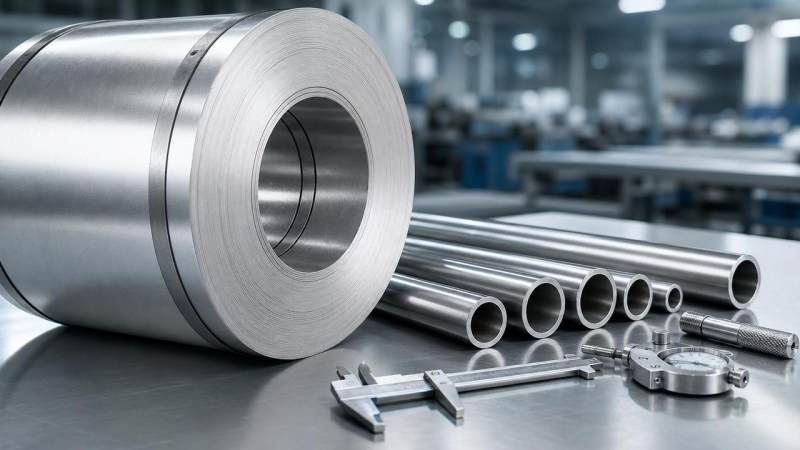
In steel fabrication, fit-up is not only a workshop issue. It is a chain reaction that affects cutting accuracy, bending repeatability, welding input, pressure integrity, and final installation speed. When a stainless steel tube coil arrives with dimensional variation beyond the expected range, the problem often appears first at the joint, not on the mill certificate.
Technical evaluators therefore need to review tolerances as a practical assembly factor rather than a simple inspection item. A coil with acceptable chemistry but poor dimensional consistency can still increase scrap, force operator adjustment, and delay project schedules. In industrial and construction supply chains, that risk quickly becomes a cost issue.
- OD variation can change clamp engagement, sleeve insertion, and ferrule compression performance.
- Wall thickness variation affects weld penetration, forming stability, and pressure-bearing confidence.
- Coil set and straightness deviation influence cutting length consistency and end preparation alignment.
- Ovality can create sealing gaps or force corrective machining in downstream fabrication.
For buyers handling global sourcing, especially from multiple mills, these tolerance variables should be checked against the actual assembly method. A stainless steel tube coil used for orbital welding, tight-bend routing, or modular skid fabrication usually needs closer dimensional control than one used in less demanding support applications.
Which tolerance items most often affect fit-up performance?
Not every dimensional deviation creates the same level of risk. Evaluators should focus on the tolerance factors that directly change contact surfaces, weld geometry, or installation clearance. The table below summarizes the most common points that influence fit-up when specifying a stainless steel tube coil.
For technical review, it is useful to separate acceptance tolerance from process capability. A supplier may quote a standard range, but the real question is whether production can hold a tighter band consistently across the full coil length. That is often the difference between stable fit-up and repetitive adjustment on the shop floor.
OD tolerance and connection compatibility
OD is often the first number checked, but many buyers only compare it against nominal size. That is not enough. If the tube will be inserted into compression fittings, sleeves, collars, or pre-machined sockets, even a small shift can affect torque response and sealing reliability. For automated lines, OD consistency also supports repeatable setup.
Wall thickness and weld consistency
Wall thickness variation changes the thermal window during welding. In thin-wall stainless steel tube coil applications, this can mean unstable penetration or localized overheating. In thicker sections, inconsistency may require repeated weld parameter correction. Evaluators should request actual thickness range data, not only nominal values.
Ovality, springback, and uncoiling behavior
Roundness matters because many fit-up failures are really geometry failures. A coil that appears acceptable in bundle form may show ovality after handling or decoiling. This can be critical when parts are cut for precise bends, end forming, or orbital weld preparation. Springback during uncoiling should also be discussed during technical evaluation.
How should technical evaluators review tolerance data during sourcing?
A good review process links purchase specifications to real fabrication conditions. This is especially important when the stainless steel tube coil will enter demanding project environments, such as modular construction, equipment assembly, or industrial piping support systems. A paper-compliant product is not always process-compliant.
- Confirm the governing standard first, such as ASTM, EN, JIS, or customer-specific drawing requirements.
- Match tolerance expectations to the final operation: welding, bending, flaring, threading, or insertion.
- Ask for dimensional control records across the coil, not only a single sample point.
- Review packaging and transport protection, because deformation can occur after production.
- If the application is critical, request sample lengths for trial fit-up before full order release.
At Hongteng Fengda, this sourcing logic is familiar because global buyers often need more than a standard quotation. They need support comparing international specifications, assessing dimensional risk, and aligning procurement with downstream fabrication requirements. That matters across steel categories, from structural profiles to precision-related steel supply.
A related lesson from other steel products
Tolerance discipline is not unique to tube products. In corrosion-resistant applications, buyers often evaluate dimensional stability and surface condition together. For example, Galvanized Round Steel used in power towers, communication towers, marine components, or hardware processing is often reviewed for diameter range, anti-corrosion finish, and out-of-roundness control.
The same procurement mindset applies here: define the operating environment, compare standards, confirm processing requirements, and identify where tighter tolerances are worth the extra control. In many projects, the most economical option is not the loosest tolerance but the one that reduces rework and installation delay.
What should be included in a practical stainless steel tube coil evaluation sheet?
A technical evaluation sheet should help engineers compare offers on more than price. The table below provides a simple procurement framework that can be adapted for RFQ review, supplier qualification, or sample approval of stainless steel tube coil orders.
This type of sheet also helps internal communication. Procurement teams can compare bids clearly, quality teams can define inspection checkpoints, and production teams can validate whether the proposed stainless steel tube coil is realistic for the intended process window.
Where do tolerance problems usually create hidden cost?
Many companies underestimate the cost of tolerance drift because it rarely appears as a single line item. The impact is usually distributed across labor, machine time, consumables, and schedule pressure. This is why experienced evaluators look beyond unit price when comparing suppliers.
- Extra fit-up correction increases labor time before welding or fastening.
- Repeated re-cutting and end dressing consume tooling and operator capacity.
- Inconsistent joints raise rejection risk during pressure, leak, or dimensional inspection.
- Production interruptions can affect installation milestones and contract penalties.
For export-oriented steel projects, lead time discipline is also part of the cost equation. A technically acceptable but unstable supply source may force emergency replacement or selective sorting at the destination. Suppliers with stable production capacity and disciplined quality control help reduce that exposure.
Standard tolerance or tighter tolerance?
The answer depends on the assembly method. Standard tolerance may be sufficient for less critical support use. Tighter control is usually more valuable when the stainless steel tube coil must interface with precision fittings, automated welding systems, or repeatable modular fabrication. Evaluators should compare the added material control cost against the likely cost of downstream correction.
How do standards and supplier capability affect the final decision?
Standards provide the baseline, but supplier capability determines consistency. Technical evaluators should confirm whether the quoted tolerance is simply a standard allowance or a routinely controlled production target. This distinction is especially important for international projects that combine different engineering documents, inspection expectations, and destination market requirements.
Points to review with the supplier
- Can the supplier align supply with ASTM, EN, JIS, or GB requirements as specified by the project?
- Is there documented incoming, in-process, and final dimensional inspection?
- Can the supplier support OEM or custom specification requests when standard range is not enough?
- Are sample approval and pre-shipment verification available for critical orders?
Hongteng Fengda works with global buyers that need this type of practical coordination. As a structural steel manufacturer and exporter from China, the company supports international sourcing with stable production, standard-based manufacturing, and communication focused on risk reduction, cost control, and reliable delivery planning.
FAQ for technical evaluators comparing stainless steel tube coil suppliers
How do I know if OD tolerance is tight enough for my application?
Start from the connection method, not the nominal size. If the tube will use compression fittings, automated clamping, or precision sockets, evaluate actual insertion clearance and sealing requirement. Ask for measured OD range and sample verification under your assembly conditions.
Is wall thickness variation more important than surface appearance?
For welding and pressure-related use, wall thickness usually has greater structural influence. However, surface condition still matters because scratches, scale, or contamination can affect weld quality and inspection acceptance. The right approach is to review both, with priority based on the process.
Should I request tighter tolerances for every stainless steel tube coil order?
Not necessarily. Tighter tolerances increase control requirements and may affect cost or lead time. They make the most sense when the downstream process is sensitive to variation, such as orbital welding, tight-radius bending, or modular repetitive fit-up. Match tolerance to application value.
What is commonly overlooked during supplier comparison?
Many buyers compare material grade and price but overlook coil handling, packaging integrity, measurement frequency, and consistency across the full batch. A technically complete comparison should include dimensional process control, not just one inspection certificate.
Why choose us for steel project support and sourcing coordination?
If your team is evaluating stainless steel tube coil fit-up risk alongside broader steel procurement needs, Hongteng Fengda can support the decision process with practical, project-oriented communication. Our experience in structural steel manufacturing and export helps global buyers coordinate standards, dimensional expectations, and delivery planning across complex applications.
- Discuss parameter confirmation, including tolerance expectations, standard references, and processing conditions.
- Review product selection for related steel items used in construction, industrial, and manufacturing projects.
- Check lead time planning, export packaging considerations, and batch consistency requirements.
- Request support for customized solutions, OEM specifications, sample evaluation, and quotation comparison.
- Confirm applicable certification or standards alignment based on ASTM, EN, JIS, or GB project needs.
For technical evaluators, the right supplier is the one that helps reduce uncertainty before production starts. If you need assistance with tolerance review, product matching, sample support, or export delivery coordination, contact us with your drawings, target standards, and application details for a focused discussion.
Please give us a message


Please enter what you want to find