Choosing the right stainless steel coil grade can directly affect corrosion resistance, strength, cost, and long-term performance. For buyers, engineers, and project planners, understanding how different grades work in real-world environments is essential for making reliable sourcing decisions. This guide explains the key stainless steel coil grades, their practical applications, and how to match material selection with actual industrial and construction needs.
How should buyers understand stainless steel coil grades in practical terms?
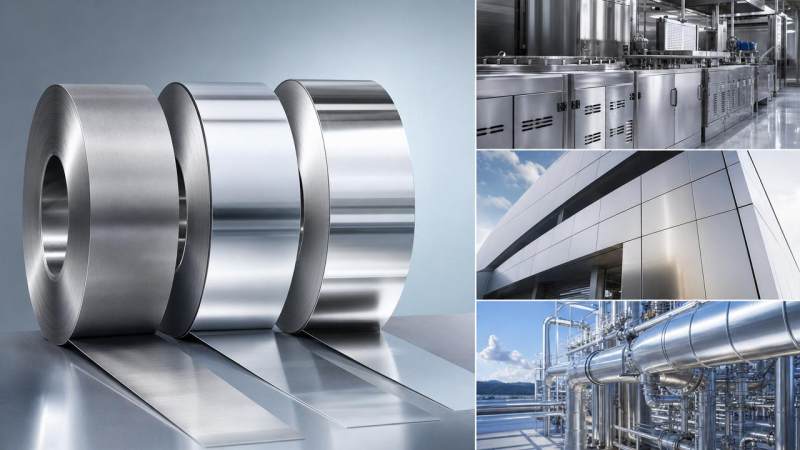
A stainless steel coil is not selected by grade number alone. In real projects, the correct choice depends on chloride exposure, forming needs, weldability, finish requirements, thickness tolerance, and budget. A grade that performs well in an indoor panel application may fail early in a coastal structure or chemical processing area.
For information-stage buyers, the biggest challenge is that many suppliers list stainless steel coil grades without explaining what changes in actual service life. The key difference usually comes from alloy composition, especially chromium, nickel, molybdenum, and carbon control, which together influence corrosion behavior and fabrication performance.
In the steel industry, common stainless steel coil grades are often grouped into austenitic, ferritic, and martensitic families. For most construction, equipment, and industrial sourcing decisions, austenitic grades such as 201, 304, 316, and 430-related comparisons appear most often because they cover a wide range of cost and performance needs.
- 201: lower nickel content, lower cost, suitable for some indoor and decorative uses.
- 304: the most widely specified stainless steel coil for general corrosion resistance and fabrication.
- 316: improved resistance in marine, chemical, and chloride-rich environments due to molybdenum.
- 430: ferritic stainless option with good appearance and lower cost, but less corrosion resistance than 304.
For global buyers, selecting the right grade also means checking the standard system. ASTM, EN, JIS, and GB may describe equivalent or near-equivalent materials, but mechanical properties, surface finish, and tolerance requirements still need confirmation on the mill test documentation and purchase specification.
Which stainless steel coil grades fit which environments?
The most useful way to compare stainless steel coil is by service environment rather than by catalog sequence. Buyers who begin with the application usually reduce rework, replacement risk, and unnecessary overspending.
The table below maps common stainless steel coil grades to real-world conditions, helping project teams judge whether they need basic atmospheric protection or stronger resistance against moisture, salt, chemicals, and temperature fluctuation.
This comparison shows why stainless steel coil sourcing should begin with exposure conditions. Many failures are not caused by poor steel quality, but by selecting a grade designed for light atmospheric service and placing it in a salt-rich or chemically active environment.
Indoor fabrication and decorative applications
If the stainless steel coil will be used for interior wall panels, elevator skins, appliance housings, or decorative trim in dry conditions, 201 or 430 may meet the requirement. The decision then depends on appearance, forming depth, and whether there is any cleaning chemical exposure during service.
General industrial and building use
For ducting, enclosures, commercial kitchen components, tanks, or mixed indoor-outdoor use, 304 stainless steel coil remains the standard reference. It offers a practical balance between price, corrosion resistance, fabrication ease, and market availability across many regions.
Coastal, chemical, and high-risk environments
Where the material will face sea air, deicing salts, process chemicals, or regular washdown, 316 is often the safer choice. In these conditions, choosing a lower-cost grade can create staining, pitting, and premature replacement that exceeds the original savings.
What technical properties matter most when comparing stainless steel coil?
When reviewing a stainless steel coil quotation, buyers should look beyond grade names and ask how the material will be processed. The right selection depends on whether the coil will be bent, deep drawn, welded, polished, laser cut, or exposed outdoors for years.
- Corrosion resistance: critical for outdoor, marine, chemical, and food-contact applications.
- Formability: important for deep drawing, stamping, profiling, and shaped components.
- Surface finish: affects decorative value, cleaning ease, and downstream coating performance.
- Mechanical strength: influences forming load, structural use limits, and deformation risk.
- Weldability: essential for tanks, frames, fabrication assemblies, and field installation.
The next table gives a practical buyer view of stainless steel coil performance. These comparisons help narrow down grades before moving to detailed drawings, thickness checks, and compliance review.
For many projects, the technical decision is less about maximum strength and more about the total service condition. Buyers should connect grade, thickness, finish, and fabrication route instead of evaluating the stainless steel coil only as a raw material line item.
How does material selection change when projects mix stainless and carbon steel?
In construction and manufacturing, not every part needs stainless steel coil. Many projects use stainless for exposed, corrosive, or hygienic zones, while using carbon steel for load-bearing or concealed sections where coating, painting, or controlled indoor conditions are sufficient. This mixed-material strategy often improves cost efficiency.
For example, some appliance, equipment, or fabricated assembly buyers compare stainless surface parts with cold-formed carbon steel components to balance finish, strength, and budget. In such cases, Carbon Steel Plate may be considered for formed panels, chassis, rails, switchboards, automobile-related parts, roofing elements, and general fabricated surfaces where the service environment is less corrosive or where protective finishing is planned.
Available grades such as SPCC, SPCCT, SPCD, SPCE, SPCF, and SPCG are commonly evaluated according to forming depth, surface needs, and downstream processing. Their practical value comes from smooth surface finish, good formability, and a range of hardness conditions from annealed to full hard, which support stamping, bending, and shaped production across industrial manufacturing.
- Use stainless steel coil where corrosion resistance is the first priority.
- Use coated or processed carbon steel where load, forming, and cost control dominate.
- Check dimensions early: widths can range from 100 mm to 3000 mm, thickness from 0.1 mm to 400 mm, with custom sizes available depending on production planning.
- Confirm standards such as ASTM, EN, JIS, DIN, ISO, or related systems when the project includes export, inspection, or OEM integration.
This kind of cross-material review is especially useful for buyers managing total project cost. Instead of over-specifying stainless everywhere, they can protect critical surfaces while using structurally suitable carbon steel in secondary zones.
What should buyers check before ordering stainless steel coil?
A good stainless steel coil purchase order should define more than grade and thickness. Many supply disputes happen because the technical requirement was incomplete, not because the product itself was wrong. A disciplined review process helps avoid mismatch during cutting, forming, and installation.
- Confirm the service environment, including humidity, chloride contact, temperature variation, and cleaning chemicals.
- Define the grade and standard system clearly, such as ASTM, EN, JIS, or GB references required by the project.
- State dimensions precisely, including thickness tolerance, coil width, inner diameter if needed, and estimated coil weight.
- Specify finish requirements, such as 2B, BA, No.4, or other production-related surface expectations where applicable.
- Ask for test documentation, especially chemical composition and mechanical property records tied to the batch.
- Review packaging and export handling to reduce edge damage, moisture intrusion, and transit claims.
For international projects, lead time consistency matters as much as price. A lower quote loses value if the supplier cannot maintain production scheduling, document accuracy, or shipment stability. This is where experienced structural steel exporters can add practical support, even when the material request includes both stainless and carbon steel products.
Why do grade mistakes happen so often?
Many buyers assume stainless steel coil is a simple upgrade from carbon steel. In reality, different stainless grades solve different problems. Mistakes usually come from incomplete environment assessment, overreliance on lowest price, or confusion between decorative performance and corrosion performance.
Common misconceptions
- “All stainless steel coil resists rust equally.” This is incorrect because chloride and chemical resistance vary significantly by grade.
- “A bright finish means better corrosion life.” Surface appearance does not replace correct alloy selection.
- “304 is always enough.” It is a strong general-purpose option, but not always the right choice for marine or chemical exposure.
- “Lower-cost grades save money.” In demanding environments, early staining and replacement often increase total ownership cost.
A better sourcing approach is to compare the cost of material against the cost of failure. If replacement requires shutdown, labor, reinstall, or reputational risk, a stronger stainless steel coil grade can be the more economical decision from the start.
FAQ about stainless steel coil selection
Is 304 or 316 better for outdoor use?
It depends on the outdoor condition. For typical urban or inland exposure, 304 stainless steel coil is often sufficient. For coastal areas, salt spray, chemical washdown, or high chloride environments, 316 usually offers better long-term resistance and lower risk of pitting.
Can 201 stainless steel coil replace 304 to reduce cost?
Sometimes, but only in controlled applications. If the material is used indoors, away from aggressive moisture and chemicals, 201 may be acceptable. If the project involves exterior exposure, sanitation demands, or long service life expectations, replacing 304 with 201 can create maintenance and durability issues.
What documents should be requested from a supplier?
At minimum, ask for material grade confirmation, applicable standard reference, chemical composition data, mechanical properties, and shipment details. For export and project work, buyers often also confirm surface finish, tolerance range, packaging method, and traceability to production batch.
How do global buyers reduce sourcing risk?
Work with suppliers that can support standard specifications, custom processing, and clear documentation across different steel categories. Buyers benefit when one experienced partner can align product selection, quality control, production planning, and shipment timing with actual project requirements.
Why choose a steel partner with structural and industrial supply experience?
For many international buyers, stainless steel coil is only one part of a larger procurement package. Projects may also require angle steel, channel steel, steel beams, cold formed steel profiles, or customized structural components. Coordinating these items through a capable exporter reduces communication gaps and scheduling pressure.
Hongteng Fengda supports global construction, industrial, and manufacturing buyers with stable production capacity, strict quality control, and familiarity with international standards such as ASTM, EN, JIS, and GB. That matters when your team needs more than a material list. It needs sourcing judgment, specification matching, and dependable delivery planning.
If you are evaluating stainless steel coil grades for a new project, you can consult on grade selection, thickness and finish confirmation, environmental suitability, custom steel solutions, lead time planning, documentation requirements, sample support, and quotation alignment with your actual application. This helps turn early research into a practical purchasing decision with lower risk and clearer cost control.
Please give us a message


Please enter what you want to find