When evaluating ss pipe specifications, wall thickness is only one part of the decision. Material grade, corrosion resistance, dimensional tolerance, pressure rating, and application standards often have a greater impact on safety, service life, and total cost. For buyers comparing steel plate for construction, steel rebar cost, or seeking a reliable h beam manufacturer, understanding these key factors helps reduce sourcing risks and improve project performance.
In steel procurement, focusing only on thickness can create expensive blind spots. A pipe with a thicker wall but the wrong stainless grade may fail early in chloride exposure. A pipe with acceptable strength but poor tolerance may slow installation, create weld mismatch, or cause sealing problems in fluid systems. For project managers, technical evaluators, operators, and purchasing teams, the right specification is the one that balances performance, compliance, delivery reliability, and lifecycle cost.
This article explains the ss pipe specifications that often matter more than wall thickness in industrial, construction, and manufacturing applications. It is especially useful for buyers who need to compare material options under ASTM, EN, JIS, or GB standards, and for decision-makers looking to lower sourcing risk when working with Chinese steel manufacturers and exporters.
Material Grade Determines Performance First
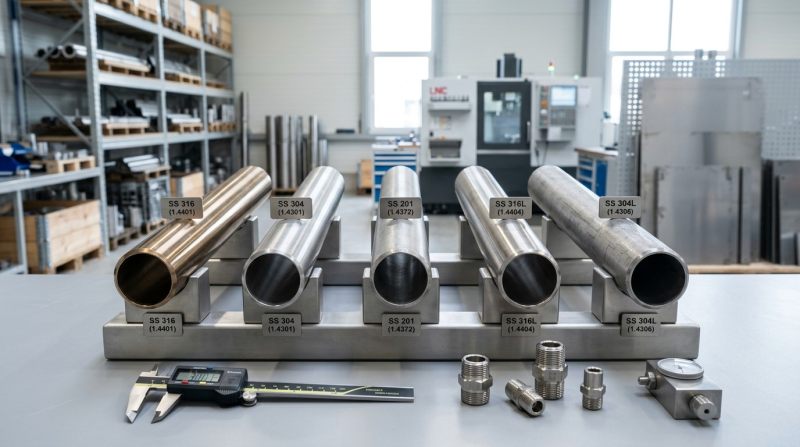
The first question in stainless steel pipe selection should be grade, not thickness. In many real applications, 201, 304, and 316 stainless steel can all look similar at first glance, but their corrosion behavior, nickel content balance, and long-term suitability are very different. A 2.0 mm wall pipe made from a poor-fit grade can underperform compared with a 1.5 mm wall pipe made from the correct grade for the environment.
For example, 201 stainless steel is often chosen for decorative use, low-grade household products, and selected indoor applications where cost sensitivity is high. By contrast, 316 is commonly preferred in marine, chemical, or high-chloride environments because molybdenum improves pitting resistance. If the medium includes salt spray, cleaning chemicals, or fluctuating humidity above 60%, grade selection typically has more influence on service life than adding 0.5 mm to wall thickness.
Technical teams should also check mechanical properties. Tensile strength, yield strength, elongation, and hardness affect forming, machining, welding, and load response. In many fabrication projects, a pipe that meets the required minimum yield strength and ductility range is easier to process consistently than a thicker pipe with unstable chemistry or inconsistent heat treatment.
Why grade selection changes total cost
Material grade influences more than purchase price. It affects welding consumables, maintenance intervals, polishing results, replacement frequency, and scrap rate. In a 3- to 5-year project cycle, corrosion-related replacement can cost several times more than the difference between two initial pipe quotations.
Buyers who compare quotations should ask for mill test data and standard references before making a final decision. A lower-priced offer may use a different grade family or looser chemistry tolerance, which changes the real value of the supply package.
The table below shows how grade considerations often outweigh wall thickness in common steel industry selection scenarios.
The key takeaway is simple: if the grade is wrong, wall thickness becomes a secondary correction rather than a real solution. For industrial buyers, the correct stainless specification starts with environment, process load, and standard compliance.
Corrosion Resistance, Surface Condition, and Tolerance Often Drive Field Results
In many projects, the actual cause of failure is not bursting strength. It is corrosion at welds, contamination from surface defects, or installation delays caused by poor dimensional consistency. This is why corrosion resistance and tolerance control often matter more than adding extra wall thickness, especially in visible architectural, food-related, marine-adjacent, or fabrication-heavy applications.
Dimensional tolerance affects fit-up, alignment, and downstream assembly. If outer diameter tolerance drifts beyond the expected range, even by small amounts such as ±0.3 mm to ±0.5 mm depending on size and standard, clamps, couplings, and welded joints may need adjustment. Across 200 or 500 pieces, these small deviations can become major labor costs on site.
Surface condition also matters. Bright polished, BA, No.4, matt, rough turning, or black finish each serves a different purpose. A decorative handrail project, for instance, may reject pipe with acceptable thickness if the polish is inconsistent. A process line may reject pipe that has inclusions or contamination, even if it passes basic dimension checks.
How related stainless products support broader fabrication needs
Pipe buyers often need matching stainless components for brackets, frames, or machined connectors. In such cases, it is practical to source compatible profiles from the same supplier to improve consistency in chemistry, finish, and documentation. One example is 316 Stainless Square steel rod, which can support fabrication work in manufacturing, construction, shipbuilding, automotive parts, medical instruments, and outdoor decoration engineering.
Its available forms include square bar sizes from 18 mm to 47 mm, round bar from 4 mm to 500 mm, flat steel thickness from 2 mm to 150 mm, and length options of 1 to 6 meters. The supplied technical data for the listed stainless material includes tensile strength of at least 520, yield strength of at least 275, elongation around 55% to 60%, hardness up to 183HB or 100HRB, density of 7.8, and elastic modulus of 197. These figures are useful when pipe systems need matching fabricated supports or accessories with predictable forming behavior.
Checks that should be on every incoming inspection sheet
- Confirm heat number, grade marking, and standard reference such as ASTM, AISI, JIS, GB, DIN, or EN.
- Measure outside diameter, wall thickness, straightness, and length on at least 3 to 5 samples per batch.
- Inspect surface finish under good lighting for scratches, scale, pits, weld seam irregularity, or polishing inconsistency.
- Check packaging condition, moisture protection, and end protection before warehouse acceptance.
The following table helps procurement and quality teams connect specification details with actual site performance.
For many steel applications, better tolerance and better corrosion performance produce more value than simply ordering a thicker wall. This is especially true where installation speed, appearance, or maintenance access affects total project cost.
Pressure Rating, Standards, and Testing Requirements Protect the Project
Another critical mistake in ss pipe sourcing is assuming that thickness alone defines pressure capacity. In reality, pressure rating depends on outer diameter, wall schedule, grade strength, manufacturing process, temperature, corrosion allowance, and the governing standard. A thicker pipe with incomplete testing documents may be less suitable than a standard-compliant pipe with full traceability.
For process, utility, or structural support systems, buyers should identify the relevant standard at the RFQ stage. ASTM, EN, JIS, and GB do not always define dimensions, tolerances, and testing in exactly the same way. If a project serves North America, Europe, the Middle East, or Southeast Asia, standard alignment should be confirmed before production begins, not after shipment arrives.
Testing requirements can include hydrostatic test, eddy current, PMI depending on project level, dimensional inspection, surface examination, and chemical analysis in the mill certificate. For quality control and safety teams, these records are often more important than nominal thickness because they confirm whether the delivered pipe matches the approved specification.
Three levels of specification control
- Basic level: confirm size, grade, quantity, and standard reference on the order.
- Control level: define tolerance, finish, test documents, marking, and packaging method.
- Project level: add third-party inspection, special testing, or OEM fabrication details if needed.
The table below shows how standards and testing affect procurement security more directly than wall thickness in many B2B supply chains.
If the pipe will be used in pressure service, a technical review should include design temperature, fluid medium, corrosion allowance, and test requirements. In practical sourcing, these 4 variables often influence safety more than one isolated wall thickness value.
How Buyers Should Evaluate SS Pipe Suppliers and Quotations
A strong ss pipe quotation should do more than show size and price. It should clarify grade, standard, tolerance, finish, testing scope, quantity, lead time, and packaging method. Without this detail, comparison between suppliers is often misleading because one offer may be based on a lower-cost grade family or a reduced inspection scope.
For procurement teams working internationally, supply capability matters just as much as product data. Stable production capacity, document consistency, and dependable lead times reduce risk for construction, manufacturing, and industrial projects. A delay of 2 weeks on pipe delivery can affect fabrication schedules, site labor planning, and customer handover dates.
Hongteng Fengda, as a structural steel manufacturer and exporter from China, supports global buyers with standardized steel products and customized solutions across construction and industrial applications. While the company is known for angle steel, channel steel, steel beams, cold formed steel profiles, and OEM structural components, the same procurement discipline applies to stainless-related sourcing: standard compliance, strict quality control, and clear communication before production are essential.
A practical 6-point quotation checklist
- Verify the exact stainless grade and whether an equivalent is being offered.
- Check standard alignment, including ASTM, EN, JIS, or GB requirements.
- Ask for dimensional tolerance, finish type, and inspection method in writing.
- Confirm mill test certificate availability before shipment.
- Review delivery cycle, such as 7 to 15 days for stock items or 3 to 6 weeks for production orders.
- Assess packaging protection for export transport and warehouse handling.
Common quotation mistakes
One common mistake is choosing the lowest unit price without checking whether testing, polishing, or export packaging is excluded. Another is approving a pipe solely because it has a thicker wall, while ignoring whether the grade is suitable for the actual corrosion environment. A third mistake is failing to define acceptance criteria before mass production.
For distributors, project contractors, and enterprise decision-makers, the best supplier is usually not the one with the shortest quotation sheet, but the one that provides the clearest technical basis and the most predictable delivery performance.
FAQ: Selecting the Right SS Pipe Specification for Real Projects
Many buyers, engineers, and end users ask similar questions when comparing stainless pipe options. The answers below focus on practical specification control rather than generic product claims.
How do I choose between focusing on grade and focusing on wall thickness?
Start with the service environment. If the pipe faces moisture, salt, chemicals, cleaning agents, or outdoor exposure, grade selection usually comes first. After that, confirm pressure, load, and fabrication needs. In many commercial cases, choosing the right grade and tolerance provides better long-term value than increasing wall thickness by 10% to 20%.
What standards should purchasing teams request?
Request the exact standard required by the project owner or end market, such as ASTM, EN, JIS, or GB. Also specify whether you need MTC documentation, dimensional inspection reports, and any extra testing. If the shipment is for export or regulated industrial use, document control should be confirmed before the production schedule is locked.
How much tolerance variation is acceptable?
The acceptable range depends on the size and standard, but buyers should not assume that “close enough” will work in fabrication. Even small deviations in diameter, straightness, or cut length can affect welding speed and fit-up quality. For projects with repeated assemblies, tighter tolerance often saves more labor than a lower purchase price saves upfront.
What is a reasonable lead time for stainless and structural steel supply?
Typical lead times vary by product type, quantity, finish, and testing scope. Stock-based items may move in 7 to 15 days, while custom production or OEM processing may require 3 to 6 weeks. If a project also includes structural steel components such as beams, channels, or cold formed profiles, integrated scheduling with one supplier can simplify logistics and reduce coordination delays.
SS pipe specifications should be evaluated as a complete technical package. Material grade, corrosion resistance, tolerance, pressure suitability, finish, standards, and testing often have a stronger effect on safety and cost than wall thickness alone. For buyers in construction, manufacturing, distribution, and project management, a disciplined specification process reduces rework, protects budgets, and improves long-term reliability.
If you are sourcing steel products for global projects, Hongteng Fengda can support you with standard-compliant manufacturing, customized structural steel solutions, and dependable export service. Contact us today to discuss your specification needs, request technical details, or get a tailored sourcing solution for your next project.
Please give us a message


Please enter what you want to find