For quality and safety teams, choosing an ss coil manufacturer is not only about price or capacity, but about batch-to-batch consistency you can verify. Stable mechanical properties, surface finish, dimensional accuracy, and traceable quality records are key signals that reduce project risk, support compliance, and protect downstream performance.
Why consistency has become a stronger market signal in stainless steel coil supply
Across the steel sector, buyer expectations have shifted noticeably in the past few procurement cycles. For a quality manager or safety officer, the main question is no longer whether an ss coil manufacturer can produce to nominal specification once, but whether the same supplier can hold that performance across 10, 20, or even 50 batches with minimal variation. This change is especially visible in projects tied to regulated fabrication, structural assemblies, pressure-related applications, and export supply chains.
Several practical forces are driving this trend. First, downstream processing has become less tolerant of inconsistency. Automated cutting, slitting, forming, and welding lines require tighter dimensional windows, often expecting thickness variation and flatness behavior to remain stable over repeated deliveries. Second, compliance pressure is increasing. Teams are being asked to document not just incoming inspection results, but also traceability from heat number to final use location, often within 24 to 72 hours when audits or nonconformance reviews occur.
A reliable ss coil manufacturer therefore stands out through repeatability, not simply through marketing claims. For buyers in North America, Europe, the Middle East, and Southeast Asia, consistency lowers the cost of reinspection, reduces the frequency of production stops, and helps avoid disputes over whether a failure came from fabrication conditions or incoming steel variability. In many cases, the hidden cost of one unstable batch can exceed the unit price difference of several prior orders.
This is where structural steel and broader steel manufacturing experience matters. Companies with disciplined process control, stable raw material management, and export-facing documentation routines are often better prepared to support quality-critical procurement. Hongteng Fengda, as a structural steel manufacturer and exporter from China, works with international buyers that value standard compliance, dependable lead times, and risk reduction across repeat orders rather than one-off transactions.
What has changed in buyer evaluation criteria
In the past, many purchasing decisions focused on three visible points: price per ton, production capacity, and shipping schedule. Those factors still matter, but quality and safety teams now apply a broader screening method. They increasingly assess whether the ss coil manufacturer can provide stable chemistry ranges, consistent surface condition, clearly readable material test certificates, and a corrective action path when a deviation appears. This is a more operational, evidence-based way to judge supplier reliability.
Another noticeable change is that receiving inspection is becoming more risk-based. Instead of checking every parameter with the same intensity, buyers classify coils by criticality, end use, and previous supplier performance. A supplier with stable records over 6 to 12 months may move into reduced inspection frequency, while a supplier with fluctuating coil width, hardness, or surface finish may remain under enhanced scrutiny for every shipment.
These changes make consistency measurable. They also make it easier to compare suppliers on lifecycle cost instead of invoice price alone.
The table below summarizes common shifts in how industrial buyers assess an ss coil manufacturer in today’s market.
The shift is clear: suppliers are judged less by single-shipment claims and more by the ability to perform predictably over time. For quality-sensitive steel procurement, that is the signal worth tracking.
The most credible signs of stable quality from batch to batch
When assessing an ss coil manufacturer, quality teams should look for signals that can be checked repeatedly, not just promises made during quotation. Stable quality usually appears in a pattern: chemistry remains within a narrow internal control band, tensile and yield values do not drift toward specification limits, thickness and width stay within agreed tolerance, and surface defects remain low enough that inspection results do not change sharply from one lot to the next.
Another important sign is process discipline. A supplier that can explain how incoming raw materials are verified, how coils are identified during production, and how nonconforming material is segregated is usually easier to trust than one that only provides final paperwork. For many buyers, the ability to trace a complaint back to a specific heat, shift, or inspection checkpoint within 1 working day is a practical indicator of maturity.
Consistency also shows up in how often extra clarification is needed. If every second or third shipment triggers questions about certificate formatting, marking, edge condition, or packing integrity, the supplier may be operationally unstable even if the steel itself sometimes passes. A dependable ss coil manufacturer should reduce friction across both product quality and information flow.
A practical checklist for receiving and supplier review
- Verify whether mechanical properties remain in a consistent range over at least 5 to 10 recent batches, not only one sample certificate.
- Check if heat number, coil tag, packing mark, and certificate references match without manual reconciliation.
- Review whether surface condition, edge quality, and protective packaging are stable enough to limit incoming claims.
- Confirm that the supplier can state applicable standards clearly, such as ASTM, EN, JIS, or GB, without ambiguity in grade conversion.
- Ask how nonconforming material is isolated, recorded, and dispositioned before shipment.
Signals that are easy to overlook but matter in practice
Packing consistency is one example. Moisture protection, edge guards, coil eye orientation, and marking durability can affect whether material arrives usable after a 3 to 6 week transit period. Another is lead-time stability. If quoted production cycles fluctuate widely, such as 15 days on one order and 45 days on the next without a clear cause, planning reliability may be weak even before quality problems appear.
For teams managing multiple steel categories, comparing quality behavior across product families can also help. In some projects, buyers source stainless coils together with structural sections or bar products. A supplier with broader steel control experience may provide useful reference points. For example, buyers also review durability and processing suitability when evaluating 45# Carbon Steel Round Bar for construction, fabrication, railing, handrail, staircase, furniture, or customized industrial use, where dimensions can range from 5 mm to 2500 mm diameter and common lengths include 2 m, 5 m, 6 m, and 12 m. The wider lesson is that repeatable material condition and documented standards matter across steel categories, not only in coil purchasing.
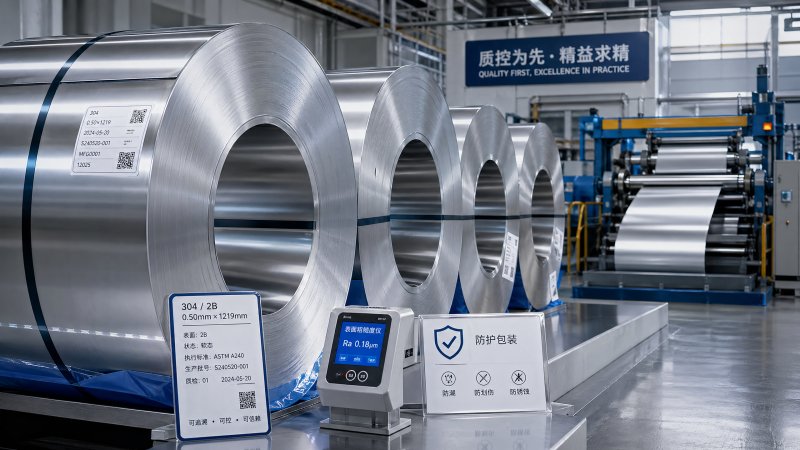
The following table shows the most useful batch-stability signals and how quality teams typically interpret them.
For quality assurance teams, these signals are more actionable than general claims about premium quality. They can be trended, audited, and linked directly to downstream production performance.
What is driving the higher demand for verifiable quality control
The demand for stronger quality evidence is not coming from one source. It is the result of several overlapping shifts in steel procurement and use. One driver is export complexity. When steel products move across regions and standards, buyers need confidence that the supplied material aligns with contract requirements and local compliance expectations. If grade interpretation or certificate language is unclear, approval cycles become longer and risk exposure increases.
A second driver is fabrication efficiency. Modern shops often run with tighter labor planning and less tolerance for disruption. If one unstable coil creates scrap, line stoppage, or weld adjustment, the cost spreads beyond material replacement into labor hours, delivery penalties, and safety review time. In this environment, the best ss coil manufacturer is often the one that helps maintain process predictability, even if its offer is not the lowest on paper.
The third driver is internal accountability. Quality managers now need evidence for supplier approval, safety managers need confidence that critical components are sourced responsibly, and procurement teams need fewer surprises over a 3-month or 6-month buying horizon. That combination pushes organizations toward suppliers with stronger process visibility and stable export execution.
How these drivers affect different roles
The impact is not the same for every function. The table below outlines how consistency concerns typically affect key stakeholders involved in steel sourcing and control.
This role-based view matters because supplier performance is experienced differently across the organization. A commercially acceptable source can still be a high-risk source if it generates repeated quality interventions.
Why export-oriented steel suppliers may gain more attention
Suppliers serving international markets are often asked to align with ASTM, EN, JIS, and GB frameworks, manage mixed specification inquiries, and prepare documentation that passes cross-border review. That does not guarantee quality, but it often builds stronger habits around traceability, packing control, and communication discipline. For buyers sourcing from China, this can be particularly useful when projects involve multiple product forms such as angle steel, channel steel, beams, cold formed profiles, and customized steel parts alongside coil demand.
An ss coil manufacturer that operates with this level of export readiness is generally better positioned to support quality teams that must justify supplier approval decisions internally.
How to judge a supplier before variation turns into a claim
The most effective quality strategy is preventive rather than reactive. Instead of waiting for a failed lot, teams should build a supplier review approach that identifies instability early. For example, reviewing 6 months of certificates can reveal whether an ss coil manufacturer controls properties consistently or merely stays inside broad specification limits. Looking at complaint response time, replacement lead time, and documentation accuracy can also expose operational weakness before it becomes a field issue.
It is also useful to separate critical parameters from secondary ones. If a project depends heavily on weldability, thickness uniformity, or surface finish, those factors should be weighted more heavily in supplier scoring than less relevant attributes. A one-size-fits-all checklist often misses real application risk. Quality and safety teams should calibrate their review to the actual consequences of variation.
Supplier communication style matters as well. Stable manufacturers usually answer technical questions directly, clarify standard equivalence carefully, and explain what they can and cannot hold within routine production. Overly broad promises can be a warning sign, especially when lead time, tolerance, and certification demands are all tight at the same time.
A workable review sequence for quality-sensitive sourcing
- Define the 5 to 8 parameters that most affect safety, fabrication, and acceptance in your use case.
- Request recent batch records instead of one ideal sample certificate.
- Compare production lead time consistency across at least 3 order scenarios.
- Review packing, marking, and traceability controls alongside laboratory data.
- Set an incoming inspection plan that adjusts after 3 to 6 stable deliveries.
This sequence helps transform supplier evaluation from a price exercise into a controlled risk decision. It also gives quality teams objective reasons to maintain, reduce, or intensify inspection levels over time.
What quality and safety teams should monitor next
Looking ahead, the strongest trend is not simply higher specification demand. It is higher demand for verifiable control. Buyers will continue to ask whether an ss coil manufacturer can demonstrate stable performance across different order sizes, delivery windows, and documentation requirements. The suppliers that respond best are likely to be those with disciplined production systems, transparent communication, and experience supporting international compliance expectations.
For quality teams, the key signals to monitor over the next 6 to 12 months include tolerance consistency, certificate clarity, claim response speed, and the supplier’s willingness to discuss process limits honestly. For safety teams, the focus should remain on traceability, marking integrity, and whether material identification remains clear from shipment arrival through installation or fabrication. These are not abstract concerns; they are practical controls that reduce uncertainty.
For organizations buying multiple steel products, supplier consolidation may also become more attractive if one partner can support structural steel sections, customized components, and stable export documentation under one operational system. That can simplify approval workflows and reduce interface risk between departments.
Why choose us
Hongteng Fengda supports global construction, industrial, and manufacturing buyers with structural steel products, customized solutions, and export-oriented service from China. Our focus is practical: stable production capacity, consistent quality control, standard-based manufacturing, and dependable delivery coordination for international projects. We work across angle steel, channel steel, steel beams, cold formed steel profiles, customized structural components, and related steel sourcing needs.
If your team is reviewing an ss coil manufacturer or comparing broader steel supply options, we can help you assess the points that matter most to quality and safety performance. You can contact us to discuss parameter confirmation, product selection, lead-time planning, customized solutions, standards alignment, sample support, and quotation details. A focused technical discussion at the start usually saves far more time than solving avoidable variation after shipment.
If you want to judge how current sourcing trends may affect your own projects, start with three questions: which properties are most critical to your downstream process, what level of traceability is required for audit or safety control, and how much variation can your operation tolerate before cost rises sharply. Those answers will make it easier to identify the right supplier path with fewer surprises later.
Please give us a message


Please enter what you want to find