When selecting cold-rolled steel for precision stamping, assuming SPCE steel is always softer than SPCD can lead to tool wear, dimensional inaccuracies, or batch failures—especially for clients sourcing ASTM A36 round bar, DX52D steel, or galvanized expanded metal sheet. As a trusted structural steel manufacturer and exporter from China, Hongteng Fengda advises technical evaluators, procurement teams, and project managers to verify actual tensile strength and hardness values—not just grade labels—before finalizing mill orders. This applies equally to users of tin can machinery manufacturer specs or those comparing angle vs channel applications. Don’t let outdated assumptions compromise quality control or cost efficiency.
Why “Softer” Isn’t Always True: The SPCE vs SPCD Misconception
SPCE and SPCD are both JIS G 3141 cold-rolled carbon steel grades widely used in stamping, deep drawing, and structural component fabrication. While SPCE is designated for *extra-deep drawing*, and SPCD for *deep drawing*, many assume this automatically means SPCE has lower yield strength and higher formability across all heats and mill runs. That’s not guaranteed.
Actual mechanical properties depend on precise chemical composition (e.g., C ≤ 0.08% for SPCE vs ≤ 0.10% for SPCD), annealing temperature (typically 680–720°C), cooling rate, and final skin-pass reduction (0.5–1.5%). A poorly controlled anneal or excessive temper rolling can push SPCE’s tensile strength above 320 MPa—matching or exceeding typical SPCD batches. This directly impacts die life: tool wear increases by 20–35% when stamping material with unverified hardness > 85 HRB.
For global buyers sourcing structural steel components—including angle steel, channel steel, and cold-formed profiles—this variability affects dimensional repeatability in high-volume production. At Hongteng Fengda, every coil undergoes third-party verified tensile testing per JIS Z 2241 and hardness validation per JIS Z 2245 before release. We provide full mill test reports (MTRs) with yield strength, tensile strength, elongation, and hardness for each heat lot—ensuring traceability down to the furnace batch.
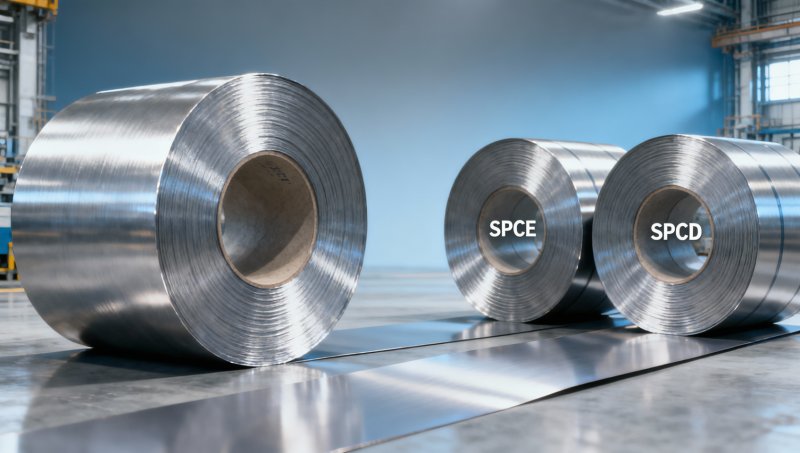
Key Mechanical Parameters: What to Measure, Not Just Assume
Relying solely on grade designation ignores critical process variables. Below are the 5 non-negotiable parameters we require from suppliers—and recommend you demand in your purchase specifications:
- Tensile strength range: SPCE: 270–340 MPa; SPCD: 290–360 MPa — overlapping by up to 70 MPa
- Yield-to-tensile ratio (Y/T): Must stay ≤ 0.72 for stable deep drawing; values > 0.75 increase springback risk by 40%
- Elongation (A80mm): SPCE ≥ 38%; SPCD ≥ 34% — but real-world values drop 5–8% after 3+ months storage due to aging
- Hardness (HRB): Target: 65–80 HRB for SPCE; 70–85 HRB for SPCD — verified at 3 locations per coil end
- Surface roughness (Ra): ≤ 0.8 μm for fine-die applications; measured via stylus profilometer pre-shipment
These parameters are validated using calibrated Instron 5969 testing machines and Rockwell hardness testers certified to ISO 6508-2. For OEM projects requiring tight tolerances (±0.15 mm on flange width or ±0.3° angular deviation), we recommend specifying maximum allowable Y/T ratio and minimum elongation in contractual technical annexes.
SPCE vs SPCD: Typical Property Ranges (JIS G 3141 Compliant)
Note: Values reflect standard mill practice. At Hongteng Fengda, we routinely deliver SPCE with tensile strength ≤ 310 MPa and hardness ≤ 75 HRB for critical stamping jobs—verified via 100% coil-end testing. For projects requiring corrosion resistance in aggressive environments (e.g., foodstuff or chemical industry applications), our 316 Stainless steel pipe offers significant improvements in corrosion resistance, high-temperature stability, and mechanical properties compared to 304 stainless steel tubing.
Procurement Checklist: 6 Critical Actions Before Placing Your Order
To avoid rework, scrap, or delivery delays caused by mismatched material behavior, follow this field-tested checklist:
- Require MTRs upfront: Specify JIS G 3141 + ASTM A653 (for galvanized variants) compliance and request full tensile/hardness data per heat lot—not just “conforms to spec” statements.
- Define aging tolerance: Add clause: “Material must be delivered within 60 days of final annealing to prevent strain aging-induced embrittlement.”
- Validate surface finish: For fine-pitch dies (< 0.5 mm clearance), require Ra ≤ 0.6 μm and specify measurement method (ISO 4287).
- Confirm packaging integrity: Coils must be wrapped in VCI paper + plastic film; moisture content ≤ 60% RH during transit to prevent rust spotting.
- Lock in sampling protocol: Mandate 1 random coil per 20-ton shipment tested per JIS Z 2241 (tensile) and JIS Z 2245 (hardness).
- Align with downstream processes: If feeding into automated bending or welding lines, confirm bendability (minimum inside radius = 1.5× thickness) and weldability (carbon equivalent ≤ 0.25).
Hongteng Fengda supports all these requirements with ISO 9001-certified documentation, 7–15 day lead times for standard structural steel profiles, and dedicated technical support for stamping line integration—including free die compatibility reviews for qualified OEM partners.
Why Partner With Hongteng Fengda for Precision Steel Sourcing?
As a professional structural steel manufacturer and exporter from China, Hongteng Fengda delivers more than mill-certified coils—we deliver procurement confidence. Our modern facilities produce angle steel, channel steel, steel beams, cold-formed steel profiles, and customized structural components compliant with ASTM, EN, JIS, and GB standards. We serve clients across North America, Europe, the Middle East, and Southeast Asia with stable production capacity, consistent quality, and dependable lead times.
We help partners reduce sourcing risks through rigorous QC: 100% coil-end hardness verification, full MTR traceability, and real-time production monitoring. For projects where material consistency impacts safety-critical dimensions (e.g., load-bearing brackets or pressure vessel supports), our engineers co-develop material specifications aligned with your exact forming, welding, and finishing requirements.
Ready to validate SPCE/SPCD performance for your next stamping run? Contact us today for: free tensile/hardness data review, customized MTR templates, lead time confirmation for 4000mm/6000mm lengths, or technical consultation on cold-formed profile integration. Let’s ensure your steel performs—exactly as specified.
Please give us a message


Please enter what you want to find