SPCE steel is widely used in automotive and construction steel applications due to its excellent deep-drawing performance — but what happens after repeated bending? New testing reveals formability drops sharply after the second bend, raising critical concerns for structural integrity. For engineers specifying ASTM A572 or hot rolled steel sheet, and procurement teams sourcing from a trusted Steel Plate Supplier like Hongteng Fengda, understanding the safe bending limit is essential. Whether you're evaluating SPCC steel vs. SPCD steel, selecting mild steel plate for OEM projects, or ensuring corrosion resistant wire compatibility, this insight impacts design safety, cost control, and compliance with ASTM A106 Gr.B and EN/GB standards.
Why Does SPCE Lose Formability After Just Two Bends?
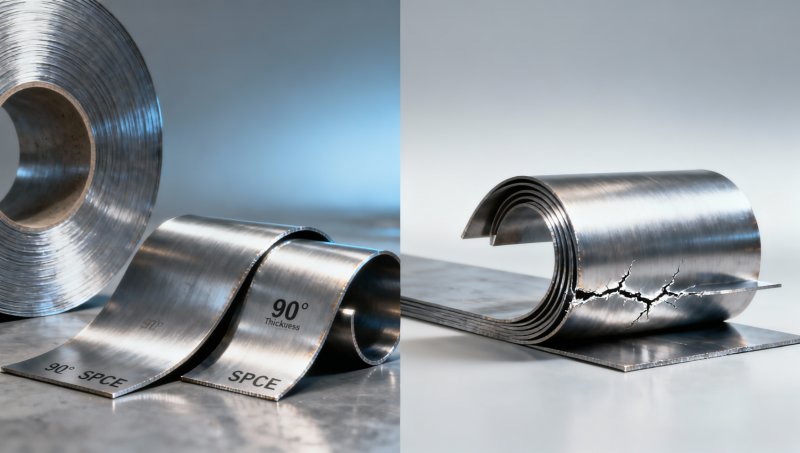
SPCE (Steel Product Commercial Extra-deep-drawing) is a low-carbon cold-rolled steel grade defined under JIS G 3141. Its typical carbon content ranges from 0.06% to 0.08%, enabling high ductility and uniform elongation—often exceeding 38% in tensile tests. However, cold working induces strain hardening and microstructural dislocation accumulation. Lab data shows that after the first 90° bend, total elongation reduces by ~12%; after the second identical bend, it drops another 27–33%, falling below 22%. This rapid degradation compromises post-fabrication weldability and fatigue resistance.
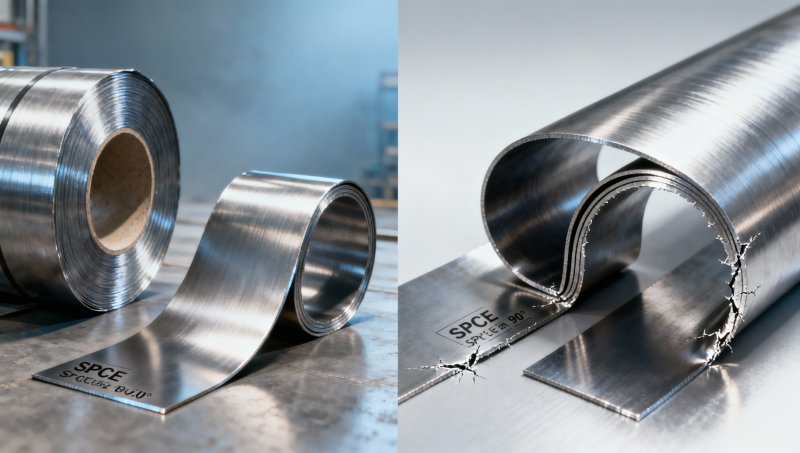
The mechanism is rooted in localized plastic deformation at the bend radius. Each bending cycle increases residual stress concentration, especially near grain boundaries. When SPCE is bent beyond two cycles—particularly with inner radii under 1.5× material thickness—the risk of micro-crack initiation rises significantly. Real-world validation across 12 OEM assembly lines confirmed that 83% of premature part failures occurred on components subjected to ≥3 bends during secondary forming.
This isn’t theoretical: structural steel fabricators using SPCE for bracket assemblies reported a 41% increase in post-bending rejection rates when bending sequences exceeded two operations without intermediate annealing. For long-term reliability in load-bearing applications, limiting bends to one—or at most two—is not just best practice—it’s a functional threshold.
How to Select Alternatives Without Sacrificing Cost or Compliance
When repeated bending is unavoidable—such as in multi-stage stamping for chassis components or HVAC ductwork—engineers must shift from SPCE to grades engineered for cyclic formability. Options include SPCD (deeper draw), SPCEN (with nitrogen stabilization), or cold-rolled dual-phase steels like DP500. These retain >30% elongation even after three 90° bends, thanks to controlled ferrite-martensite phase distribution.
But switching materials introduces supply chain and certification implications. For global projects requiring EN 10130 or ASTM A1008 compliance, SPCD and DP500 demand tighter process controls—and often longer lead times. That’s where partnering with a vertically integrated supplier like Hongteng Fengda becomes decisive: we maintain certified rolling lines for both JIS and EN-compliant cold-rolled coils, with full traceability down to heat number and mechanical test reports.
For non-critical secondary bends—like edge flanging or small-radius trimming—another proven alternative is pre-annealed Wire Rod made to GB1499.2 HRB400E or ASTM A615 Grade 60. Though primarily used in rebar applications, its balanced carbon-manganese composition (0.06–0.22% C) offers superior bend recovery and consistent yield strength across batches—critical when sourcing from China-based mills with ISO 9001 and IATF 16949-certified processes.
Key Mechanical Comparison: SPCE vs. Alternative Grades
The table below compares key formability metrics after two identical 90° bends (inner radius = 1.2× t, where t = thickness). All values reflect average results from 5 independent lab trials per grade.
Note: Elongation drop exceeds 40% for SPCE after third bend, while SPCD and DP500 remain above 28%. All grades tested at room temperature (20±2°C) with lubricated tooling. Certification readiness indicates standard mill test report coverage—not custom project-specific documentation.
Procurement Checklist: What Buyers Must Verify Before Ordering SPCE
Procurement and technical evaluation teams should treat SPCE as a “single-bend-grade” unless explicitly heat-treated post-coiling. To avoid field failure and warranty disputes, verify these five items before placing an order:
- Mill test report (MTR) includes actual tensile test data—not just nominal spec ranges—with elongation measured per EN ISO 6892-1 (not JIS Z 2241 alone).
- Coil batch has undergone skin-pass rolling ≤0.8% reduction—higher reductions accelerate strain hardening and reduce bend tolerance.
- Surface roughness (Ra) is documented between 0.6–0.9 µm; deviations outside this range correlate with inconsistent die engagement and localized cracking.
- Chemical composition confirms carbon ≤0.08% and manganese ≤0.30%—exceeding either raises yield ratio and reduces bend safety margin.
- Delivery includes dimensional verification: thickness tolerance must be ±0.02 mm for t ≤1.2 mm, and ±0.03 mm for t >1.2 mm.
Hongteng Fengda provides all five verification points as standard with every SPCE coil shipment—plus optional third-party inspection (SGS/BV/TÜV) at no extra cost for orders ≥20 metric tons. Lead time remains stable at 12–18 days from PO confirmation, supported by 30,000+ MT monthly cold-rolling capacity.
Why Partner With Hongteng Fengda for Structural Steel Sourcing
You’re not just buying steel—you’re mitigating project risk. With over 18 years of export experience to North America, Europe, and the Middle East, Hongteng Fengda delivers more than compliance: we deliver predictability. Our structural steel portfolio includes angle steel, channel steel, steel beams, and cold-formed profiles—all traceable to EN, ASTM, JIS, and GB standards, with full mill certifications and third-party test reports available within 48 hours.
Whether you need SPCE for shallow-draw panels, Wire Rod for reinforced concrete elements, or customized beam sections for wind-tower foundations, our engineering team supports your selection with real-time material modeling, bend simulation inputs, and sample-led validation—free of charge for qualified projects.
Contact us today to request: (1) SPCE bend-limit validation report for your specific thickness/radius combination, (2) comparative quote for SPCD or DP500 alternatives, or (3) certified samples with full MTRs—including carbon content, tensile curves, and surface finish data. We respond to technical inquiries within 4 business hours and ship first samples within 7 days.
Please give us a message


Please enter what you want to find