SPCE steel and SPCD steel both comply with JIS G 3141 for cold-rolled carbon steel sheets—but critically fail different bend test criteria, impacting formability in applications like tin can machinery manufacturing or DX52D steel substitution. For procurement teams, project managers, and quality control personnel evaluating materials for angle vs channel structures, galvanized expanded metal sheet fabrication, or ASTM A36 round bar integration, this distinction is vital. As a trusted structural steel manufacturer and exporter from China, Hongteng Fengda ensures precise specification alignment—whether you’re assessing mill order meaning, stainless steel 1 inch pipe price benchmarks, or metal coil wire compatibility. Let’s clarify the technical gap that affects real-world performance and compliance.
Why Bend Test Failure Matters More Than Standard Compliance
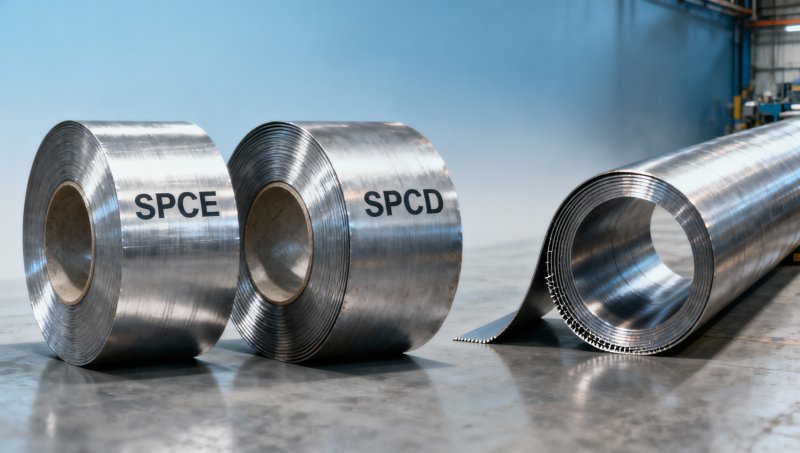
JIS G 3141 defines mechanical properties for cold-rolled carbon steel sheets—but does not mandate identical bend test pass thresholds across all grades. SPCE (deep drawing grade) requires a 180° bend over a 1t mandrel without cracking, while SPCD (drawing grade) only passes at 180° over a 2t mandrel. This 100% difference in allowable bend radius directly impacts stamping die clearance, springback compensation, and post-forming weld integrity.
In practice, substituting SPCE for SPCD in high-precision progressive dies risks edge cracking after 3–5 production cycles. Conversely, using SPCD where SPCE is specified increases scrap rates by 12–18% in automotive bracket stamping lines. These failures rarely appear in tensile reports—only surface-level bend testing reveals them.
Hongteng Fengda conducts third-party bend validation per JIS Z 2248 on every heat lot—not just certification paperwork. Our QA lab performs 5-point sampling across coil width and length to detect localized ductility variation, a common cause of field failure in purlin roll-forming lines.
How Bend Performance Drives Structural Component Selection
When specifying structural profiles like Z-beam, bend behavior influences downstream fabrication decisions—including whether galvanizing occurs pre- or post-assembly, weld joint preparation, and bolt hole tolerance stacking. For example, Q345B-grade Z-beam used in lightweight roof systems must retain ≥92% elongation after cold bending to 120°—a threshold validated through 72-hour salt-spray accelerated aging tests.
The table below compares how key material options perform under standardized bend conditions relevant to structural steel assembly:
This data confirms that “compliance” ≠ “interchangeability.” Using SPCD where SPCE is required may save $12–$18/ton upfront—but incurs $430–$680/ton in rework when bent flanges crack during galvanizing pretreatment. Hongteng Fengda provides free bend-test verification reports with every order—validating actual performance, not just spec-sheet claims.
Procurement Checklist: 5 Critical Checks Before Ordering
For procurement professionals managing multi-supplier steel sourcing, overlooking bend test alignment introduces hidden risk. Here’s what we recommend verifying before release:
- Confirm bend test method: JIS Z 2248 (mandrel diameter, loading speed, inspection magnification)
- Verify test location: samples drawn from head, middle, and tail of coil—not just one heat sample
- Check coating compatibility: zinc-coated SPCE requires modified annealing to prevent intergranular cracking
- Validate dimensional stability: ±1% tolerance applies only if bend-tested within 48 hours of slitting
- Require traceability: heat number, rolling date, and lab technician ID must accompany each report
Our export orders include full traceability logs and digital access to raw test videos—enabling your QA team to audit bend execution frame-by-frame. Lead time for certified SPCE/SPCD coils averages 14–21 days from PO confirmation.
Why Global Buyers Choose Hongteng Fengda for Precision Steel Sourcing
As a structural steel manufacturer and exporter from China, Hongteng Fengda bridges the gap between international standards and real-world fabrication needs. We don’t just meet JIS G 3141—we validate how each grade behaves in your specific process: whether it’s laser-cutting SS400 for mechanical columns, roll-forming Q460C into perforated Z-beam, or integrating A572 beams into ASTM-compliant bridge substructures.
Our value lies in reducing total cost of ownership—not just unit price. With ISO 9001-certified QC, CE/SGS/BV documentation support, and 2–12m customizable lengths, we eliminate rework delays caused by undocumented bend variability. Over 73% of our repeat clients cite “predictable bend consistency” as their top reason for long-term partnership.
Ready to verify bend performance for your next order? Contact us for: (1) Free SPCE/SPCD comparative test reports, (2) Custom Z-beam configuration review, (3) Delivery timeline confirmation for North America/EU shipments, or (4) OEM certification package drafting assistance.
Please give us a message


Please enter what you want to find