When specifying perforated steel, quality and safety teams must balance open area with structural strength to avoid performance risks in real-world use. The right design affects load capacity, ventilation, visibility, drainage, acoustic behavior, and code compliance across industrial and construction applications. A sheet with generous openings may improve airflow and reduce weight, but if the pattern, thickness, or support spacing is wrong, stiffness can drop faster than expected. This article explains how to evaluate perforated steel more accurately in practical scenarios, helping buyers and inspectors make safer, cost-effective decisions without compromising reliability.
Why application context changes how perforated steel should be judged
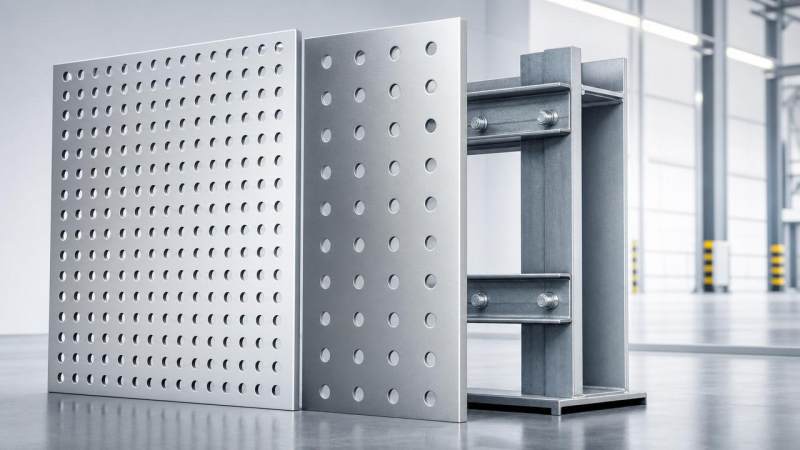
Not every perforated steel requirement starts with the same priority. In façade screens, open area may be the main target because airflow, daylight control, and appearance matter most. In walkways, machine guards, or support covers, strength, impact resistance, and deflection limits usually come first. In filtration or enclosure panels, hole precision, corrosion resistance, and cleaning performance may be more important than maximum transparency.
That is why open area cannot be reviewed as a standalone number. A 40% open area panel made from thicker material with a staggered pattern may perform better than a 30% open area panel made from thinner sheet with wide unsupported spans. Good evaluation always connects four variables: material grade, sheet thickness, hole pattern, and service conditions. In steel projects, this context-driven method reduces rework, improves safety margins, and supports better total cost control.
In architectural screens, open area often leads the decision—but only within safe limits
Architectural cladding, sunscreens, fencing infill, and decorative barriers often use perforated steel for a combination of appearance and function. In these cases, a higher open area may improve ventilation and visual lightness while reducing wind resistance. However, the panel still needs enough remaining metal to resist installation loads, local dents, vibration, and long-term distortion.
The key judgment points here are panel size, fixing method, wind exposure, and flatness tolerance. Large panels with thin stock can oil-can or flex excessively, especially when hole diameter is large relative to pitch. Stainless and galvanized options can both work, but surface finish and post-processing quality affect durability in outdoor conditions. If design intent calls for a very open look, secondary framing or edge stiffening should be assessed early rather than after fabrication.
What to check for façade and screen use
- Open area percentage versus visual target and airflow requirement
- Sheet thickness versus panel span and support spacing
- Hole pattern orientation and edge distance
- Corrosion protection for coastal, humid, or industrial environments
- Flatness after perforation, cutting, and coating
In walkways, guards, and industrial covers, strength should usually dominate perforated steel selection
For platforms, treads, catwalk covers, trench lids, and machine guards, perforated steel is rarely chosen only for appearance. It must withstand foot traffic, dropped tools, vibration, and repeated service loads. In these applications, the most common mistake is assuming that acceptable open area automatically means acceptable load performance. In reality, deflection and local yielding may become critical before obvious failure appears.
A practical solution is to begin with the required load, support condition, and allowable deflection, then work backward to sheet thickness and pattern. Round staggered holes often distribute stress better than straight rows, while narrow ligaments between holes can create weak lines under bending. If anti-slip performance matters, the hole shape and surface treatment must also be reviewed. For some assemblies, perforated sheet is combined with framing members to restore stiffness without losing drainage or visibility.
That is where support components become relevant. For example, a properly specified Metal Channel can be used as a framing or reinforcement element behind perforated panels in construction, wall beam systems, brackets, or lightweight roof support layouts. With material grades such as Q195, Q235B, Q345B, Duplex, or 304/316, and thickness options from 1.5mm to 25mm, the support system can be adapted to corrosion, welding, and strength needs rather than overloading the perforated sheet itself.
In ventilation, filtration, and equipment enclosures, hole design must match the operating environment
When perforated steel is used in ventilation grilles, acoustic housings, agricultural equipment, drying systems, or protective covers, the target is often controlled flow rather than maximum opening. Here, open area influences pressure drop, heat release, sound transmission, and particle behavior. A design that looks efficient on paper may clog too quickly, whistle under airflow, or weaken around mounting points.
Important checks include hole diameter tolerance, burr control, sheet flatness, and finish consistency. In humid or chemically exposed conditions, galvanized carbon steel may be suitable for cost-sensitive projects, while stainless grades provide better long-term corrosion performance. If cleaning cycles are frequent, smoother hole edges and fewer debris traps become more valuable than simply increasing open area.
How different scenarios change the open area versus strength balance
The same perforated steel specification should not be copied across different projects without review. The table below shows how application conditions shift the selection logic.
A practical method for choosing perforated steel in steel projects
A reliable perforated steel decision process starts with service conditions, not with a catalog pattern alone. The following sequence is practical for construction and industrial use:
- Define the function: ventilation, guard, drainage, screening, filtration, or load-bearing cover.
- Set the non-negotiable performance criteria: load, deflection, visibility, air passage, slip resistance, or corrosion resistance.
- Select material grade and finish based on environment and fabrication method.
- Choose hole pattern and pitch that deliver the needed open area without excessively reducing ligament strength.
- Review support framing, fixing points, and unsupported span.
- Confirm tolerances, inspection points, and standard compliance before mass production.
In many steel assemblies, performance depends on the full system rather than the sheet alone. A support profile such as a galvanized or stainless channel can improve stiffness, edge stability, and installation reliability. Where applicable, Metal Channel options produced to AISI, ASTM, DIN, JIS, BS, or GB/T standards can support custom structural layouts while maintaining reasonable cost, strong weldability, and anti-corrosion performance.
Common mistakes when evaluating perforated steel
Several recurring errors lead to poor perforated steel outcomes:
- Using open area percentage as the only comparison metric.
- Ignoring support spacing and edge reinforcement.
- Assuming thicker coating solves structural weakness.
- Overlooking stress concentration around large holes or repeated patterns.
- Not checking burrs, flatness, and dimensional tolerance after perforation.
- Choosing material grade without considering corrosion, welding, or forming requirements.
These issues are especially costly in export projects, where replacement time, freight, and on-site modification can quickly exceed any initial savings. A disciplined review of drawings, standards, and sample performance is usually far less expensive than correcting an underdesigned panel after shipment.
What to do next for safer and more cost-effective perforated steel selection
To select perforated steel well, compare options by scenario rather than by appearance alone. Start with the real duty conditions, verify the needed open area, then confirm that remaining strength, stiffness, and corrosion resistance still meet the application. When panels are part of a larger steel structure, evaluate the sheet together with its support members, fixings, and tolerances.
Hongteng Fengda, a structural steel manufacturer and exporter from China, supports global construction, industrial, and manufacturing projects with reliable steel products and customized solutions. With modern manufacturing facilities, strict quality control, and compliance with major international standards such as ASTM, EN, JIS, and GB, the company helps reduce sourcing risk and improve delivery confidence. For projects involving perforated steel, channels, beams, or custom structural components, preparing a clear requirement list—load, environment, hole pattern, dimensions, finish, and standards—will make technical review faster and more accurate.
If the goal is better ventilation without sacrificing safety, or stronger panels without unnecessary material cost, the best next step is to request a specification review based on the actual application. That approach turns perforated steel from a generic sheet choice into a reliable engineered solution.
Please give us a message


Please enter what you want to find