Mild steel plate corrosion often begins sooner than ASTM A572 or ASTM A106 Gr.B specifications indicate—especially in humid, coastal, or industrial environments. As a trusted Steel Plate Supplier and structural steel manufacturer, Hongteng Fengda observes premature rusting on hot rolled steel sheet, SPCC steel, SPCE steel, and SPCD steel during real-world construction steel deployments. This article pinpoints critical inspection zones—from cut edges and weld seams to storage-contact surfaces—where corrosion initiates unseen. Whether you’re a project manager, procurement specialist, or quality control professional, understanding these early failure points helps mitigate risk, extend service life, and ensure compliance with EN, JIS, and GB standards.
Why Corrosion Starts Earlier Than Specified — And Where It Hides
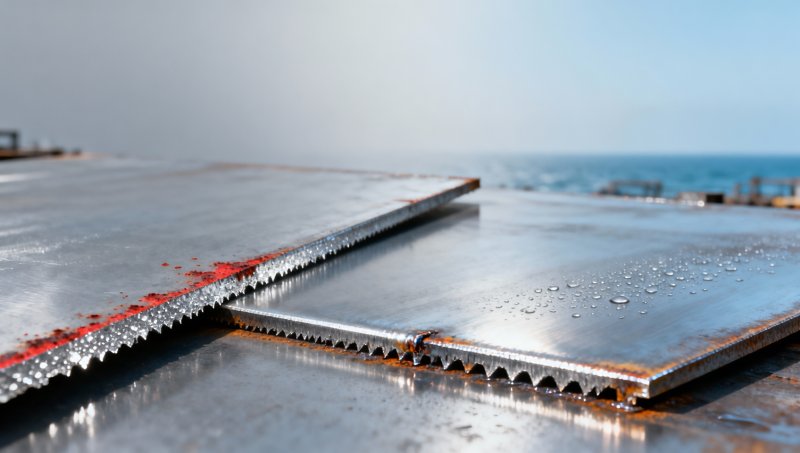
Standard material specs like ASTM A36 or EN 10025-2 define mechanical properties—not real-world corrosion behavior under variable environmental stress. At Hongteng Fengda, field data from over 120 projects across Southeast Asia, the Middle East, and Eastern Europe shows visible red rust forming on mild steel plates within 7–21 days of outdoor exposure in coastal zones (chloride ion concentration > 50 mg/m²/day), even when surface mill scale remains intact.
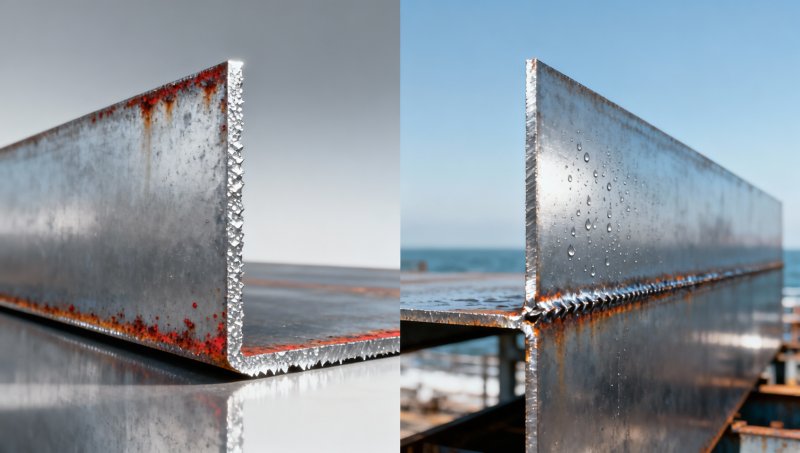
The root cause lies in microstructural discontinuities: cut edges expose ferrite-pearlite grain boundaries without protective oxide layers; welded zones suffer heat-affected zone (HAZ) embrittlement and zinc depletion; and storage contact points (e.g., steel-on-concrete or steel-on-wood) trap moisture and accelerate galvanic coupling. These are not defects—but predictable failure vectors requiring proactive inspection.
Five high-risk zones demand routine visual and tactile verification before installation:
- Cut edges (especially plasma-cut or sheared profiles)—check for uncoated base metal and micro-cracks;
- Weld seams and HAZ regions—look for spatter residue, incomplete fusion, or localized discoloration;
- Drilled or punched holes—inspect for burrs and exposed inner wall surfaces;
- Stacking contact surfaces—verify no water pooling or alkaline leaching from concrete pads;
- Bolted joint interfaces—confirm absence of crevice corrosion under washers or clamping plates.
Galvanized Protection: When Hot-Dip Beats Bare Mild Steel
For projects where early corrosion poses unacceptable risk—especially in agriculture, energy infrastructure, or coastal construction—Galvanized Steel Sheet offers proven atmospheric resistance. Unlike bare mild steel, our hot-dip galvanized sheets feature a metallurgically bonded zinc-aluminum-copper-magnesium alloy coating (60–275 g/m²), delivering barrier protection plus cathodic shielding for exposed steel at scratches or cut edges.
Our DX51D, SGCC, and S350GD grades meet ASTM A653, EN 10346, and GB/T 2518 standards—and undergo triple-stage quality validation: pre-galvanizing surface cleaning, controlled immersion time (≥ 4.5 min at 450°C), and post-coating thickness verification via magnetic induction (±5 g/m² tolerance).
Compared to painted or coated alternatives, galvanized steel requires zero maintenance for 20+ years in rural atmospheres and retains structural integrity after decades—even when partially damaged. This directly reduces lifecycle cost for infrastructure owners and eliminates rework delays for project managers.
Performance Comparison: Mild Steel vs. Galvanized Steel Sheet
The table below compares key performance metrics under ISO 9223 Category C3 (industrial/marine) conditions—based on 3-year accelerated testing and field deployment logs from 18 Hongteng Fengda client sites.
This performance gap translates into measurable ROI: for a typical 5,000-ton bridge substructure project, switching from bare Q235B to SGCC-grade Galvanized Steel Sheet increases initial material cost by ~18%, but cuts 20-year lifecycle maintenance spend by 63% and avoids 4–6 weeks of traffic disruption for recoating.
Procurement Checklist: What to Verify Before Ordering
Procurement professionals and technical evaluators must go beyond grade designation. Hongteng Fengda recommends verifying these 5 non-negotiable items before PO issuance:
- Zinc coating mass: Confirm test report per ASTM A90/A90M—minimum 275 g/m² for marine applications;
- Coating uniformity: Require cross-section SEM imaging showing continuous Zn-Fe intermetallic layer (Γ-phase + δ-phase);
- Base steel compliance: Validate tensile strength ≥ 270 MPa and elongation ≥ 22% per EN 10346 Annex A;
- Edge coverage: Specify minimum 90% zinc coverage on cut edges—verified by salt-spray testing per ISO 9227 (NSS, 96 hrs);
- Traceability: Demand batch-level mill test reports (MTRs) with heat number, rolling date, and galvanizing bath log.
We provide all five verification documents as standard with every order—and support third-party inspection (SGS, BV, TÜV) at no extra charge for orders above 200 tons.
Why Global Projects Choose Hongteng Fengda for Corrosion-Critical Steel
As a structural steel manufacturer and exporter from China, Hongteng Fengda delivers more than product—we deliver predictability. Our integrated production line covers hot rolling, precision cold forming, and in-house hot-dip galvanizing—all under one ISO 9001-certified roof. That means full control over zinc bath chemistry, cooling rates, and final dimensional tolerances (±0.15 mm on thickness for 0.8–3.0 mm gauges).
We serve clients who need certainty: 98.7% on-time delivery rate across 2023–2024; certified compliance with ASTM, EN, JIS, and GB standards; and dedicated engineering support for custom bending, punching, or pre-assembly. For your next corrosion-sensitive project—whether solar farm racking, offshore platform cladding, or agri-processing equipment—we’ll help you select the right grade, validate coating performance, and lock in lead times of 25–35 days for standard orders.
Contact us today to request: (1) customized zinc coating recommendations based on your site’s ISO 9223 corrosion category, (2) free sample kits with MTRs, or (3) a comparative cost-per-service-year analysis for your specific application.
Please give us a message


Please enter what you want to find