MOQ requirements for steel products are not as fixed as many buyers assume. They often vary by product type, production method, customization level, and export destination. For sourcing teams comparing suppliers, understanding these differences can reduce costs, avoid delays, and improve negotiation results. This article explains why steel MOQ standards change so much and what global buyers should evaluate before placing an order.
Why MOQ requirements for steel products vary so much
Many buyers begin supplier discussions expecting one simple answer to MOQ requirements for steel products. In reality, there is no universal minimum that applies across all steel categories. A supplier may accept a small trial order for one item but require a much larger quantity for another, even within the same factory.
The main reason is that MOQ is rarely just a sales policy. It is usually tied to production economics, raw material purchasing, machine setup time, labor allocation, packaging efficiency, and shipping practicality. When any of these factors change, the minimum order threshold can also change.
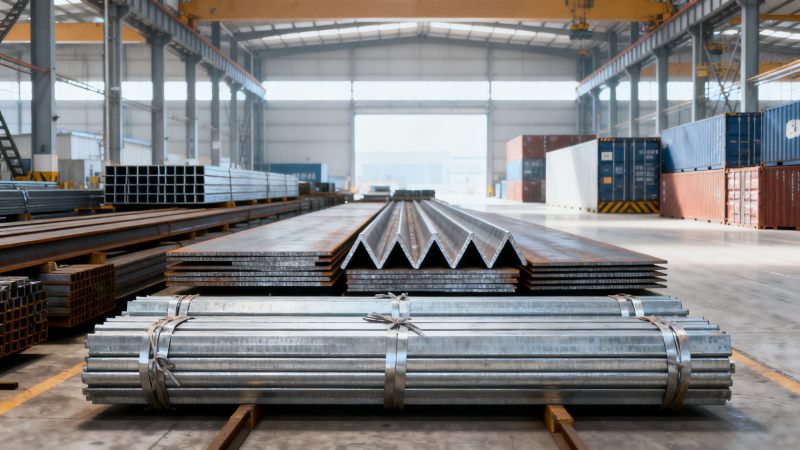
For example, standard structural steel sections with stable demand are often easier to produce in flexible quantities. Common angle steel, channel steel, and steel beams may be available from stock, or they may fit into regular rolling schedules. In these cases, the MOQ can be lower than buyers expect.
On the other hand, customized structural steel components, special dimensions, unusual grades, and project-specific fabrication usually require more planning and machine changeover. That increases the supplier’s cost per order, which often leads to higher MOQ requirements or a price adjustment for smaller quantities.
This is why experienced sourcing teams do not ask only, “What is your MOQ?” They also ask, “What is driving it?” That second question often reveals more useful information for cost control and supplier comparison.
What information-focused buyers usually want to know first
For information researchers and early-stage sourcing teams, the biggest concern is not simply whether a supplier has a minimum order. The real concern is whether the MOQ is reasonable, negotiable, and aligned with the project’s budget, timeline, and risk level.
Most buyers at this stage want answers to a few practical questions. Can they place a trial order before committing to a full volume purchase? Will a mixed container help reduce minimum quantity pressure? Does a standard size have a lower MOQ than a customized one? Will the price rise sharply if the order is below the preferred production batch?
They are also trying to avoid hidden cost traps. A low quoted MOQ may look attractive at first, but if it leads to inefficient freight, extra processing fees, or long lead times, the total procurement result may still be poor. In steel sourcing, a “low MOQ” is not automatically a “low-risk” option.
Another common concern is comparability. Buyers often receive quotes from multiple exporters and find that MOQ numbers differ significantly. That does not always mean one supplier is more flexible than another. It may simply mean the suppliers are quoting under different assumptions about specification, finish, tolerance, packaging, or delivery terms.
What usually determines MOQ in steel manufacturing and export
To understand MOQ requirements for steel products, buyers need to look at the full chain behind the quote. In most cases, MOQ is influenced by five key factors: material sourcing, production process, specification complexity, post-processing, and logistics.
1. Raw material and mill sourcing. Some steel products depend on coil, billet, slab, or plate feedstock purchased in standard mill quantities. If the upstream material is only available in large lots, the downstream supplier has limited flexibility. Even if a buyer needs only a small order, the producer may need to buy much more material to run it efficiently.
2. Production line setup. Rolling, cutting, punching, bending, welding, drilling, galvanizing, and surface finishing all involve setup time. The smaller the order, the more that setup cost affects each ton or each piece. Suppliers often use MOQ to make sure the order can absorb those operational costs.
3. Standard versus customized specifications. Standard dimensions usually fit normal production patterns. Custom hole positions, uncommon section sizes, non-standard lengths, or special tolerances require separate handling. This is one of the most common reasons MOQ increases.
4. Surface treatment and certification. Galvanized steel, painted components, third-party inspections, or special export packaging may all require outside services or added process control. These services often work better at scale, so the minimum economical order may rise.
5. Shipping efficiency. Export orders are heavily affected by container utilization, port handling, and inland transport. A supplier may technically accept a small quantity, but if it cannot fill a container efficiently, the freight cost per ton may become unattractive. In practice, logistics can function like a second MOQ.
How MOQ changes by steel product type
Different steel categories naturally lead to different ordering patterns. This is important for buyers because MOQ should be evaluated by product family, not as a fixed company-level rule.
Structural sections such as angle steel, channel steel, and steel beams often have relatively flexible MOQ options when they are standard sizes. Since they are common in construction and industrial projects, manufacturers may produce them continuously or maintain inventory. Buyers who can accept mainstream specifications usually have more room to negotiate.
Cold formed steel profiles may show wider variation. If the profile uses regular tooling and common thickness ranges, MOQ may remain manageable. But if the section shape is custom, the supplier may need dedicated rollers, forming adjustments, or tooling development. In such cases, the minimum order can increase quickly.
Customized fabricated components usually have the most complex MOQ logic. A small order with many drawings, weld points, drilled holes, or assembly details may be less attractive than a larger order of simple standard sections. Here, MOQ is not just about tonnage. It is about engineering time, workshop scheduling, and quality control intensity.
Flat products can also vary widely. For instance, stainless plate orders may depend on thickness, finish, width, and cutting service. A buyer evaluating applications in chemical processing, food equipment, transport, or industrial manufacturing may consider 304L Stainless Steel Plate for its corrosion resistance, formability, and weldability. With thickness options from 0.3mm to 200mm, multiple widths and lengths, and finishes such as BA, 2B, NO.1, NO.4, HL, and 8K, MOQ can shift depending on whether the order matches stock-friendly sizes or requires custom cutting and finishing.
This is also why buyers should compare not only grade but also processing depth. A standard stainless plate may have one MOQ, while the same material cut to special dimensions, certified for a specific end use, or packed for export-sensitive handling may have a very different threshold.
Why customization usually raises the minimum order
Customization adds value, but it also changes the supplier’s cost structure. When a product is made to drawing, the supplier may need to confirm technical details, prepare production documents, arrange tooling, run sample validation, and perform tighter final inspection. These are real costs, even before mass production begins.
From the buyer’s perspective, this often creates confusion. They may see that the raw material quantity is small and assume the order should also have a low MOQ. But the material itself may be only part of the cost. For a customized steel product, engineering and handling can be just as important as tonnage.
This is especially true for OEM structural steel parts used in construction support systems, machinery frames, plant installations, or export projects with strict dimensional requirements. The more project-specific the product becomes, the less useful standard MOQ assumptions become.
In these cases, buyers should ask the supplier to separate the discussion into two parts: the minimum economical production batch and the minimum quantity for acceptable pricing. Sometimes a factory can produce a small quantity, but the unit cost will be much higher. Understanding that distinction helps avoid unrealistic expectations.
How destination market and compliance requirements affect MOQ
Export destination matters more than many buyers expect. MOQ requirements for steel products can change when the supplier must meet different certification, packaging, marking, and documentation standards for different regions.
For North America, Europe, the Middle East, and Southeast Asia, buyers may request compliance with ASTM, EN, JIS, or GB standards, depending on project specifications. If a supplier already produces regularly to that standard, MOQ may remain competitive. If special testing or documentation is needed only for one order, the minimum quantity may rise to absorb those additional costs.
Packaging is another factor. Some markets require stronger anti-rust protection, fumigated wooden supports, special labeling, or bundle identification for customs and site handling. Small orders often carry a relatively higher packaging cost per unit, which can push practical MOQ upward.
Inspection requirements can have a similar effect. If the buyer needs third-party inspection from SGS, BV, or another agency, the inspection fee may be manageable for a full container or project batch, but inefficient for a very small shipment. Buyers should therefore evaluate MOQ together with compliance cost, not separately.
How buyers can evaluate whether an MOQ is reasonable
The best way to assess an MOQ is to connect it to the total procurement picture. A reasonable MOQ is not necessarily the lowest one. It is the one that balances production feasibility, landed cost, quality consistency, and delivery reliability.
Start by asking whether the quoted MOQ applies to one specification, one size, one grade, or a mixed order. This matters because some suppliers are flexible if the total quantity is enough to support production, even when individual line items are small. Mixed orders can be a useful strategy for distributors, project buyers, and trial-stage importers.
Next, ask whether the MOQ is based on stock supply or new production. Stock-based orders may allow lower volumes, but the available dimensions and grades will be limited. New production usually offers more flexibility in specification but often requires a higher commitment.
Also compare MOQ against lead time. A supplier may accept a lower quantity if the order can wait for the next regular production cycle. If the buyer needs urgent delivery, the factory may require a larger order to justify schedule interruption. In this sense, time flexibility can sometimes be traded for quantity flexibility.
Finally, calculate the real cost difference between ordering below, at, and above the MOQ. In some cases, increasing the order slightly improves freight efficiency and lowers the unit price enough to offset the extra volume. Buyers who make decisions only on tonnage may miss that optimization opportunity.
Practical negotiation strategies for global steel buyers
MOQ negotiation works best when buyers show commercial logic, not just price pressure. Suppliers are more likely to be flexible when they see a path to repeat business, efficient production, or combined orders.
One useful strategy is to ask for standard alternatives. If your preferred size triggers a high MOQ, ask whether a nearby standard dimension is available with a lower threshold. In many projects, slight dimensional adjustments are commercially acceptable if they reduce cost and lead time.
Another strategy is to combine specifications where possible. Instead of placing several very small separate orders, buyers can consolidate grades, lengths, or processing steps into one production schedule. This may help meet the supplier’s operational minimum while preserving project flexibility.
Trial orders should also be framed carefully. Rather than asking for the smallest possible quantity, explain that the initial purchase is for qualification and that larger follow-up orders are planned if performance is confirmed. Serious suppliers often respond better when they can see long-term potential.
Buyers should also request transparency on the pricing structure. If the supplier can quote one price for the preferred MOQ and another for a smaller order, that comparison helps the buyer make an informed choice. Sometimes paying a small premium for a smaller first order is better than overcommitting inventory.
Common mistakes to avoid when comparing steel MOQ offers
One of the most common mistakes is comparing MOQ numbers without comparing specifications in detail. A quote for standard angle steel is not directly comparable to a quote for fabricated, drilled, galvanized components, even if both are described as structural steel.
Another mistake is ignoring logistics. A low factory MOQ may still create high landed cost if container space is poorly utilized or inland transport to the port is inefficient. Buyers should review MOQ together with Incoterms, packing method, shipment mode, and destination handling needs.
Some buyers also assume MOQ is always non-negotiable. In fact, many suppliers have more than one internal threshold: a technical minimum, a preferred commercial minimum, and a promotional or relationship-based minimum. The key is to understand which one is being quoted.
Finally, do not focus only on the first order. An MOQ that looks slightly high today may still be a better choice if the supplier offers stable quality, dependable lead times, and easier repeat ordering in future project phases. For long-term sourcing, consistency often creates more value than a one-time quantity concession.
Final takeaway for buyers assessing steel MOQ
MOQ requirements for steel products vary more than expected because they are shaped by manufacturing reality, customization depth, compliance demands, and export logistics. Buyers who treat MOQ as a fixed universal number often misunderstand supplier quotes and miss better sourcing options.
The most useful approach is to look beyond the number itself. Ask what drives the MOQ, whether standard alternatives exist, how pricing changes at different volumes, and how shipping and certification affect the total result. This helps buyers judge whether the requirement is restrictive, reasonable, or negotiable.
For global sourcing teams, especially those comparing structural steel suppliers from China and other export markets, better MOQ analysis leads to better purchasing decisions. It reduces delays, improves negotiation outcomes, and helps match order strategy to real project needs. In steel procurement, the smartest question is not only how low the MOQ can go, but whether the entire order structure supports cost, quality, and delivery goals.
Please give us a message


Please enter what you want to find